“INCENDIES” My rating: A
120 minutes | No MPAA rating | French and Arabic with subtitles.
Twelve hours after watching Denis Villeneuve’s “Incendies,” I’m still on a cinema high and more certain than ever that this is some sort of masterpiece.
The Oscar-nominated (for foreign language film) “Incendies” (French for “fires”) is about war and peace, about family and forgiveness. It has more pure horror and more unforced emotional beauty than any film I’ve seen in ages, yet it delivers its potent payload with a minimum of sentimentality and filmic melodrama.
It’s the story of one life, but also about how the ripples from that life have spread to engulf many other lives. It’s an intimate epic.
In modern-day Quebec twins Jeanne and Simon Marwan (Melissa Desormeaux-Poulin, Maxim Gaudette) learn that their late mother, Nawal, a native of Lebanon who lived in Canada for more than two decades, has left behind a will packed with bombshells.
Through a notary (Remy Girard) the dead woman instructs Jeanne to find the twins’ father and deliver a letter to him. Simon is told to locate their older brother and hand over a similar epistle.
They are stunned. They were told their father was dead. And Nawal never mentioned having another child.
These revelations send the twins on a journey through time and geography.
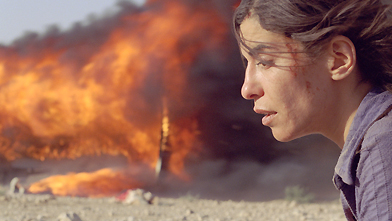 Jeanne is the first to set out, retracing her mother’s early life in a poor Lebanese village. Writer/director Villeneuve deftly juxtaposes Jeanne’s search with episodes from the life of Nawal (Lubna Azabal). The two actresses look so much alike that there are times when we’re not sure which decade we’re in.
Nawal’s story begins in 1970 with her affair with an Arab from a nearby refugee camp. She’s Christian, he’s Muslim and her family reacts violently. Nawal gives birth to a baby boy who is placed in an orphanage.
Leaving the village where she is considered an outcast, Nawal wanders through her country’s long civil war. She barely escapes being slaughtered along with the Muslim riders on a bus stopped by right-wing Christian militiamen. Her attempts to find her son are stymied — the orphanage has been destroyed in the fighting and the children have vanished.
Her increasing radicalization leads her to side with the Arab resistance. Her journey encompasses assassination, torture, and nearly 20 years of imprisonment. Her Christian jailers are determined to break the will of this turncoat; Nawal’s ability to endure every torment thrown at her makes her something of a legend — the “woman who sings.”
The tale then turns to Simon’s efforts to discover the whereabouts of his older brother, whom he learns was taken in as a child by the Arabs and emerged as a ruthless killer. By talking to now-graying revolutionaries who still live in hiding, Simon slowly unravels the secrets of his mysterious sibling.
In his adaptation of Wajdi Mouawad’s stage play Villeneuve parcels out a series of stunning revelations, each one carefully timed for maximum impact. Too many films give away their secrets too easily…this one teases us until we’re left in open-mouthed astonishment by its final, heartbreaking development.
The cast members deliver indelible characters without a hint of artifice…these performances are so unforced, natural and histrionic free that we’re never aware that it’s acting.
Great movies satisfy not only in the watching but in the remembering. Once seen, you can’t help but remember the complex emotions evoked by “Incendies.” They keep coming back, like a myth that resonates with deeper and richer meanings every time we contemplate it.
| Robert W. Butler
 Butler's Cinema Scene
Bob,
Your description of French-Canadian director Denis Villeneuve’s “Incendies” as an “intimate epic,” is so on-target. Thank you for a beautiful review of one of the most amazing movie experiences I have had in my many years of watching and studying those films that have come to be considered landmarks in global cinema. I add my voice to yours in considering it “some sort of masterpiece.”
I’ve been a college professor of Film Studies for over four decades, so I’ve made my living studying & teaching films that have come to be considered masterworks.
Thanks to your review of “Incendies,” it occurs to me that, perhaps, one of the common denominator of films that, over time, come to be considered “masterpieces” is their ability to make the film’s viewer leave the film feeling they have experienced an “intimate epic.” Indeed, films that would appear to be so stylistically polar opposites as De Sica’s simple Neo-Realist “The Bicycle Thief(s)” and David Lean’s cinematically spectacular “Lawrence of Arabia,” are both great movies because they are “intimate epics.”
Granted, “intimate epics” are often personal stories during times of war. In that regard, “Incendies” is in that tradition (as is the currently running in KC film, “Winter in Wartime”). A case could be made that all great War Movies are “intimate epics,” in that they boil-down our inability to convey the horror of war to a narrative that the mind can grasp. They allow us to think the unthinkable.
That said, to my mind, what makes “Incendies” so special is that it is an “intimate epic” in a more profound way. Villeneuve’s remarkable film is not really a “War Movie,” but rather an “intimate epic” as detective story (in the way “Chinatown” is one of cinema’s great “intimate epics” as detective story).
Our narrative journey begins with a simple enough question: who are the twins’ father and brother and can they find them?
Immediate, we become detectives, too. Amazingly, until the end, the film’s viewer is actually ahead of the twins – we are given clues to the mystery before they are given them. The film viewer is always a step ahead of the twins, until, the film’s emotionally shattering conclusion. And it is an emotionally shattering conclusion. I had tears streaming down my cheeks, and not just for the film’s fictional characters, but also for the very real Middle East and our contemporary world.
What makes “Incendies” so powerful is that, as an old fashion “detective” story, it reminds us that our earliest known origin of the “detective” story was also an “intimate epic.” It was penned by a guy named Sophocles and titled “Oedipus Rex.” It was a detective story full of impossibly coincidences that becomes so believable because it reveals something more truly than a “believable” story. It revealed a painful truth about the human condition and the price we pay for hatred, and the need for revenge. But, in “Oedipus Rex,” the end result is blindness; in “Incendies” a similar journey leads to a blinding in-“sight” about our common humanity and the our human species as a dysfunctional “family,” but still a family, where forgiveness and reconciliation is always possible.
The glory of “Incendies” is that it questions the “psychological determinism” that Freud read into “Oedipus Rex” and offers a shred of hope that the cycles of revenge can be overcome in rituals of forgiveness and reconciliation.
Sorry for the uber-long response, but great film reviews give rise to really thinking about films and I’m SO glad your blog will offer a place and space for “thinking” about films.
Regards,
G. Tom Poe, Ph.D., Professor of Film & Media Studies, The University of Missouri, Kansas City