
A balloon the size of a football stadium will lift the BLAST telescope array above Earth's atmosphere to photograph deep space.
The science is hands on and way out there in two recent documentaries just out on DVD:
“BLAST!”: The title stands for “balloon-bourne large aperture submillimeter telescope” which, I’ll grant you, doesn’t sound all that sexy.
Wrong. Wrong. Wrong.
Paul Devlin’s documentary is about a group of astrophysicists who hope to photograph deep space by using a massive balloon — it’s the size of a football stadium — to lift a sophisticated telescope above our atmosphere. There it can drift for several days, taking pictures of parts of our universe never before seen.
Most of the team members — professionals and grad students — hail from the University of Pennsylvania and the University of Toronto.
Devlin’s film follows months of preparation as the telescope is hand crafted. Then his cameras tag along first to an Arctic region of Sweden — where the team members find themselves at the mercy of bad weather and bad luck — and then, a year later, to McMurdo Station in Antarctica where they may have a better chance at success.
It’s a very cool science story — these big brains hope to find clues to the creation of all matter by looking far into the past — but it also has a personal dimension.
There’s an undercurrent of tension here. Pennsylvania’s Mark Devlin (the filmmaker’s brother) is co-director of the team. He’s a pragmatist who believes what he sees.
His partner is Toronto’s Barth Netterfield, a Christian who finds no conflict between faith and science.
The two men are clearly friends who agree to disagree about some things. But it makes for fascinating movie watching.
Director Devlin, a five-time Emmy winner, knows how to structure his film for maximum drama…not that he had to work too hard at it, since fate threw some seemingly insurmountable problems the scientists.
Got a science lover in the family? “BLAST!” will send them to geek heaven.
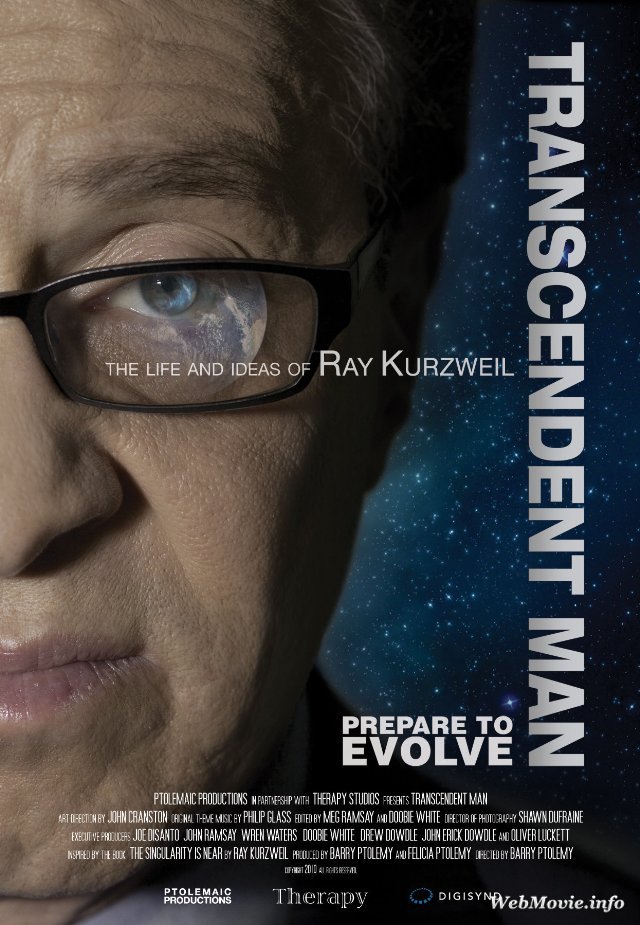 “TRANSCENDENT MAN” : Ray Kurzweil may be our most accomplished and perplexing futurist.
He’s an inventor (having fashioned machines and programs that allow the blind to read without Braille), a millionaire businessman and a deep thinker.
He’s the author of the best-selling The Singularity is Near, in which he predicts that within 20 or 30 years the exponential growth of knowledge and technology will so completely reinvent human life that nothing will be the same again.
Specifically, Kurzweil envisions tiny robots/computers (nanotechnology) that can be injected into the human body, creating a machine/organism hybrid. People will soon be able to resist aging and disease, achieving near immortality, Kurzweil argues.
Barry Ptolmey’s documentary borrows not a few riffs from the films of Errol Morris (“Fast, Cheap and Out of Control,” “The Fog of War”). Kurzweil is often photographed head on, speaking directly to us through the camera. There are many poetic montages mixing scenes from the natural and manmade worlds. There’s a minimalist, Philip Glass-ish orchestral score.
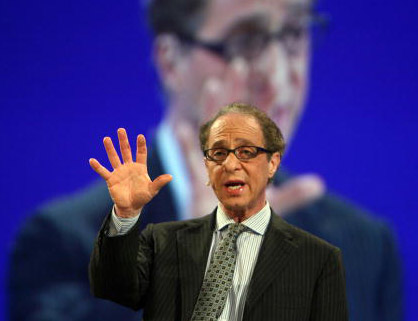
Ray Kurzweil...visionary and boat rocker
But more than just examining Kurzweil’s often-controversial ideas (Ptolmey found plenty of nay-sayers willing to challenge his predictions), “Transcendent Man” is a character study. Much time is devoted to Kurzweil’s father, a musician who never realized his potential and who died early of heart disease, and of how that loss has molded his son.
In fact, Kurzweil has saved thousands of letters, photos and other material documenting his father’s life so that at some future date — I’m not making this up — he can use technology and super-smart computers to recreate his dad.
Cue the “Twilight Zone” theme.
The film forces us to consider our own stance on the future Kurzweil envisions. Will we follow him into the brave new world? Or will we take the more cautious path urged by other scientists who fear that a super-smart computer capable of original thought might become our master?
Want to get a lively discussion going? Show “Transcendent Man” to your friends.
Then duck and cover.
| Robert W. Butler
 Butler's Cinema Scene
Both films look great.
I don’t understand why a balloon, at the edge of earth’s atmosphere will garner better pics than Hubble????
A decade or so ago, I read an article in Wired Magazine by Steve Joy, called “Why the Future Doesn’t Need Us”. Joy is the founder of Sun Microsystems I think. Too lazy to look it up. My point, is that most of the things he thought would be in place by 2011, are NOT in place (Robots, food etc.)
The robot thing, and artificial intelligence, will NOT happen ala a “Terminator” movie. jmo—
Cellular reproduction and the connection of spiritual nature to same, precludes the scenario.
Living forever, would be a horrible fate.
A circle of hell, horrific thought, that is almost too terrible to contemplate.