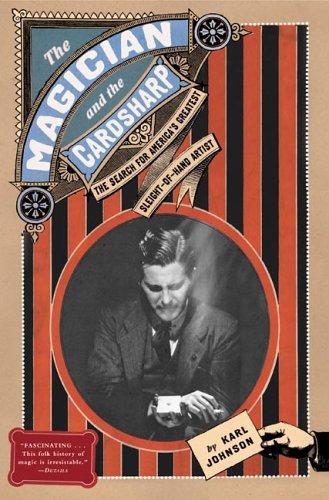
 “THE MAGICIAN AND THE CARDSHARP” (Owl Books)
Karl Johnson’s breezy nonfiction read — just out in paperback — offers a multitude of attractions.
For anyone who’s ever been fascinated by magic, it’s a detailed look into the world of professional illusionists and sleight-of-hand artists.
For card players it’s replete with possibilities for cheating.
For general readers it’s a real-life detective story.
And for residents of this neck of the woods — Kansas City and environs — it’s a yarn set in our own back yard.
Johnson’s principlal subject is Dai Vernon, a Canadian who became New York high society’s premiere performer of close-up magic, established himself as the dean of North American magicians, and who spent the last 30 years of his life (he died in 1992 at age 98) as the in-house attraction of Los Angeles’ famed Magic Castle, training young magicians and putting on amazing shows for a delighted public.
Early in the 1930s Vernon, already considered a legendary figure, heard rumors of a professional gambler in the Midwest who could do what most magicians and card cheats thought impossible: he could deal any hand he desired from the middle of the deck.
From the top, of course, is how you’re supposed to deal cards. Bottom dealing was illegal but very common.
Middle dealing, though, was undetectable, making it the most powerful skill in a crooked card player’s arsenal.
The Magician and the Cardsharp follows Vernon’s long quest to locate this mysterious/mythological center-dealer.
He did exist. His name was Allen Kennedy, a farmer’s son from Pleasant Hill MO who gave up the plow for games of chance…not that there was much chance involved when Kennedy picked up a deck of cards. He spent nearly two decades developing the technique and manual dexterity required for center dealing.
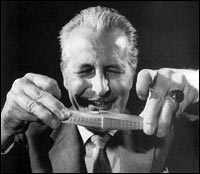
Dai Vernon in later years
A good chunk of Johnson’s tale is devoted to descriptions of life in Pleasant Hill, which in the 1930s was a major rail hub supporting dozens of illegal poker and dice games that drew travelers, railroad workers, farmers and professional cheats. In fact, the Cass County burg was like an early prototype for Las Vegas, controlled by a mover and shaker named Midnight Underwood who ran an operation as wide open as Pendergast’s in Kansas City just a few miles to the northwest.
Dai Vernon’s search took him to KC, of course, and there are wonderful descriptions of our town’s lurid nightlife in the ’20s and ’30s, as well as of daily business in Kansas City Card, a store catering almost exclusively to professional gamblers looking for equipment and techniques that would allow them to beat the odds.
There’s more than a little suspense in Vernon’s quest. There always has been a fair amount of animosity between stage magicians and professional card sharks. While the former courted publicity, gamblers lived and sometimes died by the effectiveness of their cheating skills. They saw no reason to draw attention that might put their lives and livelihood at jeopardy.
Frequently the urbane Vernon had to assume the role of a seasoned gambler to gain the confidence of the pros. Often he was forced to beat a hasty retreat.
Johnson has an accomplished eye for the memorable anecdote and for capturing the personalities of these often larger-than-life characters. In these pages the worlds of magic, of illegal gambling and of the Midwest in the ’30s come beautifully to life.
| Robert W. Butler
 Butler's Cinema Scene
Leave a comment