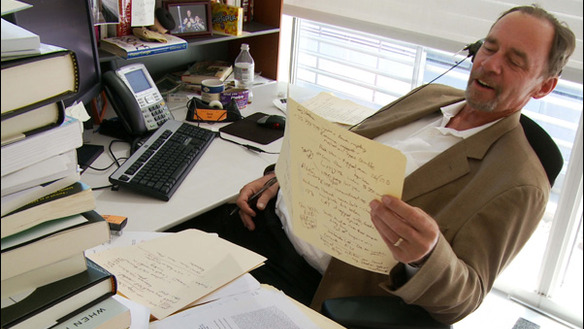
David Carr...defending the honor of the New York Times in "Page One"
“PAGE ONE” My rating: B (Opens July 22 at the Glenwood Arts)
88 minutes: MPAA rating: R
The recent woes of print journalism are front and center in “Page One,” a documentary for which director Alex Rossi spent a year observing the inner workings of our greatest newspaper, The New York Times.
Although it remains America’s most successful daily, the old gray lady nevertheless is struggling to stay economically viable in an era when the internet and other free sources of news have cut badly into both her advertising revenue and her once-exclusive position as the ultimate source of information on current events.
And if things are bad for the unassailable Times, imagine what it’s like for other papers.
(I personally could tell you a few tales of woe…but, no, that’s for another day.)
During the time Rossi was shooting “Page One” The Times endured several rounds of layoffs and, attempting to reverse the financially ruinous trend of giving news away for free on the web, launched a subscription internet service.
There was the WikiLeaks scandal, which redefined how the net can be used to make an end run around government, and a big scandal in the executive suites of the Tribune Co., one of The Times’ rivals.
There’s an awful lot going on here and Rossi, who eschews narration or explanatory inter-titles, often struggles to organize all this information and provide the film with a true shape.
Happily, he has as one of his prime subjects David Carr, the Times’ new media columnist, who is an old-school journalist for a new-fangled era.
Carr is a former drug addict who cleaned up, raised two daughters, and got a gig at the Times. He’s sardonic, outspoken (with a gravel-road voice) and an unabashed lover of print journalism, but knows his way around blogs and web sites. He’s clever and cranky and brutally opinionated…and it’s a pleasure to watch him in action.
Sitting on a panel with internet types who reject the value of traditional papers, Carr produces a printout of a typical page from a popular web news site — only he’s used a pair of scissors to cut out any item that originated with The Times or another “mainstream” news source.
He defiantly holds up the doctored page, which looks like someone let loose on it with a shotgun.
Point made. Without newspapers, who are all these sites going to steal from?
A handful of other Timesmen emerge as players here, though none have Carr’s screen presence.
Tim Arango is a young reporter on the new media desk who yearns for a more substantial beat — like Iraq. Brian Stelter is a plump teenage blogger hired by the Times to be a real reporter…Carr refers to him as “a robot assembled in the basement to come and destroy me.”
And then there’s the media desk editor, Bruce Headlam, who comes off as pretty bland, although he does have a wall-sized French movie poster for “Citizen Kane,” which earns him quite a few points in my book.
| Robert W. Butler
 Butler's Cinema Scene
I’m looking forward to seeing this movie.