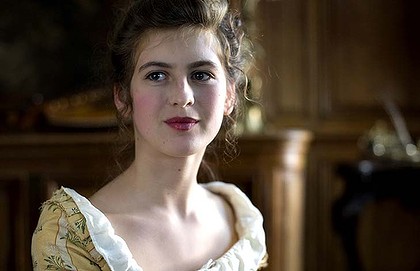
Marie Féret as "Mozart's Sister"
“MOZART’S SISTER” My rating: C (Opening Nov. 4 at the Tivoli)
120 minutes | No MPAA rating
The very title — “Mozart’s Sister” — suggests the film’s approach.
This is the story of a woman — Maria Anna “Nannerl” Mozart — whose public identity will be irrevocably chained to that of her famous sibling. No matter what her own accomplishments, she will always be viewed through the distorting lens of little brother Wolfgang, perhaps the greatest musical genius of all time.
René Féret’s film is a lushly produced look at 18th-century life that undoubtedly will prove a bit of cultural catnip for Mozart lovers ever on the prowl for new insights into an immensely talented family.
But despite its feminist take on the material, “Mozart’s Sister” is a surprisingly nonengaging affair: slow-moving, almost painfully formal and generating little or no emotional juice.
We first encounter the Mozart family on the road somewhere in France. They travel in winter in an enclosed carriage, bouncing along rutted roads.
They’re a close-knit bunch: father Leopold (Marc Barbe), mamma Anna Maria (Delphine Chuillot), 14-year-old Nannerl (Marie Féret, the director’s daughter) and Wolfgang (David Moreau), four years her junior.
Perhaps the best thing about Féret’s screenplay and direction is the family dynamic he establishes, that of a nomadic show-biz unit scrambling to make ends meet. Leopold is the manager, dictating the performances of his two musically talented offspring. Mama tends to their emotional needs.
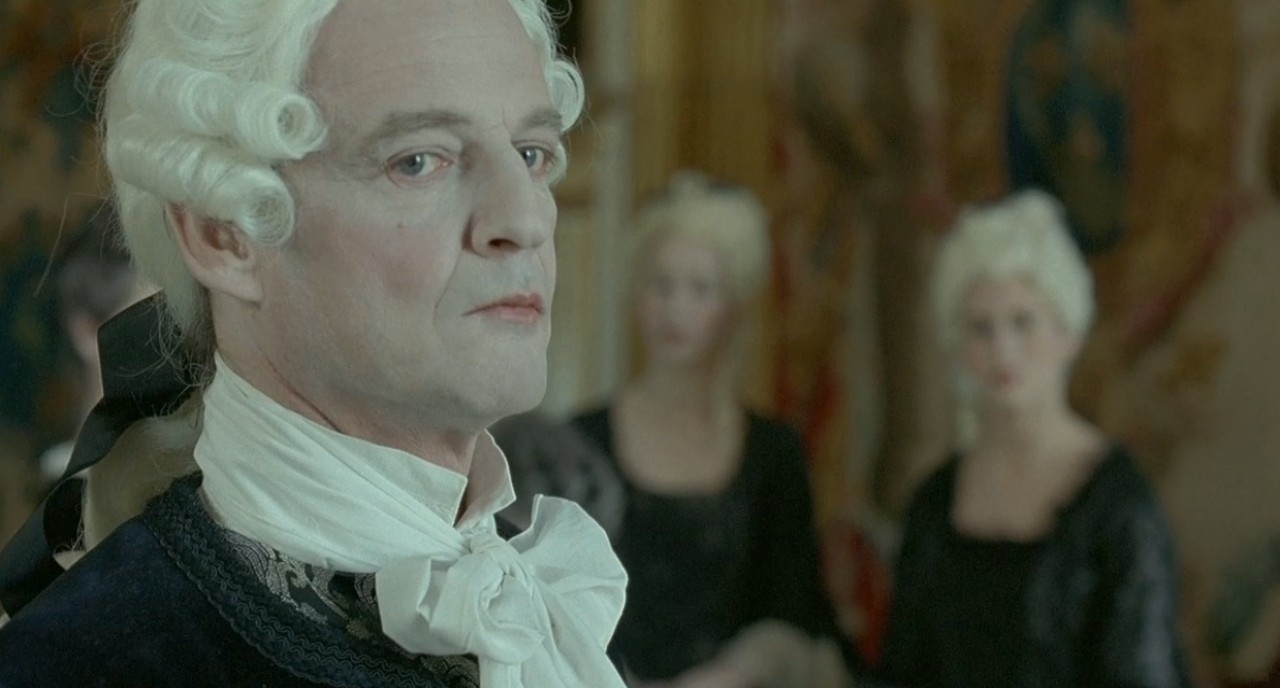
Marc Barbe as Leopold Mozart
It’s a hard life (after an evening of music the Mozarts may find themselves stiffed by their rich patrons, who can’t be bothered with petty concerns like money) but not an unhappy one. Despite the rigors of their lives and art, the Mozarts seem to enjoy one another.
But Nannerl (the film’s main focus…Wolfgang is but a supporting character here) nurses a growing discontent. Although an accomplished violinist, her father forbids her to perform in public…or even to practice. A violin, he says, is not a woman’s instrument.
And he discourages Nannerl from writing her own music. Leopold is focused on his genius son, and Nannerl is simply part of Wolfgang’s support system, providing harpsichord accompaniment behind her brother’s virtuoso solos or singing the songs penned by him.
“Mozart’s Sister” follows Nannerl through two relationships with members of the French royal family. First there’s a young princess (Lisa Féret…yet another of the filmmaker’s offspring) Nannerl encounters during a stayover at a rural monastery. The princess and her two sisters have been raised by nuns virtually from birth, and though they may dream of court and romance their only real option is to eventually take vows. There’s just a hint of a lesbian attraction between these two tweeners.
More intriguing is the semi-romance Nannerl strikes up in Versailles with the Dauphin (Clovis Fouin), a young widower who encourages Nanerl to dress as a young man in order to visit him in his quarters.
Is it love? Is it exploitation?
Actually, it’s just weird. The Dauphin may seem a romantic figure, but he’s got big-league emotional/mental problems. And if Nannerl’s drag alter ego is supposed to seem daring or scintillating or adventurous…well, it falls flat.
It might help if Mme. Féret showed some range, but her performance is so one-note and low-keyed that “Mozart’s Sister” seems more like a clinical case study than a story of passions unfulfilled.
The closest the film gets to making us feel anything is during a written postscript that reveals Nannerl’s later life as a married woman and perpetuator of her brother’s legacy.
See it if you must for the music, the dresses and the castles. Just don’t expect much of a buzz from this one.
| Robert W. Butler
 Butler's Cinema Scene
Leave a comment