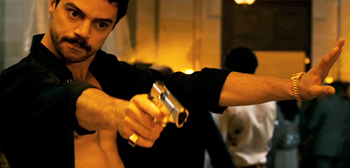
Dominic Cooper as Uday Hussein
“The Devil’s Double”:
If Brit actor Dominic Cooper doesn’t get an Oscar nom for his work here we should start an Occupy Hollywood movement.
In Lee Tamahori’s film Cooper (he was the bridegroom in “Mamma Mia!”) plays both Uday Hussein — Saddam Hussein’s psychotic and murderous older son — and real-life Iraqi officer Latif Yahia, who looked enough like the young despot to become his double, filling in for Uday at boring affairs of state and, on at least one occasion, drawing an assassin’s bullet.
It’s a delicious star turn, with Cooper reveling both as the piggish, ultra-violent Uday, and as Latif, a decent guy forced to live side-by-side with a man he despises.
Tamahori doesn’t bring a whole lot of style to the proceedings, but then he doesn’t have to. This is Dominic Cooper’s movie and he owns it from first frame to last.
“13 Assassins”:
Takashi Miike’s samurai tale may not score many points for originality (it’s yet another clone of Kurosawa’s timeless “Seven Samurai”), but it’s hugely enjoyable.
 A dozen jobless ronin and a comical forest-dwelling goofball join forces to assassinate the shogun’s brother, a handsome but dissipated creep who with impunity rapes and murders his way across Japan.
The assassins are led by an aging fighter (Koji Yakusho) who wants only to die nobly; their ranks have the usual mix of scarred veterans and young swordsmen yet to experience their first kill.
The last 45 minutes of the film is non-stop fighting as the conspirators lure their prey to a seemingly unexceptional village, then unleash a slew of tricks and their incredible fighting skills for a fish-in-a-barrel slaughter.
How ballsy are these guys? Well, the old samurai looks out over 200 enemy soldiers and tells his 12 comrades, “Kill them all!” That’s how ballsy.
“The Conversation”:
There are times when I think Francis Ford Coppola is a borderline hack. And then I rewatch the “Godfather” movies or “The Conversation” (just out on Blu-Ray) and realize that this hack has made at least three great American movies.
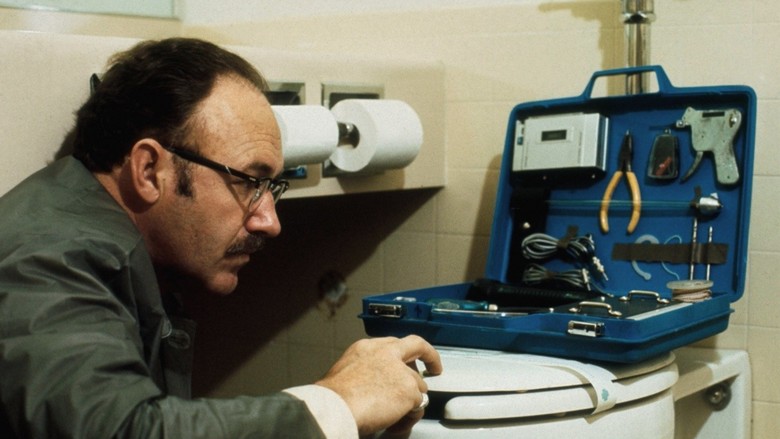
Gene Hackman as Harry Caul
“The Conversation” (1974) is an existential thriller wrapped up in a character study– and in nearly 40 years it has hardly aged at all.
Gene Hackman plays Harry Caul, a legendary but secretive surveillance expert who can record “private” conversations under seemingly impossible circumstances.
Here he’s got a tape of a young man and woman (Frederick Forrest, Cindy Williams…yes, she of “Laverne and Shirley”) chatting in San Francisco’s Union Square. Examining the feed from multiple microphones, running the recordings through various filters, Harry concludes that his client — the woman’s husband (Robert Duval) — has gotten wind of their illicit affair and plans to murder the lovers.
But what should he do? Harry’s rep rests on his moral ambivalence. He does his job, turns over the evidence and cashes his check. What happens afterwards shouldn’t be his concern.
Still, Harry feels responsible for a couple of underworld killings from previous cases and so begins his own private investigation of the couple and her husband. Get ready for a big shock.
Around this central mystery Coppola and Hackman create a world of paranoia, competition, pride and emptiness, for Harry Caul is a man who cannot get close to anyone.
Hackman is fantastic, as is the supporting cast: John Cazale, Harrison Ford, Teri Garr, Allen Garfield.
Oscar noms for best picture, Coppola’s screenplay and, fittingly, sound.
“A Better Life”:
Chris Weitz (“About A Boy,” “American Pie”) gets serious with this realistic portrayal of an illegal immigrant (the excellent Demian Bichir) and his American-born teenage son.
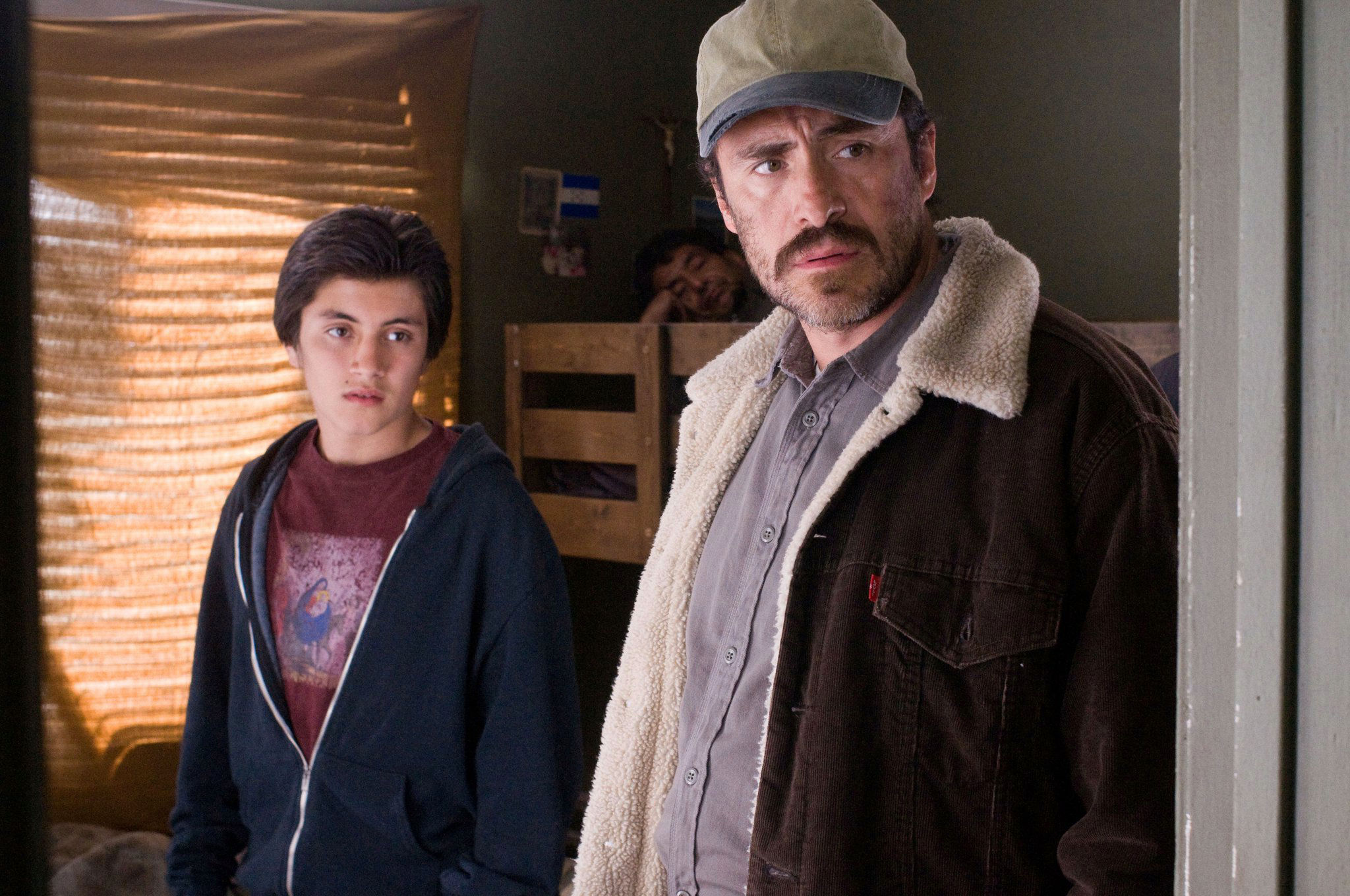
Jose Julien, Demian Bichir
Carlos works as a gardener in Los Angeles. This single dad focuses all his efforts on creating a life for his boy Luis (Jose Julien). Unfortunately, while Carlos is out breaking his back, Luis is turning into a spoiled jerk who’s toying with joining a local gang.
“A Better Life” soon turns into a variation on the Italian classic “The Bicycle Thieves.” Carlos invests his life savings in a used truck so he can become his own boss; when the truck is stolen, he and Luis must search the Hispanic community to locate the thief.
The details of their search are less important than the bonding that takes place as Luis begins to realize Carlos’ sacrifices made daily on his behalf.
Bichir, so memorable as the Mexican drug lord a couple of seasons back in Showtime’s “Weeds,” does a 180 here, playing a simple, sincere and humble man, and making us believe.
| Robert W. Butler
 Butler's Cinema Scene
Leave a comment