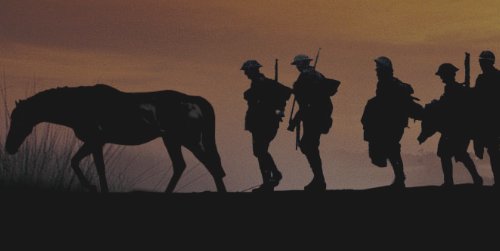
 “WAR HORSE” My rating: C+ (Opening wide on Christmas Day)
146 minutes | MPAA rating: PG-13
Visually rich and dramatically undernourished, “War Horse” is director Steven Spielberg’s attempt at a David Lean-style epic.
It’s big. It’s gorgeous.
And, unfortunately, it is largely uninhabited despite a deep cast of yeoman British thespians.
The source material, Michael Morpurgo’s 1982 book for children, already has become a hit West End and Broadway show. The dominant critical view of the stage version is one of indifferent material elevated by brilliant staging, with breathtaking life-size puppets portraying the equine characters.
The question going into the Spielberg film, then, was whether the yarn would still deliver in a “real” world without that awe-inspiring stagecraft. The answer: Every now and then the movie is magic. But too often it feels overplotted and plodding.

Jeremy Irvine and "Joey"
The setup is awfully similar to that other famous horse tale, Black Beauty. We follow a beautiful horse throughout its life, from a bucolic colthood through a series of masters, in this case English and German military men during World War I in France.
There’s also a “Lassie Come Home” element, with the young farmer who raised the colt and names it Joey going to war in the hope of being reunited with his beloved animal soul mate.
That may sound like a fool’s errand — finding one horse in the madness of global conflict — but then “War Horse” is overloaded with unlikely coincidences and manipulative plot twists. This film will burn out cynics in short order.
In the long (too long, actually) opening sequence we see how the young horse is purchased by a drunken Devon farmer (Peter Mullan), who spends way too much money on an animal built for racing, not pulling a plow.
But the man’s son, Albert (Jeremy Irvine), befriends and trains Joey. Sadly this boy/beast love affair must end; the family can only keep their farm by selling Joey to the army.
There the horse becomes the mount of a cavalry captain (Tom Hiddleston); an ill-advised (but thrilling) attack on a line of German machine guns ends that segment.
Joey becomes the charge of two young Germans who use him in their plan to desert; then he’s taken in by an aged French farmer (Niels Arestrup) and his sickly granddaughter (Celine Buckens).
Retaken by the Germans, Joey must pull massive artillery pieces, a chore that usually kills off the animals within weeks.
But thin and weary he survives, at one point breaking free to race through the crowded trenches and across No Man’s Land between the warring armies (a superb visual set piece).
Spielberg and his screenwriters (Lee Hall, Richard Curtis) attempt here to have it every which way. They want to make a PG-13 film suitable for young audiences (there’s hardly any blood) but substantial enough to satisfy adult interests (the madness of war) and end up shortchanging both audiences.
 Some of Spielberg’s choices are lamentable…like having the French and German characters speak in heavenly-accented English rather than employing subtitles.
The biggest problem is that the film has no central character. Spielberg is smart enough to not anthropomorphize Joey; the horse (actually, horses) does a pretty great job of “acting,” but he’s still just an animal.
But rarely do any of the human players — among them familiar faces like Emily Watson, Benedict Cumberbatch, David Thewlis, Liam Cunningham and Eddie Marsan — get a chance to establish their characters. Most are in and out with just a few minutes of face time.
Irvine is fine as young Albert, but he never seizes the screen, which is what this film requires.
Thus the success of “War Horse” rests largely on the showmanship of its director. And at numerous points in the film Spielberg delivers.
At its best “War Horse” employs all the tools of modern cinema to capture the sweep of its sprawling tale. John Williams contributes a lush score heavily influenced by Ralph Vaughan Williams. The art direction and costuming is impeccable.
And there are lump-in-the-throat moments of visual beauty — at various times Spielberg seems to be channelling not only David Lean (a cavalry charge through a wheat field) but also John Ford (“How Green Was My Valley,” “The Quiet Man”), Victor Fleming (the red sunset from “Gone With the Wind”) and Lewis Milestone (an infantry attack across No Man’s Land).
Frame for frame, this is a gorgeous movie.
Now if only it had engaged my head and heart as completely as it mesmerized my eyes.
| Robert W. Butler
 Butler's Cinema Scene
Thanks, Bob. I will probably go see it … but I’d much rather get to NYC or London and see the play. I did listen to the book and found it enjoyable – it was in the young adult section, of course. Black Beauty was always my “go-to” book as a girl – I could find just the chapter to let me have a good cry or one to lift my spirits. I still have my book – it was given to my Mother by one of the field hands in the early 20th century.
“War Horse” is an animal lover’s movie, as long as you don’t know much about horses … then it’s an insult to your intelligence. I’ve been around horses and trainers for 20 years and horses don’t act like that. But that fault is minor compared to the way Spielberg sugarcoats war as a scary, but bloodless adventure with a generous share of glory and a feel-good ending.
Wars don’t have happy endings.
When I was a kid there were dozens of WWII movies … nearly all portraying war as a great, glorious adventure where most of the dying was done by the “Japs” or “Nazis.” Our guys usually died quietly after telling their best friend they didn’t mind dying to protect the folks back home. I think growing up on those movies made it easy for the Boomer generation to go to war in Vietnam … one of the dumbest things this country ever did.