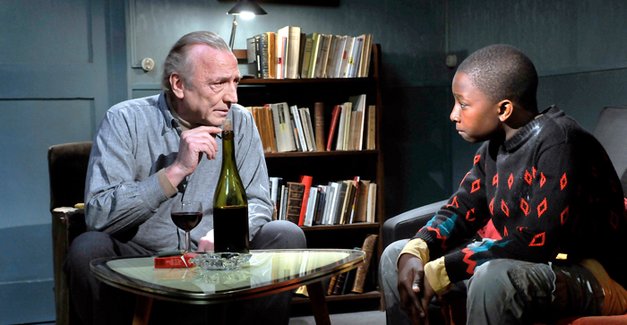
Andre Wilms and Blondin Miguel in "Le Havre"
“LE HAVRE” My rating: B (Opens Jan. 30 at the Tivoli)
93 sminutes | No MPAA rating
I’ve never known quite what to make of Finnish director Aki Kaurismaki. I guess you could say he makes dour comedies (“Leningrad Cowboys Go America,” “Man Without a Past”), though in truth it’s sometimes hard to know if we’re supposed to laugh or not.
But there’s no missing the intentions of “Le Havre,” which might be described as a Communist fairy tale. However you describe it, it is the most audience friendly film Kaurismaki has yet produced.
In the French port city of Le Havre the graying shoeshine man Marcel Marx (Andre Wilms) plies his trade, even though he’s frequently hassled by the police and pompous merchants who don’t want him conducting business outside their swank shops.
In the nearby dockyards authorities hear noises coming from one of those big steel shipping containers. Inside are a dozen illegal immigrants from Gabon who have been locked inside and forgotten for several weeks.
The youngest of these illegals, a 14-year-old boy named Idrissa (Blondin Miguel), makes a break for it. Marcel — a closet intellectual with a love of books and leftist causes — finds the kid hiding in the cold water beneath the pier and takes him home.
Turns out Marcel has plenty of room because his beloved wife Arletty (Kati Outinen) is in the hospital with what looks like incurable cancer.
Thus far “Le Harve” sounds kind of grim. Not to worry. It’s actually quite warm and fuzzy.
Marcel’s friends and neighbors — considered by many to be the dregs of the Le Havre waterfront — form a conspiracy to protect Idrissa. They try to throw off the trail the police inspector Monet (Jean-Pierre Darroussin) who is hunting the fugitive.
And to raise funds for Idrissa’s passage to London (where his mother awaits him) Marcel and friends put on a rock concert, dragging from retirement local rockabilly legend Little Bob (Roberto Piazza).
Kaurismaki’s unambiguous message is that it takes a village, so to speak. Despite their relative poverty, Marcel and his friends collectivise for a good cause. Hey, it’s no coincidence that the main character is named Marx and that he has a pooch named Laika (that was the name of the Soviet lab dog that in 1957 became the first animal to orbit Earth).
It’s a satisfying humanistic story, and it has been presented by Kaurismaki with a weird formalism. Most shots are stationary (when the camera does move it seems revelatory) and the actors often stare directly into the camera. Individual shots are exquisitely composed and even ugly settings somehow seem beautiful.
But the real story here is that people — even the physically eccentric people with which Kaurismaki populates his story — can be beautiful.
| Robert W. Butler
 Butler's Cinema Scene
Leave a comment