 “EXTREMELY LOUD AND INCREDIBLY CLOSE” My rating: B (Opening Jan. 20)
129 minutes | MPAA rating: PG-13
I was prepared to be irritated by “Extremely Loud and Incredibly Close.” And I was.
This is a movie about a too-cute kid (he may or may not be autistic) who after losing his father in the 9/11 attack goes on a borough-to-borough scavenger hunt throughout NYC, attempting to solve the final conundrum left by his puzzle-posing papa.
This yarn has an off-the-charts potential for preciousness.
And yet by the end, Stephen Daldry’s film adaptation of Jonanthan Safran Foer’s novel had me by the throat and the tear ducts.
This puts your humble critic in an uncomfortable position. My left brain is telling me, “Aren’t you ashamed?” My right brain is saying, “Yeah, but it feels so good.”
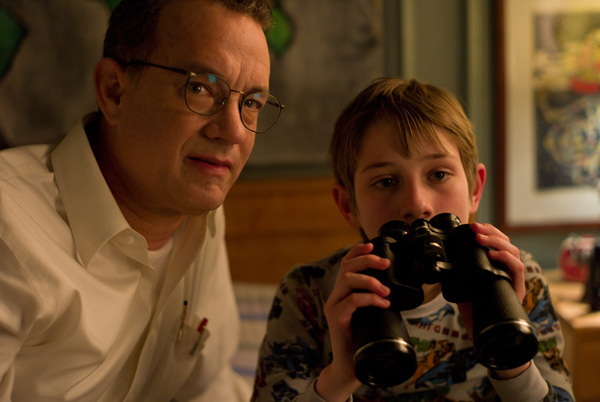
Tom Hanks, Thomas Horn
Thomas Horn plays nine year old Oskar Schell, who lives in a Manhattan apartment with his widowed mother, Linda (Sandra Bullock). Oskar is an odd duck…on the one hand incredibly rational (he can cite all sorts of statistics to support any stance he takes) and on the other off-the-rails emotional (he’s a font of phobias and, when overwhelmed by too much sensory input, calms himself by shaking a tambourine).
In flashbacks we see his relationship with his late father, Thomas (Tom Hanks), one of those superhumanly great dads who senses his “special” child’s skewed view of the world and devotes himself to creating brain games that will pull the best out of Oskar.
In the wake of his father’s death in one of the Twin Towers, Oscar is haunted by dreams of people jumping to their doom. His child’s psyche can hardly process the grief.
Poking around in his father’s closet, Oskar finds a key in an envelope marked with but one word: Black. There’s no hint as to what they key is meant to open, but deciding that “Black” refers not to a color but to a person, the boy determines that he will interview everyone named Black in the NYC phone books. He’s so bent on solving the mystery that he overcomes his fear of riding on the
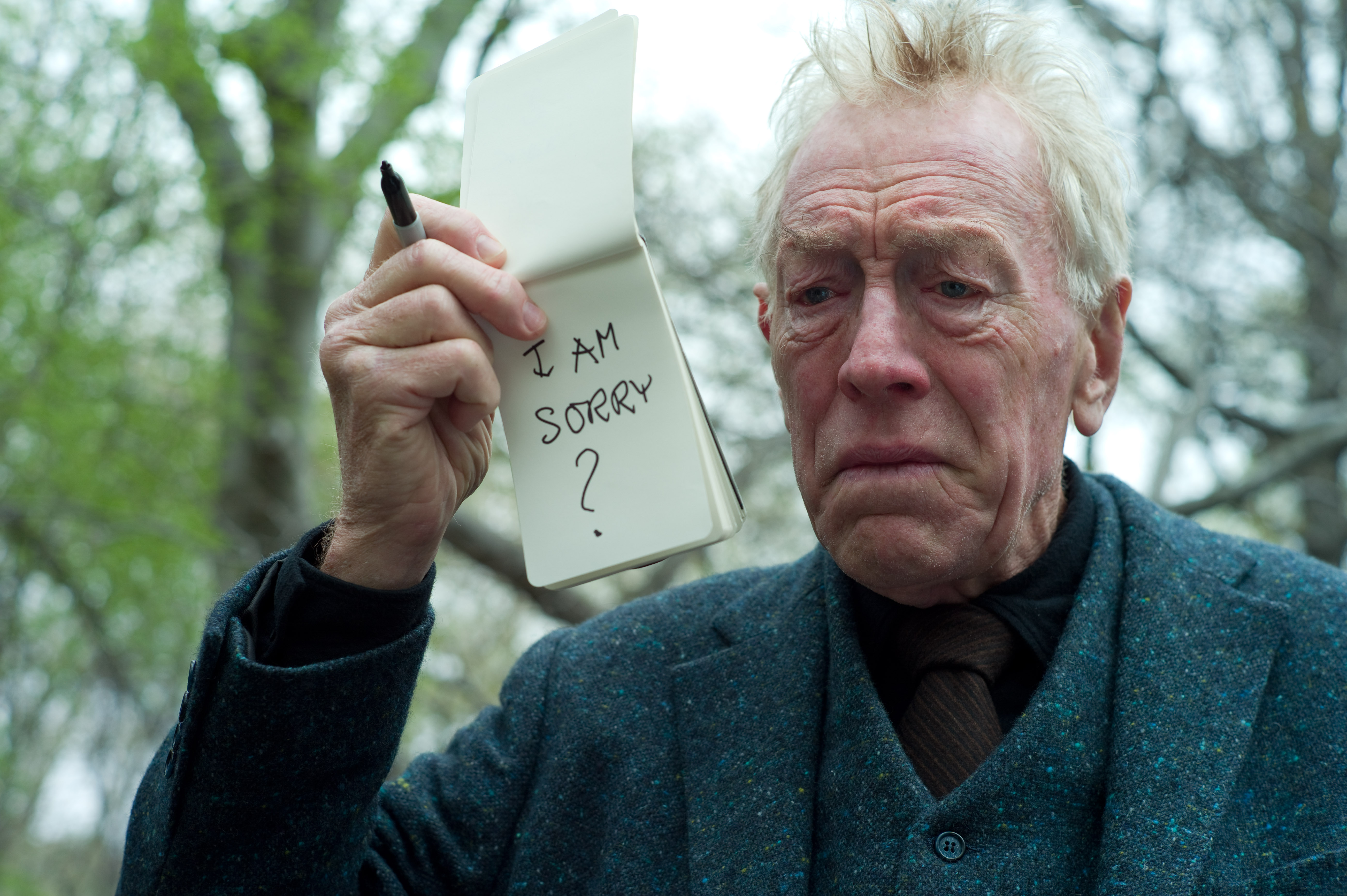
Max von Sydow
subway.
Oskar’s companion for many of these crosstown perambulations is an elderly fellow who rents a room from his grandmother, whose apartment is just across the street.
The grizzled old guy (Swedish film icon Max Von Sydow) is mute, though we don’t know if his problem is medical or psychological. When he must communicate he scribbles messages on a notepad; for simple queries he has the word “Yes” tattooed on one palm, and “No” on the other. He perfectly complements Oskar, who talks compulsively.
Yes, it is all terribly contrived. It should be unbearable. The only problem is that Von Sydow gives a wonderful performance. Go figure.
The various “Blacks” Oskar interviews are played by a large stable of character actors, with one falling-apart couple portrayed by the sublimely wonderful Viola Davis and Jeffrey Wright. There’s a whole “family of man” thing going on here, with the desperately searching Oskar eliciting sympathetic responses from many of his subjects. I mean, here’s this weird/cute kid trying to find answers to his dead father’s life. How are you not going to be sympathetic?
Sandra Bullock
Though surrounded by seasoned pros (Hanks is his usual charming self and Bullock is fine at expressing moist suffering), first-time actor Horn carries the film on his thin shoulders. He takes a character that is more literary conceit than actual human being and makes us care. The problem with Oskar is that his condition has been carefully calculated — first by novelist Foer and then by screenwriter Eric Roth– to be odd cute rather than odd irritating. You could call it Asperger’s Lite…an affliction meant to tug at our heartstrings without actually alienating us.
Even so, I find the movie to be more satisfying than the book, which was filled with digressions that fractured the narrative without adding that much to the overall package.
And director Daldry (“The Hours,” “The Reader”) has an uncanny knack for making Oskar’s story seem somehow bigger and grander than just the quest of a young boy. He manages somehow to turn it into an epic of human emotion.
So you’ll probably bawl. If you have any sense at all, you’ll feel guilty about it.
|Robert W. Butler
 Butler's Cinema Scene
Concise review, Robert. I wasn’t going to go see it; now I will. Thank you.