
Glenn Close as Albert Nobbs
“ALBERT NOBBS” My rating: B (Opens Jan. 27)
113 minutes | MPAA rating: R
There’s so much interesting stuff going on in “Albert Nobbs” that it’s hard to know where to begin.
First, of course, there are the Oscar-nominated performances by Glenn Close (best actress) and Janet McTeer (supporting actress). What makes it doubly intriguing is that both play women disguised as men.
Then there’s the true but semi-fantastical premise of the screenplay by Close and John Banville, which springs from the fact that in Victorian Ireland (and elsewhere around the world during various epochs), certain women to simply survive or to realize their ambitions have opted to go through life as males, never letting society know of their secret.
And finally there’s the man behind the camera, Rodrigo Garcia, who has given us two wonderful and criminally underappreciated masterpieces of independent cinema (“Nine Lives,” “Mother and Child”) and produced (and, frequently, directed) the HBO series “In Treatment” about a psychotherapist and his patients.
“Nobbs” is set mostly in late 19th-century Dublin in a small hotel catering to genteel ladies and gentlemen. The owner, Mrs. Baker (Pauline Collins), seems a decent enough sort, but she’s always fretting about making ends meet. The chief butler/attendant is Albert Nobbs (Close), a rawboned fellow who has been a fixture at the hotel for decades.
Albert is a stickler for protocols. A proper hotel operates best when everyone knows their job and devotes themselves to serving the customer — that’s his approach.
Of course Albert is terribly quiet about his private life, which is a mystery. Forced to share his room with a workman who is painting the hotel’s interior, Albert is mortified when his unwelcome bedmate discovers the truth — that Albert is actually a woman.
Of course the interloper, Hubert, has a secret of his own. He, too, is a woman posing as a man (and played by McTeer, who uses her imposing height to great effect). What’s more, Hubert has been living with a woman in their own version of a traditional marriage, a revelation that gives the lonely Albert hope.
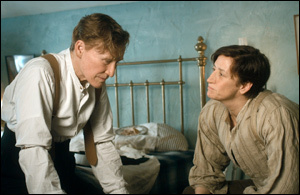
Glenn Close, Janet McTeer
In fact, he/she sets her sights on wooing Helen, one of the hotel chambermaids (Mia Wasikowksa). You see, Albert has a small fortune hidden under the floorboards of his rooms, the result of years of scrimping and saving. He dreams of marrying and starting his own modest business.
Of course first he’ll have to compete with the loutish but crudely charming Joe (Aaron Johnson), the hotel handyman who has been sniffing around Helen’s skirts.
The main problem with “Albert Nobbs,” I think, is that McTeer’s overwhelmingly masculine Hubert pulls focus from Close’s tentative Albert. Hubert is a swaggering working-class type, all muscle and attitude. By comparison, Albert comes off as, well, a closeted gay man terrified of letting too much out. He’s so tightly wound up and reluctant to reveal anything that we are denied entry into his private world.
“Albert Nobbs” is a thought-provoking minor-key tragedy marked by a nice sense of time and place and a slew of solid performances (I haven’t yet mentioned the supporting work from the likes of Brendan Gleeson, Jonathan Rhys Meyers, Maria Doyle Kennedy, Phyllida Law and other instantly recognizable faces from British TV and movies).
But at its heart there lingers a frustrating enigma.
| Robert W. Butler
 Butler's Cinema Scene
Leave a comment