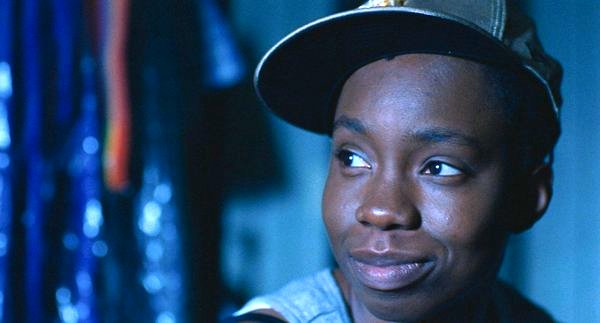
Oduye
“PARIAH” My rating: B (Opens March 9 at the Tivoli)
86 minutes | MPAA rating: R
Being black. That’s one strike.
Being a woman. That’s two.
And being gay…well, those are shaping up as pretty daunting odds.
In “Pariah” Adepero Oduye gives a luminous performance as a high school senior who day by day, incident by incident is being pushed ever closer to revealing to her disapproving family that she’s a lesbian.
Among the many remarkable things about Oduye’s performance is this: At 33 she’s twice the age of the character she so convincingly plays.
Upon our first glimpse of Alike — or Lee as her friends know her — it’s hard to tell just what her sex is.
She’s in a crowded nightclub and her clothing — baseball cap, loose sweatpants, shapeless hoodie — make her look like a young man. Only the fact that there are only women dancing and drinking in the place suggests that, yep, she’s a girl.
On the bus ride home Lee undergoes a transformation, loosening her hair and changing into something less mannish. She’ll be going to college in a few months, hopefully on a scholarship, and if she can only hold out until then she’ll be long gone without having to have that devastating you-know-what conversation with her parents and younger sister.
That will be easier said than done. Her mother, Audrey (a terrific Kim Wayans) desperately wants to be in her daughter’s life and is getting more and more exasperated. She presses for mother/daughter shopping trips. She tries to buy nice girlie outfits for Lee.

Kin Wayans
Audrey is a case study in denial. She already suspects that Lee is gay and is waging war to prevent it. She bans Lee’s friend Laura (Pernell Walker), an older girl who clearly has no interest in things feminine. And in a desperate last ditch effort, she orchestrates a friendship between Lee and Bina (Aasha Davis), the daughter of a friend from church.
Poor virginal Lee is about to have her heart broken for the first time.
In the hands of writer/director Dee Rees, “Pariah” is a deeply felt coming-of-age movie.
Characters this complex are hardly ever seen on the big screen nowadays. Winan’s Audrey, for instance, is a smart woman, modern in most regards, who has a crippling phobia when it comes to lesbianism.
Her police officer husband (Charles Parnell) is the sort of guy who’s loving and funny until you take one step too many on his prerogatives, at which point he becomes terrifying.
Neither is a bad person, but their personal and cultural baggage has left them totally unprepared to cope with or accept a brilliant, willful daughter who happens to be gay.
Nor is “Pariah” one of those joyless yarns of misunderstanding and oppression. There are moments of terrific humor, such as the scene in which Alike’s little sister (as open-minded as her parents are bricked up) discovers Alike fumbling with a strap-on dildo.
“Pariah” is a coming-out tale of beauty, grace and uncommon intelligence.
| Robert W. Butler
 Butler's Cinema Scene
Leave a comment