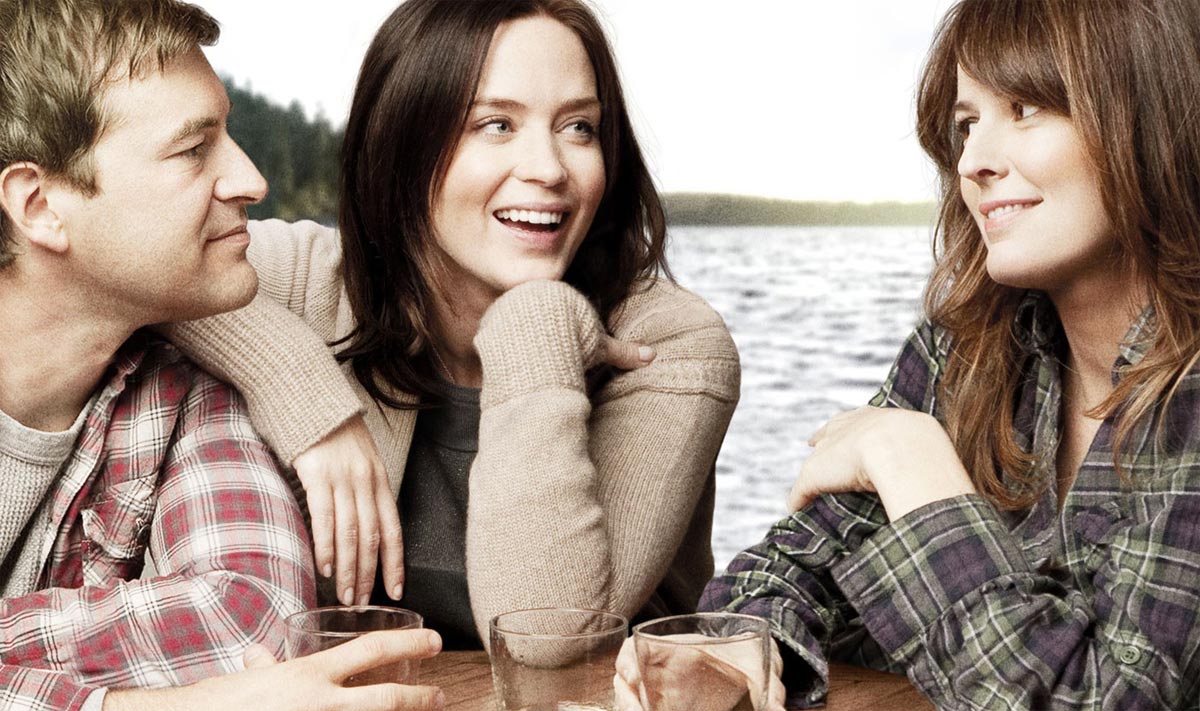
Mark Duplas, Emily Blunt, Rosemarie DeWitt
“YOUR SISTER’S SISTER” My rating: A- (Opening June 29 at the Tivoli and Leawood)
90 minutes | MPAA rating: R
Lynn Shelton’s “Your Sister’s Sister” is some sort of miracle — a cleverly conceived, perfectly acted three-character dramedy that has all the verbal beauty of a great stage play and yet always feels absolutely cinematic, albeit in an unforced sort of way.
Iris (Emily Blunt) was dating Tom. But Tom died. Since then Iris has become best friends with Tom’s brother Jack (Mark Duplass). Now she’s concerned because Jack’s drinking, bitterness and lack of direction since Tom’s death have reached a tipping point.
So she initiates her version of an intervention, telling Jack — ordering him, really — to ride his bike to the ferry (they live in Seattle) and go to an island where Iris’ family has a rarely-used home.
No TV. No Internet. Jack will be forced to spend time alone with himself.
Except that when Jack pedals up to the threshold on a cold night (nights are always cold on the island, and wet, too) he finds the house occupied. Iris’ half sister, Hannah (Rosemarie DeWitt), is already encamped. She’s left her girlfriend of seven years and is trying to get her head together.
A bottle of tequila and some clever conversation later and Hannah and Jack are tumbling into bed together. It’s not an auspicious mating (he’s got, er, control problems and she hasn’t been with a man for a long time) and the next morning they’re prepared to write the whole thing off as a Cuervo-instigated mistake.
Except that Iris suddenly appears. Jack and Hannah agree not to tell her what happened.
You can guess how well that resolution works, especially when Iris confides to Hannah her true feelings about Jack.
“Your Sister’s Sister” specializes in long conversations (we’re talking 10, 15 minutes) that play out in real time. Hannah and Jack’s boozy night together is a highlight — two bruised people charming each other to see if they still have the ability. It feels absolutely real.
But there are other moments, some featuring the two sisters, some with all three of the characters tiptoeing cautiously around the elephant(s) in the room.
These exchanges feel like improv but I’m pretty sure they’ve been carefully scripted. Each has its own arc, shape and specific beats, and that’s just about impossible to accomplish if the actors are winging it.
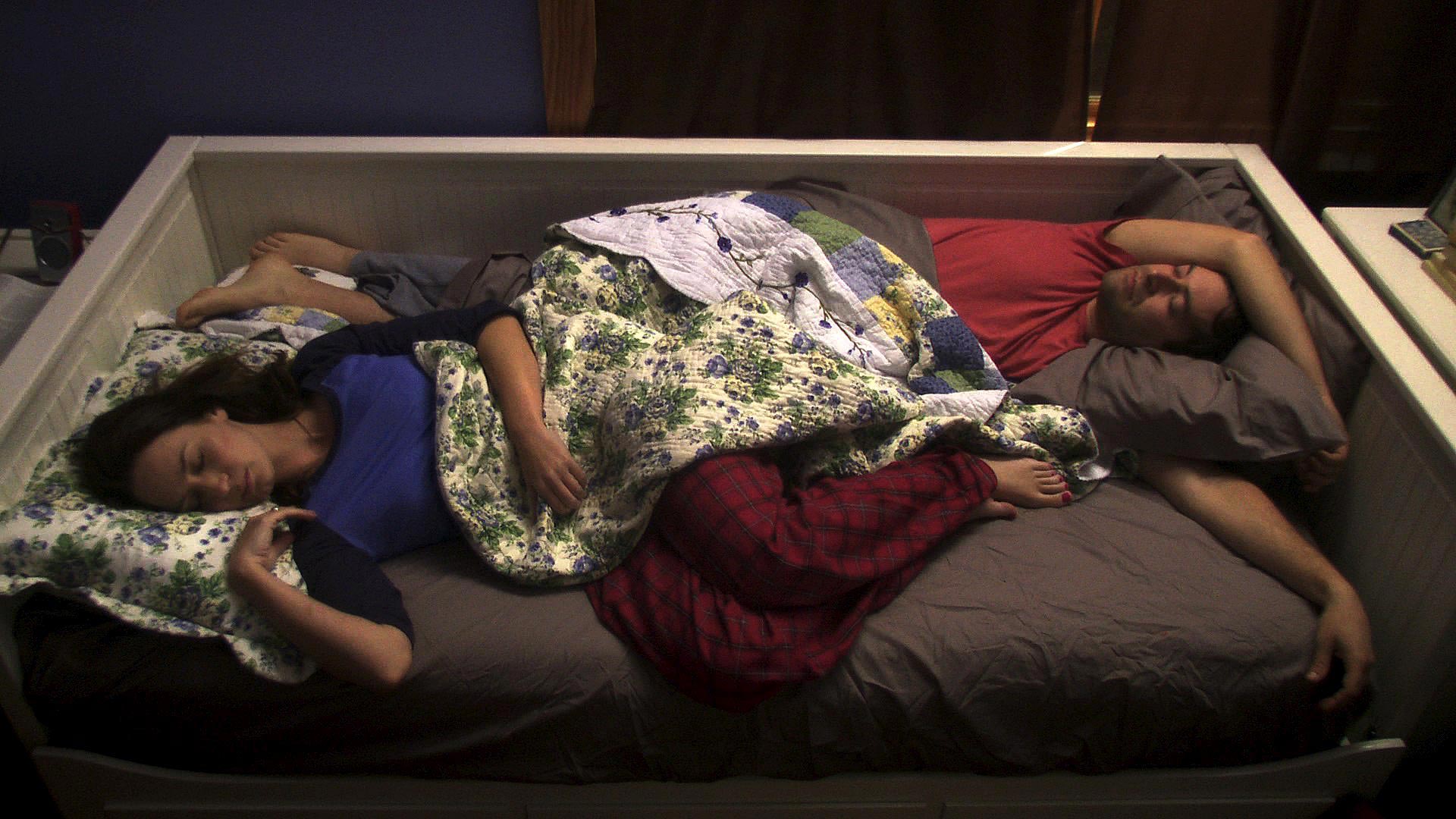
Blunt, Duplass
Yet for all the meticulousness of the spoken word, “Your Sister’s Sister” is visually effective as well. Benjamin Kasulke’s cinematography is equally at home with the natural beauty of the island setting and with the features of the human face. Late in the film Shelton treats us to a wordless visual passage that contrasts the two sisters’ time together against Jack’s soggy wanderings around the island.
She has it both ways.
“Your Sister’s Sister” represents a qualitative leap forward from her last movie, the so-so comedy “Humpday” (Duplass starred as one of two straight guys who on a dare make a date to have sex together). In fact, this latest film is so much better that it’s hard to imagine both were made by the same woman.
| Robert W. Butler
 Butler's Cinema Scene
Robert, I’m afraid we saw two completely different movies.
This one, the one I saw, began in a promising way with some excellent dialogue in a warmly inviting setting, allowing us, the viewers, to feel as though we, too, were at the party, sipping a beer, eulogizing a friend, feeling awkward at the outburst of the angst-ridden brother. And then, being confronted by the earnestness of the beautiful friend, we agreeably bicycled our way to the Cabin in the Wood, where the Wild Things might have been. But here the journey ended. The boozy conversation (which was well done) did nothing other than bookend the painfully predictable interaction of these bland, cookie-cutter Pacific Northwest (typically Seattle but it could have been Portland) two-dimensional stereotypes.
It is not just that American independent film is obsessed with our Aged Youth (the Millennials, the GenYr’s), but that this obsession blinds them to anyone who is not a Vegan Lesbian, pseudo-artist, a Hi-Glamour Female Careerist (just for contrast), or a Schlub (an overweight, clumsy, weak, unemployed, clueless, non-threatening, asexual late-twenty something male) who is ‘just friends’ with all the good-looking women. Given that collection of tired icons, it is not surprising that the claustrophobic universe Ms. Shelton builds around them is so entirely, blandly passionless.
This is no place for love; this is no place for lust. This is not a place for any hard-edged emotion and barely accommodates just a low-cal smidgen of clumsy, empty sex. So let us contrast this closed, hermetic world to another equally tightly bound… I think of Picnic, the so-safe world of 1950’s small town Kansas and I think of Holden’s Hal Carter. He, too, was unemployed (but he was begging for a job) and he too was clueless (at least when it came to small-town/family politics) but he was in every other way a force of nature; he was the anti-Jack.
The world Hal entered, like the Cabin in the Woods, was limited, was empty, was filled with characters simply going through the motions, grieving for might-have-beens. Jack, in the Cabin, simply endorses; he agrees; he soothes; he fetches liquor and cuts carrots. He is embarrassed by sex and so awkward at it that he empties it of all meaning; it is non-sex or zero-sum sex. That is not surprising, though, because his very presence is a non-presence and the two sisters barely recognize him when he’s there and do not miss him when he’s gone. In the end we are left with a question but by then we are completely indifferent to the answer…and so, we suspect, are the 3 people in the bathroom. It doesn’t really matter.
Hal Carter is a different animal. Where Jack ameliorates, Hal explodes. He tears the cabin’d world of Kansas wide open — not because he seeks destruction, rather because he seeks desperately to live. When he sees Kim Novak’s Madge, he burns. When she sees him, she melts. When the two dance, beneath the moon, upon the night, across the river, the world stops. Picnic is not about settling for what’s available or negotiated accommodation of quirky personalities or discovering, you know, that after some considerable thought, weighing pros and cons, looking at all the factors and reaching appropriate peer-endorsed consensus, it’s right for the rather incestuous two to be together. Picnic, unlike Sisters, is about passion.
Both stories place the ‘outsider’ inside. Both challenge him with life, with sex, with love, with the possibility of Difference. Picnic, however, pushes our understanding of that closed world, those formulaic lives with the “The force that through the green fuse drives the flower…Drives my green age; that blasts the roots of trees…Is my destroyer.” Picnic gives us Hal and we see what life could be.
Your Sister’s Sister gives us nothing but a studied sameness and a continued bland indifference, There is no one in that world who says, “I got so used to things as they were: Everything so prim, the geranium in the window, the smell of mama’s medicines. And then he walked in, and it was different! He clomped through the place like he was still outdoors. There was a man in the place and it seemed good!” In the end, we’re not sure that anyone walked in because nothing is different, just the same as it ever was, same as it ever was.