 “FAREWELL, MY QUEEN” My rating: B+ (Now showing at the Glenwood Arts)
100 minutes | MPAA rating: R
The fate of France’s King Louis XVI and his wife, Marie Antoinette, never seems to lose its appeal for filmmakers.
But writer/director Benoit Jacquot finds a new twist with “Farewell, My Queen,” in which the French Revolution and the fate of royalty is viewed through the eyes of the hired help. It’s like “Upstairs Downstairs – Gallic Division.”
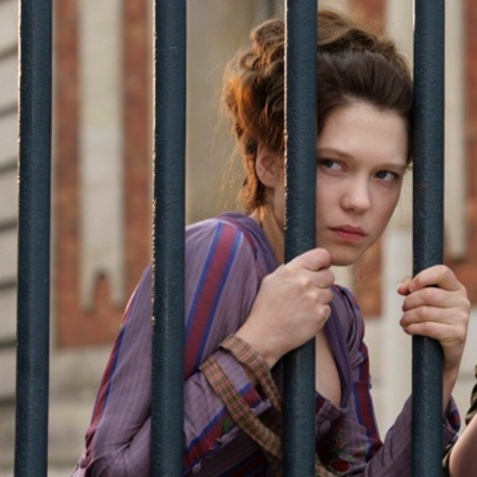
Sidonie (Lea Seydoux, who was an assassin in the last “Mission Impossible” film and the shop owner who ends up with Owen Wilson in Woody Allen’s “Midnight in Paris”) is the Queen’s reader. Each morning she greets Her Majesty with a few passages from a favorite book … precisely which book is determined by the head lady in waiting (Noemie Lvovsky), who attempts to match the day’s reading to the Queen’s current temperament.
Living in Versailles in 1789, it turns out, is less glamour than drudgery. Sidonie and her fellow workers spend most of their time in dank, undecorated rooms with meager furniture and dirty plastered walls. They take their meals in a cellar that’s positively dungeon-like.
But Sidonie came here to serve her queen. And the moments she spends with Marie Antoinette in the Queen’s sumptuously appointed suites are her reason for living.
Marie is played by the German actress Diane Kruger (Marie came from Austria), who is best known in this country as Nicolas Cage’s love interest in the “National Treasure” franchise. She’s been good in several films (especially “Inglourious Basterds”), but here she’s spectacular.
Marie, of course, famously said that her starving subjects should “eat cake,” a statement that has often been used to prove her callous indifference to the plight of common Frenchmen. But the Marie we get here is less wicked than sheltered, a blend of sophistication (at least when it comes to food and fashion) and almost childlike emotions.
Yes, she’s spoiled. And she can throw a tantrum worthy of a three-year-old in the Wal-Mart toy department.
But she seems kindly and is capable of considerable charm, and there are moments when young Sidonie can actually believe that the Queen is her friend, that there’s an affection between them that transcends monarch and menial.
“Farewell, My Queen” unfolds over the three days in July in which residents of Versailles learn of the storming of the Bastille and of an approaching mob of starving, furious Parisians.
Once the setup has been established, the film becomes a study of how individuals deal with crisis and uncertainty. In both the ranks of the royalty and of the staff you have some who panic, others who are calm and still others — like Sidonie’s friend Honorine (Julie-Marie Parmentier) — who are completely unmoved by events and devote themselves to their usual regimen of petty gossip and love affairs.

Diane Kruger as Marie Antoinette
One old fellow, the court historian Moreau (Michel Robin), has lived so long in the palace that he cannot conceive of any other way of life. The momentous changes so unnerve him that he’s reduced to a near-infantile state.
The Queen and the beautiful Gabrielle de Polignac (Virginie Ledoyen, whom director Jacquot turned into an instant star with 1995’s “A Single Girl”) are devoted to one another. In fact, it’s rumored that the two women are lovers.
Now Sidonie’s love of the Queen is tested when Marie sends her on a mission meant to save Gabrielle, possibly at the cost of Sidonie’s life. Does her devotion to the Queen extend that far?
Though it has plenty of massive sets (some scenes were actually shot at Versailles) and glorious period costumes, “Farewell, My Queen” is more about the subtleties of personality and relationships than about spectacle. It has a lived-in feel that – and I know this sounds odd – is more documentary than histrionic.
It figures. Life at Versailles was all about the proprieties. A certain attitude had to be maintained, even if deep inside you were terrified of losing your head.
| Robert W. Butler
 Butler's Cinema Scene
I may have enjoyed the clip more had it been supplied with English subtitles.