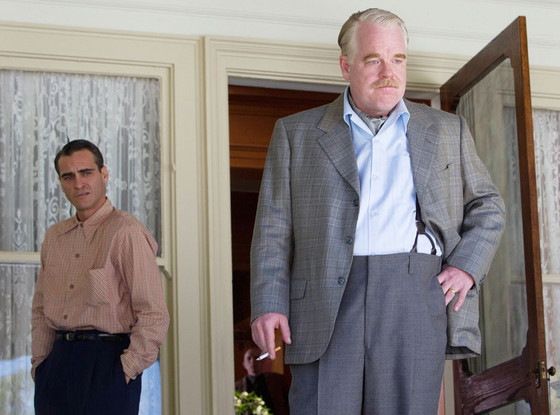
Joaquin Phoenix, Phillip Seymour Hoffman
“THE MASTER” My rating: B- (Now showing)
137 minutes | MPAA rating: R
As screen craftsmanship, “The Master” is flawless.
As a detailed depiction of abnormal psychology it is virtually without peer.
And as an acting tour de force it is unforgettable.
And yet I left the latest from the ambitious Paul Thomas Anderson feeling, well, kinda empty. The preliminaries are terrific. But there’s no main event.
Essentially this is a character study of two men who complement each other in weird and possibly unsavory ways.
Freddie Quell (Joaquin Phoenix) is a Navy veteran, and a dipsomaniac who likes to mix up his own brain-melting concoctions of alcohol, paint thinner and household chemicals. Freddie is mentally and emotionally troubled. He can pass from laid-back laziness to hair-raising intensity in the blink of an eye. His head is full of sexual fantasies.
In the years after World War II he drifts in and out of jobs. His departures are usually precipitated by a violent outburst.
Lancaster Dodd (Philip Seymour Hoffman) is a leader of a self-help cult called the Cause. He calls himself a physician and a scientist and a metaphysicist and all sorts of other things, some of which may be true. He’s written a book promulgating his beliefs and has come up with a course of treatment for his followers called “processing” which allows them to revisit past lives and confront millennia-old issues that are dogging them in this incarnation.
He travels from town to town with his soft-on-the-outside, steely-on-the-inside wife (Amy Adams) and brood, subsisting mostly off the charity of wealthy believers.
One night on a California pier, a homeless Freddy slips aboard a big yacht on which a very swank party is taking place. When he awakens in a bunk the ship is already at sea. In charge of the boat is Dodd, who calls himself The Commander. He offers Freddy a job doing…well, whatever needs doing. It begins with Freddie whipping up a batch of blinding joy juice for his new master; before it’s all over the mercurial Freddy will be a true believer and even a thug on the behalf of The Cause.
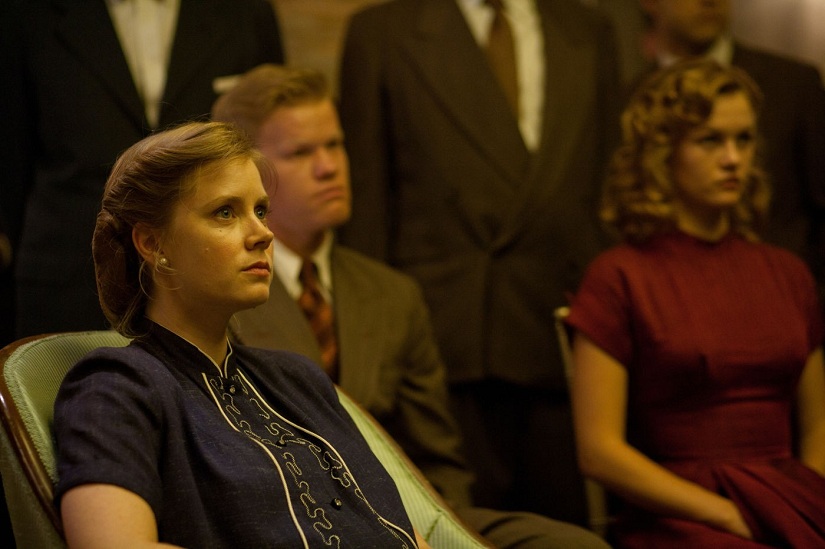
Amy Adams
Much has been made of the fact that Lancaster Dodd and The Cause bear more than a passing resemblance to L.Ron Hubbard and Scientology. Yet it’s obvious that Anderson isn’t interested in creating an expose. The cult setting is merely the background which brings together two unique personalities and allows them to interact.
It’s a bit difficult to see precisely what Dodd sees in Freddie, who quickly alienates the Missus and other higher-ups in The Cause. Perhaps he envies Freddie’s peripatetic life, his live-on-the-edge daring, his absolute dismissal of the usual rules. And perhaps the Master sees Freddie as a challenge, as the ultimate test of the efficacy of the processing treatment.
Freddie, for his part, is a lost and wandering soul who desperately needs the stability that The Cause provides. And little by little the madness that torments him seems to be toned down, contained by his sessions with Dodd. But it always seems to come bubbling up again.
Phoenix and Hoffman are spectacular here, and not necessarily in a flashy give-me-my-Oscar way (although there’s plenty of that, too). These are fabulously layered, tremendously subtle performances that work on numerous levels. Expect them to clean up during awards season.
But “The Master” feels as if it has been insufficiently thought out. There’s no there there. One leaves consumed by ambivalence. The film works on an intellectual level, but emotionally it’s as remote as the surface of the moon.
No doubt much of this is due to the fact that Phoenix’s Freddie is a fiercely alienating personality, as repellant (and fascinating) as DeNiro’s Jake LaMotta in “Raging Bull.” You can try to feel for him, but he is forever pushing us away.
And so is this film.
| Robert W. Butler
 Butler's Cinema Scene
Leave a comment