
Jake Gyllenhaal, Michael Pena
“END OF WATCH” My rating: B+ (Now playing)
109 minutes | MPAA rating: R
“End of Watch” is like an entire season of TV’s excellent “Southland” distilled into one feature film.
Which is another way of saying it’s one of the better cop flicks you’ll ever see.
Writer/director David Ayer, who made a splash a 11 years ago with “Training Day” and has been struggling ever since to match that film’s blend of style, suspense and acting chops, here makes up for a wasted decade.
“End of Watch” is a buddy movie, but one so reeking of versimilitude, one that so perfectly captures the camaraderie of cocky young cops on patrol, that it transcends a couple of common-sense objections (no officers in LAPD history have ever seen as much action as the uniforms played here by Jake Gyllenhaal and Michael Pena) to emerge as a near-documentary look at life on the job.
Part of that is Ayer’s technique. Recognizing that nothing happens nowadays that isn’t captured by some sort of recording device (the police learned this the hard way with the Rodney King beatdown), Ayer presents his story largely as “found footage” captured by surveillance cameras, police dashboard cams and cell phones. And then there are the images recorded by cop Brian Taylor (Gyllenhaal), a techno geek of the first order who pins mini-cams on himself and his partner, Mike Zavala (Pena), wires his police cruiser for sight and sound, and often carries his own digital camera onto crime scenes.
Heck, even the bad guys like to record their crimes for posterity.
Ayer isn’t a slave to all this technology. There are scenes and shots here that break with the found footage concept, but they come late enough in the film that we’ve been seduced by the “realism” the format imparts. And even in its conventionally photographed moments, cinematographer Roman Vasyanov employs grainy effects and handheld point-of-view shots that are of a whole with the rest of the picture.
But technique is only half the story. What gives “End of Watch” real heart and soul are the performances of Gyllenhaal and Pena.
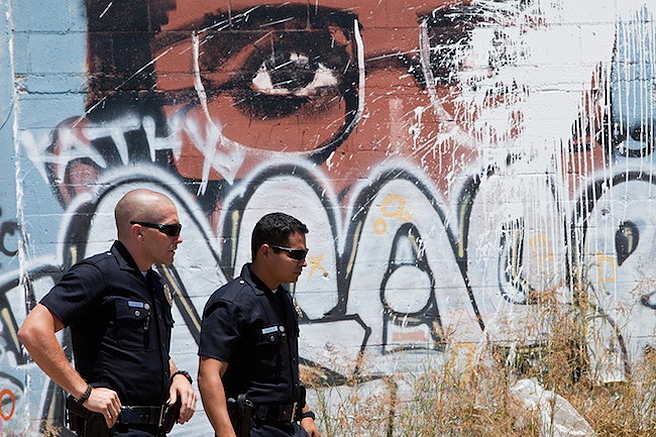 This weekend we’ve already seen the arrival of “The Master” with its knockout perfs by Joaquin Phoenix and Philip Seymour Hoffman. Well, Gyllenhaal and Pena’s are their equal, with the added plus that “Watch” is a far more satisfying film experience.
The first two-thirds of the film cover several months in the young cops’ lives. Pena’s Mike has been married since he was a teen. Gyllenhaal’s Brian is looking for that sort of stability.
Of course, they discuss these issues in hysterically funny give-and-take style … not funny in a forced, Hollywood way, but in the sort of casual teasing and banter you’d expect from two guys who have each other’s back and daily face the worst that a modern city can throw at them.
These two guys are aggressive in seeking out the craziest, hairiest situations. Whether they’re saving three children from a burning house or going nose-to-nose with Uzi-waving bangers, they reek of youthful macho and a sense of immortality. They’re cowed neither by the bad guys or by their own bosses.
That they somehow make this feel fresh and true rather than like a stale rehash of “Bad Boys’” phoniness is entirely up to Gyllenhaal and Pena. Ayer is credited with the screenplay, but I find it hard to believe that the two stars didn’t improvise and ad lib whole patches of dialogue.
Whatever the truth, both of these guys deserve recognition at awards time. They’re not acting. They’re inhabiting.
They get some great support from Anna Kendrick and Natalie Martinez as the ladies in their lives, America Ferrera, Cody Horn, David Harbour and Frank Grillo as their fellow cops, and a huge cast of players who make the killers, drug pushers and less-than-innocent-bystanders feel entirely real.
Most cop dramas fall back on the tried-and-true cliches. “End of Watch” strikes out into some new territory, and when it does flirt with cliches, it does so with such aplomb that we’re sold anyway.
|Robert W. Butler
 Butler's Cinema Scene
Leave a comment