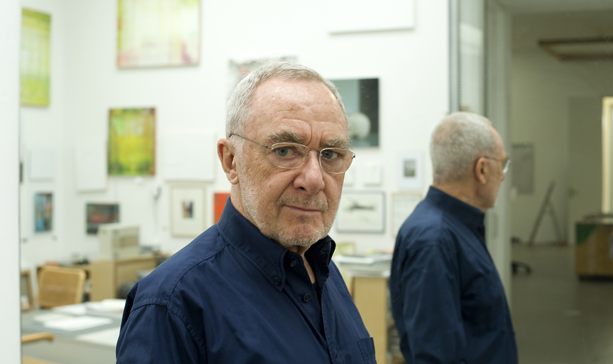
 “GERHARD RICHTER PAINTING” My rating: B (Opens Sept. 28 at the Tivoli)
97 minutes | No MPAA rating
For those unfamiliar with painter Gerhard Richter, Corrina Belz’s new documentary might not mean much.
It’s basically a cinema verite effort (no narration, no interpretation) that follows Richter as he paints and plans gallery shows. But the film doesn’t illuminate his life much beyond what happens while the camera is running. Despite some vintage footage and old TV interviews , you can’t call it a biographical project. It captures just a thin slice of Richter’s 80 years.
If, however, you’re a hard-core art fan, you’ll recognize Richter as the world’s top-selling artist with total sales that now top those of Claude Monet, Alberto Giacometti and Mark Rothko.
As the film makes clear, Richter’s success isn’ just hype. He’s a brilliant painter who, like Picasso, keeps changing his style.
So the chance to spend time in his Cologne studio, to hear his ideas on art, and to actually watch this normally reclusive genius actually create paintings is a big deal.
Belz had her work cut out for her, for Richter is notoriously reluctant to say much about himself or his work. Oh, he’s affable enough, an amazingly trim and vital fellow who looks and acts 20 years younger than his actual age and who with his latest works turns painting into an act of great physicality.
But he never uses two words when one will do and is clearly uncomfortable with the being the center of attention. He carefully chooses his words. He keeps his own counsel.
The documentary takes in a retrospective exhibition of Richter’s portraits, many of which offered blurred images as if from an out-of-focus or moving camera.
But the best part of the film simply watches as Richter creates large abstract pieces on canvas. Like a kid with a paint set he brushes on big splashes of colors, then uses huge – like six-feet long – squeegees to scrape the surface, blending and smearing the pigments to create new hues and textures. Often he will cover a colorful underlayer with gray paint, then squeegee that to reveal patches where the color breaks through.
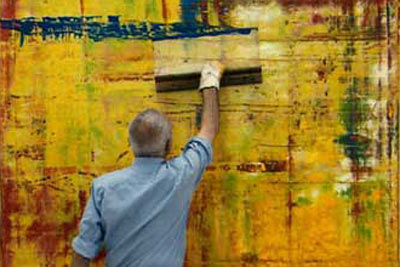 Richter tells the camera that he never has a plan for his abstract paintings, which “do what they want.” He works on instinct. Lots of paintings don’t work out and are destroyed. And any given painting may go through a dozen different versions as paint is applied and wiped away.
The film doesn’t address Richter’s private lfie. Apparently he’s married, for at one point he’s told he has a phone call from “Mrs. Richter,” but whether she’s been around for decades or is a recent trophy wife we never learn. (In fact, he and his third wife have been married since 1995 and have two children.) We never see her in the film, unless she’s in the group accompanying the artist at a gallery opening.
Perhaps the most human moment in the film comes when Richter observes that after fleeing East Germany in 1960 he never again saw his parents. He doesn’t tear up. There’s no catch in his voice. He simply slips into silence.
“Gerhard Richter Painting” ends as it began, with Richter hoisting a giant squeegee and giving a big canvas a thorough going over. Stepping back he looks over his work, then says to an assistant, “Man, this is fun!”
If the film is limited in what it can tell us about Richter, it justifies itself by giving us a chance to see him in the act of creation. In those moments, this documentary is sublime.
| Robert W. Butler
 Butler's Cinema Scene
Leave a comment