
Nicholas Barclay, age 13
“THE IMPOSTER” My rating: A- (Opening Nov. 9 at the Tivoli)
99 minutes | MPAA rating: R
If a Hollywood feature film came along to tell the same story related in the new doc “The Imposter,” I’d write it off as a typical bit of Tinseltown overstatement and the product of a screenwriter with a tenuous grasp on reality.
(In fact, it did become a feature film, 2010’s “The Chameleon” with Ellen Barkin and Famke Janssen. The movie never played in KC.)
But “The Imposter” is the real deal, a hair-raising, gut knotting true-life tragedy that will leaving you brooding and marveling.
In 1994 13-year-old Nicholas Barclay failed to return to his suburban San Antonio home after spending an evening playing video games on a nearby military base. No trace of him was ever found.
His mother, Beverly Dollarhide, older sister Carey Gibson, and other family members mourned, got angry, sought answers, and finally accepted that they’d never know what happened to Nick.
Then, three years later, they received word from authorities in a small Spanish city that Nick had been found. He had a story of being kidnapped, kept as a sexual slave, and living as a homeless teen. Now he was being held in a youth facility, waiting for a family member to come get him.
Only it wasn’t Nicholas at all, but rather a 23-year-old French man named Frederic Bourdin. Bourdin’s eyes and hair were a different color than Nicholas’ and he spoke English with a French accent. Yet Nicholas’ blue-collar clan brought him to America, embraced him, nurtured him, and got him therapy for the many traumas he had experienced. They were completely taken in.
Bart Layton’s film lets us know up front that they were the victims of an elaborate scam. Early in the film we meet Bourdin, now 40 years old, who faces the camera and explains how he called the Spanish cops to report a lost child, then became that child, then pretended to be American, then chose Nicholas Barclay’s identity from a list of missing children.
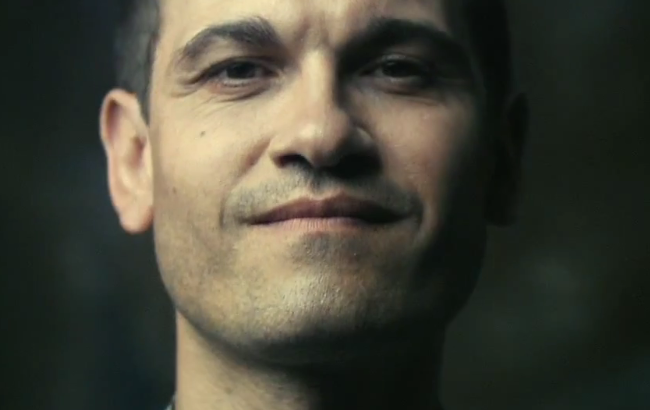
Frederic Bourdin
Secretly using a phone in the office of the group home where he was being held, he contacted the FBI and had the agency fax him the details of Nicholas Barclay’s disappearance. With that information – especially a physical description of the missing boy — he proceeded to dye his hair blonde and obtain a “jailhouse” tattoo to match the one described in Nicholas’ file.
Many of these moments are depicted by Layton in spectacularly artistic re-enactments.
Bourdin – who talks of growing up in a brutal racist household and living for years on the streets — describes his panic, his fear of being exposed, his desire to leave Europe for America. And it’s weird, but we actually come to admire his chutzpah, his resourcefulness, his ability to think on his feet. He’s like the adolescent airline “pilot” in “Catch Me If You Can.”
He was so good that he was able to convince an FBI agent of his story of being snatched by a cabal of sexually deviant U.S. military officers who flew him to Europe and used him (and other captive teens) as a sexual toy.
Layton balances Bourdin’s story against those told by members of Nicholas family. These are not sophisticated people, but they don’t seem all that gullible. Clearly, their desperate need to believe Nick was still alive clouded their perceptions.
And then things get really weird. Both a child psychologist treating “Nick” and a private detective hired by a TV news program to look into the case conclude that the boy is an imposter.
Found out, Bourdin tries to save himself by claiming to have knowledge that Nicholas was murdered by a member of his own family. Again, he’s so good at lying that the authorities begin investigating his allegations.
Before it’s all over we come to realize that Bourdin is both a career criminal and a world-class psychopath who cheerily admits he cares for no one but himself.
Layton (this is his first theatrical documentary) presents his story as a big mysterious onion, with layer after layer of revelations being peeled off, pulling us ever deeper into a puzzle that defies solution. It’s gripping, it’s dramatic, it’s packed with suspense…and when it’s all over you feel absolutely drained.
In fact, you feel like you’ve come fact to face with the Devil.
| Robert W. Butler
 Butler's Cinema Scene
SPOILERS****
I viewed this tonight on Netflix and found your blog when I did a google search about the case afterward. Since you’ve spelled out some of the film’s revelations, I wonder if you feel the suspicion about the family was unwarranted. I was quite startled 3/4 of the way through the movie by the revelations that the cops were at the family’s home “2-3 times a month”, as the neighbor stated. This gave me a totally different impression of the family than I’d had so far. (The filmmakers/editors were extremely skilled at revealing their cards one at a time.) They also made reference to the kid’s mother being into drugs at the time of his disappearance (a website I read after the movie which seemed to have its other facts straight said that she was addicted to heroin).
The other things in the movie I found very suspicious (more than I felt could be written off to denial on the part of the family and just a need to have the kid back) were the sister turning up at the airport AFTER the FBI agent (whose gullibility I could write volumes about) told her that the man was not Nicholas, and the mother throwing a fit and refusing to give a DNA sample to help prove his identity.
Having said all of that, I don’t believe for a second that the mother confessed the murder to Bourdin (as he later told the cops). And yes, the guy is CLEARLY a sociopath. All the B.S. he spouted early on about just wanting a family to love him, etc. was clearly a ploy for sympathy. He was waaaay too pleased with himself. It is not hard for me to imagine him trying to implicate them for his own amusement…but he was not the only one suspicious of how quickly, thoroughly, and desperately he was embraced by even the boy’s mother, who had to look at that face (his eyes were the wrong freaking color!!!)and know that he was not Nicholas.