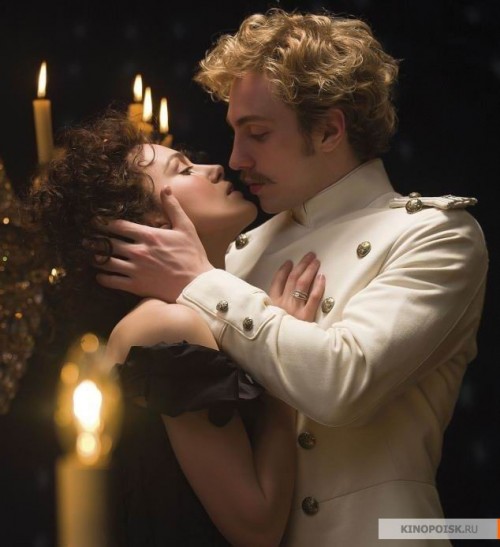
 “ANNA KARENINA” My rating: B (Opens wide on Nov. 30 )
130 minutes | MPAA rating: R
Georgeous to gaze upon but muted dramatically, Joe Wright’s “Anna Karenina” is an honorable adaptation of Leo Tolstoy’s great Russian novel.
But then I don’t expect ever to see a movie that captures all the aspects of this monumental piece of literature, which contains within its pages not only a story of doomed love but a practically encyclopedic portrait of upper-class tsarist society.
In a way Wright (his resume includes “Pride and Prejudice,” “Hanna,” “Atonement” and “The Soloist”) has given us a Cliff’s Notes version of the book that touches on most of the main themes without developing them with anywhere near the detail provided by Tolstoy.
Part of the problem is that most of us go to “Anna Karenina” expecting breathless, tragic romance. That was the main selling point of earlier movie versions with Greta Garbo and Vivien Leigh.
Tolstoy had no intention of writing a romance. In depicting the affair of the married Anna (Wright protégé Keira Knightley) and the handsome but shallow officer Vronsky (Aaron Taylor-Johnson), his goal was not to bathe in swooning emotion but to dissect – some would say clinically and cruelly – the flaws in human character and in society at large that will lead to his heroine’s eventual downfall.
To the extent that Wright’s approach to the material is also clinical, he emulates Tolstoy. The problem, of course, is that we want, nay, demand to be emotional voyeurs, and this film’s dour take doesn’t give us the kick we’re expecting.
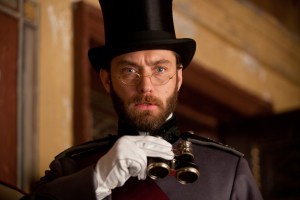
Jude Law as Karenin
Where Wright has succeeded – brilliantly, I think – is in reimaging “Anna Karenina” and late 10th-century Russian life as a sort of grand pageant, one that actually unfolds on the stage of a Moscow theater.
While a few scenes are shot in real locations (more on that later), most of this “Anna” takes place in what looks like a grand opera house. Scenes are played out throughout the building – on the stage and in the cellar beneath it, in the balconies, on the catwalks in the fly loft.
The props and costumes appear authentic enough, but the backgrounds sometimes seem deliberately artificial, like painted examples of classical stagecraft.
Wright’s restless camera wanders all over, segueing effortlessly from one scene to another. Some of the effects he achieves are quite marvelous – a steeple chase that finds real horses pounding across the stage is thrilling and terrifying — though I fear literal-minded viewers will resist his play-within-a movie approach.
And the film certainly nails the backbiting world of Russian aristocracy, with its ironbound rules of behavior, carefully constructed caste system and rather sterile (or so it seems to us today) pleasures.
As to the film’s central romance…well, it doesn’t generate all that much heat. We can sense right from the get-go that this Vronsky is a self-centered narcissist, a handsome peacock but not a person of substance. Taylor-Johnson is quite good at projecting the outer slickness and inner ambivalence.
Thus it falls to Knightley to project Anna’s irrational devotion to the man. And here’s the thing…I don’t believe Knightley is old enough to pull it off. She needs more gravitas, more seasoning if she’s going to make us care about Anna even as the character spins increasingly out of control. I hate to say it, but she’s the weak link here.
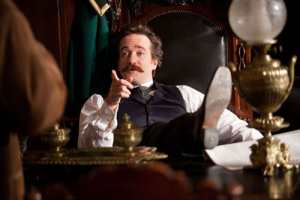
Angus MacFadyen as Oblonsky
Other of the performances are quite good. I was particularly taken with Angus McFadyen (he played Darcy to Knightley’s Elizabeth) as Oblonsky, Anna’s married-yet-womanizing bon vivant of a brother. Kelly Macdonald (of HBO’s “Boardwalk Empire”) is fine as his long-suffering spouse.
Jude Law, as Anna’s older, stiffer husband Karenin, projects real vulnerability onto a character who has often been portrayed as a flinty, cruel, and joyless. There are moments here when you genuinely feel sorry for this cuckolded bureaucrat.
In contrast to the Anna-Vronsky romance is the marriage of Levin (Domhnall Gleeson) and young Kitty (Alicia Vikander, currently starring in the Danish “A Royal Affair”). Levin may have been Tolstoy’s favorite character, a member of the landed gentry who embraces equality and works in the fields with the peasants (one of the few times Wright’s camera leaves the theater to take in actual environments).
Ill at ease in the world of society, Levin woos and wins the titled Kitty through his simple, unaffected sincerity. Their story offers a positive counterpoint to the proceedings elsewhere.
The cast is rounded out by the likes of Olivia Wiliams, Emily Watson, Shirley Henderson, Michelle Dockery (of PBS’ “Downton Abbey”) and other familiar faces.
| Robert W. Butler
 Butler's Cinema Scene
Yesterday I saw “Anna Karenina” and have to agree with you that Knightly does not bring off her part well as Anna, certajnly not as well as Garbo or Leigh. She is too young and as you say she lacks “gravitas.” I wonder if Greer Garson would have done that part well. I did enjoy the on stage presentation. Also, Jude Law was quite sensitive as Karenin although I don’t think Tolstoy presented him that way. I did read Tolystoy’s grand novel and also agree with you on his intent. Your reviews are almost always right on.