
Filmmaker Arnon Goldfinger…pondering a perplexing past
“THE FLAT” My rating: B (Opening Dec. 9 at the Tivoli)
97 minutes | No MPAA rating
A real-life detective story with far-reaching implications, “The Flat” is a worthy addition to the genre of Holocaust-related cinema.
But Arnon Goldfinger’s celebrated documentary – it’s been playing in theaters in Israel for more than a year — isn’t about cattle cars and gas chambers. It’s about human curiosity and human denial.
Five years ago filmmaker Goldfinger’s grandmother, Gerta Tuchler, died at age 98 in Tel Aviv. Born in Germany, Gerta left behind in her apartment more than 70 years’ worth of clothing (lots of creepy fox wraps and dozens of pairs of fancy ladies’ gloves) and evidence of her early life that her children and grandchildren knew nothing about.
The first clue was a yellowing Nazi newspaper, Der Angriff (The Attack), with an article about a trip to Palestine in the mid-1930s taken by Goldfinger’s grandparents, accompanied by Baron Leopold von Mildenstein, a German “journalist,” and Mildenstein’s wife.
The trip, as described by Mildenstein in the article, was to evaluate the suitability of Palestine as a destination for German Jews. The idea, at that time anyway, was that Jews could be shipped out of the Reich and relocated to another part of the world.
Goldfinger also found correspondence suggesting that in the wake of that trip the Tuchlers and the Mildensteins became close friends, and continued the relationship after the Tuchlers in 1937 emigrated to what would become Israel.
After the war the two couples picked up where they left off; the Tuchlers even traveled to Germany, where Mildenstein was now head of public affairs for Coca-Cola.
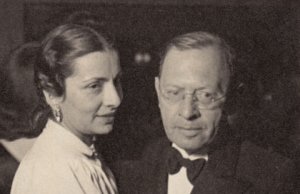
Gerda and Kurt Tuchler
Goldfinger is flummoxed. Why would his Jewish grandparents cozy up to Germans, especially after Gerta’s mother, who refused to leave Germany, died in a concentration camp?
He gets little help from his mother, Hannah Goldfinger, who knows next to nothing about her parents in those years and exhibits a remarkable lack of inquisitiveness into the mystery.
Undeterred, Goldfinger tracks down the Mildensteins’ daughter Edda in Germany. In their initial phone conversation Edda says that she remembers the Tuchlers from her childhood and invites the filmmaker to visit her.
Goldfinger gets a warm reception from Edda and her husband, both of whom maintain that the late Baron von Mildenstein was apolitical.
But research by Goldfinger turns up an entirely different story – that Mildenstein was a high-ranking member of the SS who was the predecessor of the infamous Adolf Eichmann in handling Jewish affairs. He later wrote propaganda for Joseph Goebbels. After the war Mildenstein seems to have been hugely successful in coving up his Nazi past.
“The Flat” becomes a very human story as Goldfinger ponders how much of this information he should bring to Edda’s attention – clearly she has lived most of her life in a state of denial.
Just as frustrating, why did the Tuchlers retain their friendship with a former SS man? In part it may have been because they still considered themselves German (despite living in Israel for seven decades, Gerta never learned Hebrew). Goldfinger consults a psychologist who offers another interpretation.
“The Flat” is a study in the ways different generations of Jews and Germans address (or refuse to address) issues of complicity in the Holocaust. For the filmmaker it’s simply a matter of establishing the truth; those of his parents’ generation, though, seem mostly to want to forget.
There’s no big smoking gun moment in “The Flat.” Filmed over five years, the doc relies on the slow accumulation of details that slowly coalesce to create an incomplete but evocative picture of individuals and an era.
| Robert W. Butler
 Butler's Cinema Scene
Leave a comment