
Denis Lavant…as a sewer-dwelling mutant
“HOLY MOTORS” My rating: B (Opening Dec. 28 at the Tivoli)
115 minutes |No MPAA rating
I won’t try to tell you that I understand what’s going on in Leos Carax’s brain-scratching “Holy Motors.”
But like a handful of other impenetrable, out-there films (I’m thinking especially of David Lynch’s “Mulholland Drive”), this spectacularly weird entry gnaws its way into your head and takes up residence without ever laying its cards out on the table.
I found it exhilarating. No doubt many will find it maddening.
Both responses are perfectly valid.
“Holy Motors” follows one day in the life of Monsieur Oscar (Denis Lavant). We meet him leaving an ultra-modern residence in the Paris suburbs. He’s a gray-haired, middle-aged man in an expensive business suit, and as a slew of frolicking children calling him “Papa” wave bye-bye and wish him a good day, Oscar walks down his driveway and enters a white stretch limo driven by Celine (Edith Scob), a quietly elegant woman in her early 70s.
Once ensconced in the back of the limo, Oscar picks up a folder which holds information on his next “assignment.” Soon he has shucked his hair (it’s a wig…he’s bald underneath) and clothing and transformed himself – with the help of makeup, costumes and props stashed in the car – into a crippled crone who spends an hour on a Paris bridge begging for coins.
Next it’s off to a film studio. Oscar pulls on a form-fitting black motion-capture suit (the kind peppered with ping pong balls) and enters a dark soundstage where he goes through a series of martial arts movements and engages in an erotic dance with a similarly-suited female contortionist.
Then it’s off to Pere Lachaise Cemetery where Oscar (having fashioned himself into a hideous, flower-eating madman) kidnaps an American fashion model (Eva Mendes) from a photo shoot and takes her, Quasimodo style, to a room deep in the city’s sewers.
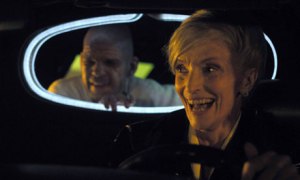
M. Oscar (Denis Lavant) and Celine (Edith Scob)
These amazing transformations go on all day as Oscar enacts various scenarios. In one he is a dying man watched over by a beloved niece. In another he is a father, picking up his teenage daughter from a party.
In two episodes he murders people … or does he really? It might all be an elaborate act. For when Oscar himself seems mortally wounded, he collapses into the limo and we see that it’s all stage blood. Either that or he heals really quickly.
Between assignments Celine drives him around Paris, chides him about not eating enough, makes small talk and watches the clock to make sure Oscar is where he needs to be for his next assignment.
There are two big musical numbers, including a fantastic sequence in which Oscar leads a small orchestra of accordion players in a dizzying procession weaving between the pillars of a huge Medieval cathedral.
WTF?
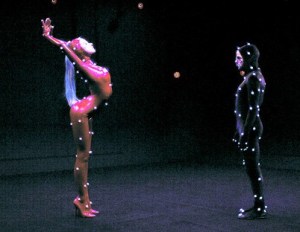
The contortionist and Oscar
Filmmaker Carax (“Pola X,” “The Lovers on the Bridge”) gives a few hints of what he’s about, starting with the title. What’s so “holy” about a white limo?
Then there’s a prologue in which a man (Carax) awakens in an airport hotel room, finds a secret door in his room (he unlocks it with a key growing from one of his fingers) and emerges onto the balcony of a huge old-fashioned movie palace. I guess you could call this the director’s cryptic statement of intent.
At one point Oscar finds in his limo one of his supervisors (French film veteran Michel Piccoli), who asks whether our protagonist is still committed to the job.
Then there’s Oscar’s late-night encounter with Eva (Kylie Minogue), who like him drives around all day in a stretch limo. Apparently they’re in the same business; Eva lets him accompany her to the roof of an abandoned department store, where she is to meet her “lover” as part of her latest assignment.
So we know that whatever Oscar is up to, it’s part of a much bigger enterprise.
Are Oscar and Eva angels? Or perhaps demons? Who is giving them their assignments? Are the people they encounter clients? Victims? Is it all random? Or part of a larger scheme?
Damned if I know.
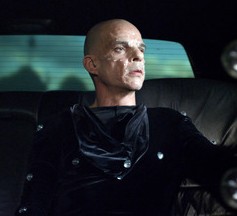
Denis Lavant…M. Oscar out of costume…or is he?
But I do know this: The chameleonic Denis Lavant gives not just a performance but multiple performances, each a perfectly rendered character. It’s one of the most remarkable things I’ve ever seen in a movie.
Lavant has been a much-employed character actor in French film for nearly 30 years (nearly 40 features, 20 shorts and a handful of TV movies). But relatively few of the movies in which he has appeared (“A Very Long Engagement,” “Entre Nous,” “Beau Travail,” “Lovers on the Bridge”) have found their way to the States.
Based on his extraordinary work here, he’s due for major reassessment by the Yank critics.
And writer/director Carax takes his place as one of the masters of forehead-slapping cinema.
| Robert W. Butler
 Butler's Cinema Scene
Leave a comment