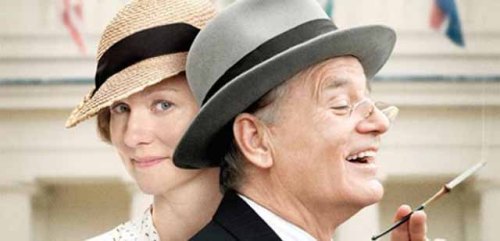
 “HYDE PARK ON HUDSON” My rating: B (Opens wide on Jan. 4)
94 minutes | MPAA rating: R
The natural reaction upon learning that comedy legend Bill Murray is portraying Franklin Roosevelt is to expect some sort of farce, perhaps a feature-length version of a “Saturday Night Live” skit.
Nope. Murray’s carefully-contained performance in “Hyde Park on Hudson” is the real deal, an attempt to present an historically plausible FDR. This does not mean that Murray and the film are solemn and humorless; merely that they story they tell is bigger than one star turn.
Actually, this piece of history from director Roger Michell (“Notting Hill,” “Changing Lanes”) is several stories mashed together (not unpleasantly).
It begins with Daisy Suckley (the ever-superb Laura Linney), spinsterish sixth cousin of the President, receiving an invitation – a plea, actually – to leave her wooded rural home in upstate New York and visit the summer Presidential compound in nearby Hyde Park.
Franklin, she is told, is restless (actually he’s driving his staff nuts) and could use some fresh companionship.
Through Daisy’s eyes we are introduced to the President’s near and dear. Most of them are very strong women: The First Lady, Eleanor (Olivia Williams, looking very horsey with a mouthful of prosthetic teeth), who spends most of her time at a sort of all-woman commune. Also FDR’s assistant Missy LeHand (Elizabeth Marvel), who knows her boss so well she can anticipate his whims. And the President’s mother (Elizabeth Wilson), whose main job is to serve as official hostess (Eleanor’s rarely around) and nag her son about drinking and his health.
Though surrounded by women devoted to him, Franklin makes Daisy feel like a co-conspirator in defying their dictates. He proudly shows off his stamp collection (he has found it useful in repelling blowhards). He engages Daisy in long conversations. He takes her racing down country roads in an open-air touring car equipped with hand controls (the president was paralyzed from the waist down after a bout with polio).
And, on one such ride, after ditching his Secret Service escort, Franklin parks in a flower-dappled meadow and places Daisy’s hand on his crotch. Evidently he’s not entirely paralyzed.
From this introduction (all of this takes place in the first 20 minutes) you expect “Hyde Park on Hudson” to be the Franklin-and-Daisy story.
But that is merely the first chapter in playwright Richard Nelson’s screenplay.
The bulk of the story concerns the 1939 visit to America of King George VI (the stammering protagonist of “The King’s Speech”) and his wife, Queen Elizabeth. Not only was this the first time a British monarch had set foot in America, it was a desperate time in George’s reign. War with Germany seemed inevitable and His Majesty badly needed American aid to prepare for the conflict. But most Yanks were isolationists unwilling to get involved in a European war.
Nelson does a terrific job of presenting the two sides in this historic encounter. Being Yanks, the White House regulars are bowled over by the very idea of meeting royalty, but at the same time are astonishingly plebeian in their tastes (they plan a picnic for Their Majesties featuring hot dogs and Native American tribal dances).
For their part, the King (Samuel West) and Queen (Olivia Coleman) are nursing badly frayed nerves. Away from the comforts of home they feel insecure and clownish. They’re determined to make a good impression, but are sadly out of practice when it comes to being “just folks.” Nelson has written for them a wonderful marital spat that’s doubly tense because it takes place in a bedroom at FDR’s Hyde Park home, a structure with paper-thin walls.
And in the film’s best passage Nelson delivers an astonishingly satisfying late-night exchange between FDR and George. Murray’s Franklin is at his charming best here, recognizing the younger man’s acute discomfort and loosening things up with alcohol, humor, and a fatherly demeanor.
It’s funny, inspiring and unexpectedly touching, not in the least because of Franklin’s willingness to show his own vulnerability by pulling himself out of his wheelchair and painfully making his way around the room supported only by his arms.
Just two world leaders, trying to get on like drinking buddies.
Eventually (and somewhat abruptly) the movie returns to the long-ignored Daisy, who is about to learn a disheartening lesson in Presidential romantic politics.
A diverting bit of history with some soap on the side, “Hyde Park on Hudson” is lightweight but satisfying. And while I can’t claim to have ever forgotten that this was Bill Murray (this isn’t a total immersion on the level of Daniel Day-Lewis’ Lincoln), the comic actor does a credible and occasionally exemplary job.
| Robert W. Butler
 Butler's Cinema Scene
He wasn’t too bad in “The Razor’s Edge” either imo.