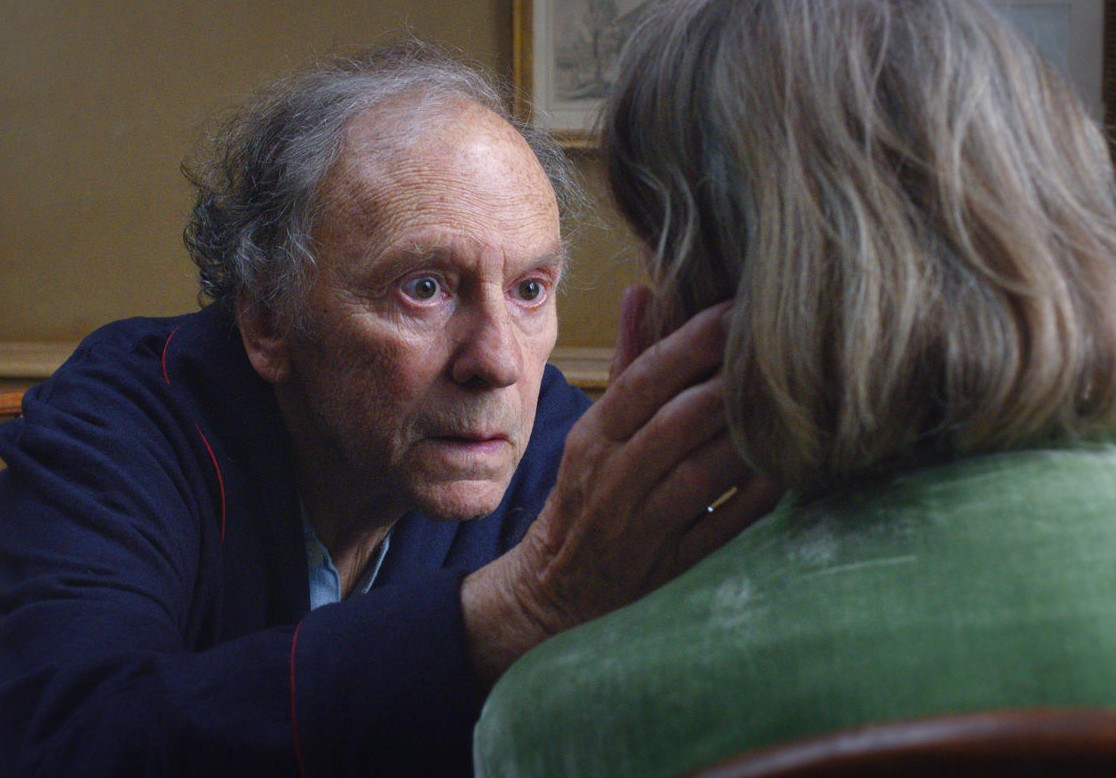

“AMOUR” My rating: A- (Opening Feb. 8 at the Tivoli and Glenwood Arts)
95 minutes | MPAA rating: PG-13
Forty years ago, when I was a cub reporter for the Kansas City Star, I followed a police dispatch call to a seedy midtown transient hotel. The bodies of an elderly couple had been found lying side by side on the bed in their cramped one-room apartment.
The cop in charge said it was either a murder-suicide or a double suicide. He’d been told that in recent weeks the wife had been seriously ill.
Back then I was too shallow and, well, scared to examine the implications of this sad tableau. But Michael Haneke’s “Amour” brought it all back to me.
Haneke is an Austrian auteur who makes seriously disturbing movies.
Movies like “Funny Games” in which a couple of young creeps imprison and torture a vacationing family. Haneke liked that one so much that he later made an English version that was almost frame-for-frame identical to the original.
Movies like “The Piano Teacher,” a psychosexual drama about a woman with buried pathologies and sado-masochistic tendencies, all wrapped up in an elegant environment.
Compared to those twisted tales “Amour,” might seem downright humanistic. But there’s savagery even here.
“Amour” has received five Oscar nominations: Best Picture, Best Foreign Language Film, Best Actress (Emmanuelle Riva), Best Director, and Best Screenplay. It earns them.
Anne and Georges (Emmanuelle Riva, Jean-Louis Trintignant) are octogenarian music lovers and music teachers. They get along famously — while some couples argue or grouse, they seem perfectly content with one another.
Then one morning over breakfast, virtually in the middle of a sentence, Anne freezes.
Georges thinks she’s kidding him. He waves his hands in front of her face. No reaction. His amusement turns to alarm. He runs off to dress for a trip to the ER, but by the time he returns to the kitchen Anne is puttering about as if nothing had happened. She has no memory of her incident.
It’s the beginning of the end. We know this because in a flash-forward prologue we saw the police breaking into the apartment and discovering Anne’s corpse on the bed, surrounded by wilted flowers. No miracle cure this time.
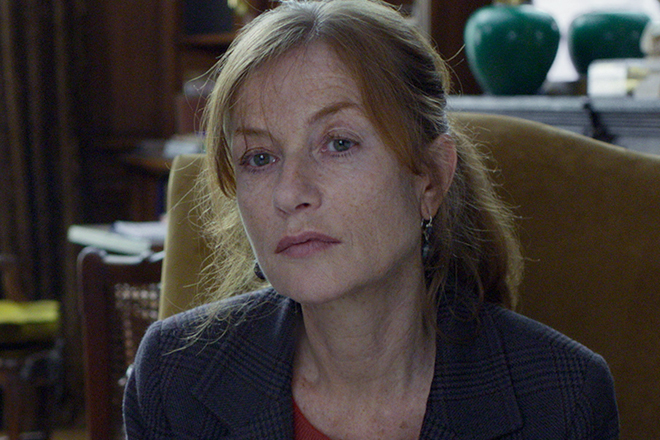
Isabelle Huppert
With the exception of bookending scenes set in a concert hall, Haneke’s screenplay is confined entirely to Georges and Anne’s Paris apartment. We never accompany them on a trip to the doctor’s office, or to the hospital for one of the many procedures to which Anne is subjected (and which in some instances seem to worsen her condition). In fact, no medical type appears on screen to deliver a diagnosis — stroke, Alzheimer’s, some odd variety of catatonia.
A scene that takes place in the hallway beyond the couple’s front door turns out to be Georges’ dream…it’s not real.
“Amour” is about the slow, inexorable slide toward mental emptiness and death.
Georges is determined to look after his beloved, so much so that he fires caregivers who don’t live up to his standards of excellence. He’ll do the spoon feeding and diaper changing himself.
Right.
Oh, there are visitors. Like Anne and Georges’ daughter (Isabelle Huppert), who is so distracted by her disintigrating marriage to a famous classical musican that she can’t do much to ease her parents’ plight (she’s so self-absorbed you get the feeling she’d be useless under the best of circumstances). One of Anne’s former students, now an up-and-coming concert artist, drops by to pay his respects. So does their son-in-law.
Most mostly it’s the day-to-day grind of Georges watching the woman he loves sink ever deeper into confusion and helplessness.
“Amour” isn’t a cruel movie…at least not deliberately cruel in the way other of Haneke’s films are.
But it is a merciless movie, one that observes wtihout comment, without any obvious play for sympathy or empathy.
This is the way it is.
“Things will go on,” Georges predicts, “and then one day it will all be over.”
| Robert W. Butler
 Butler's Cinema Scene
I’d love to see this movie in all it’s stark reality. For it is life and it is death. Problem being, I can no longer find it playing anywhere in the greater K C area.Thanks for your take on this Robert.
I think I cannot see this. It is too much parallel to my own experience in watching my brilliant architect husband become unable to do or think anything
before he, mercifully, died when his brain could no longer tell him to do the things necessary for life.
I’m afraid to see this movie. I read where one reviewer said he was glad he had seen it, but was even more glad he wouldn’t have to see it again. Is it worth the agony, Bob? I keep hearing how excellent it is…but I’m not sure I want to be haunted by it.
Is it just me, or are there an awful lot of very dark, distressing or otherwise troubling topics in the Oscar pool this year? I’m not denying realities of the times nor the important role of cinema in communicating them, but it seems recent movie topics do little to cheer or otherwise uplift the human spirit.