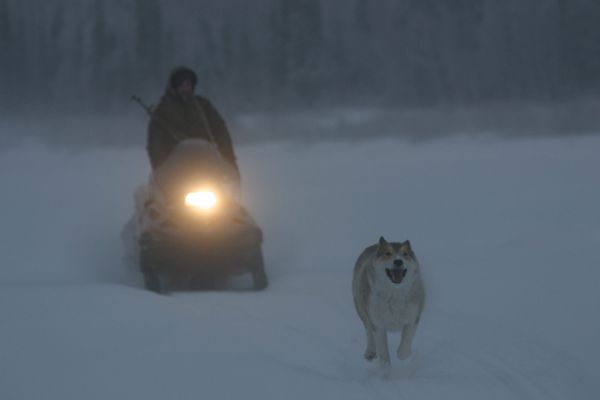
 “HAPPY PEOPLE: A YEAR IN THE TAIGA ” My rating: B (Opening March 22 at the Tivoli)
95 minutes | No MPAA rating
In recent years filmmaker Werner Herzog has gravitated toward documentaries dealing with man’s relationship to nature: “Grizzly Man” about an eccentric eaten by the wild bears he adored, “Encounters at the End of the World” about the snowbound residents of an Antarctic research station…even “Cavern of Forgotten Dreams” about cave paintings left behind by Stone Age artists.
“Happy People: A Year in the Taiga” seems to fit nicely among those other titles, but in fact it’s a weird hybrid.
This 90-minute film about the residents of a remote Siberian village was fashioned by Herzog from a four-hour Russian TV documentary directed by Dmitry Vasyukov. With Vasyukov’s input Herzog wrote his own English narration and re-edited scenes without ever setting foot in Siberia.
How closely this film hews to the Russian original is anybody’s guess. At some later date scholars may have a heyday comparing the two to show how even documentary footage can be molded to serve a filmmaker’s intent.
Any way you slice it, though, it’s an effective example of the ethnology documentary.
“Happy People” focuses on Bakhta, a burg of 300 souls so remote it can be reached only by aircraft or (during the brief summer) river boat.
The film’s title notwithstanding, not everyone in Bakhta is happy. Certainly not the indigenous folk who must contend with widespread alcoholism and lives of menial labor.

Anatoly in one of his cabins
Faring better are the Russian population, especially the trappers and hunters who become Herzog’s main focus. Anatoly, a fiftysomething fellow with a bushy beard and a thinning pate, is the principal character.
Anatoly came to Siberia in the early ‘70s. He had trapped near his childhood home, but was unprepared when he was dropped off in the middle of a vast wilderness to live in a hut without a cooking stove. He barely survived the first winter.
Now, though, he is an experienced woodsman who can fashion his own skis from fresh-cut lumber. Though he has a chain saw and a skimobile, Anatoly employs mostly primitive technology for his months-long sojourns in the wilderness.
Working the same vast expanse of fir forest deeded him by the old Communist government, Anatoly and his dog work tirelessly to harvest ermine pelts while living off the land. When he’s not hunting he is maintaining the thousands of deadfall traps he has built, as well as a dozen or so tiny cabins in which he takes refuge from an environment that routinely delivers minus 50-degree temperatures.
Some of the footage is spectacularly beautiful.
Possibly suspect is Herzog’s voiceover, which every now and then drifts into hyperbole and overstatement in an effort to present Anatoly’s life as some sort of ideal mating of man and environment.
Completely self sufficient and living off the land, these trappers are truly “happy people,” the filmmaker declares.
Well, ethical ones, anyway. Anatoly talks about how much he hates greed, as exemplified by trappers who for a few extra coins will kill pregnant game, trap out of season and otherwise violate the unwritten rules of the trade.
The film makes much of the symbiotic relationship between man and canine, and Anatoly almost chokes up when he relates how his best dog ever was gutted by a rampaging bear. The trappers’ dogs, we learn, work so hard that few live past age 5.
Herzog seems to envy Anatoly, one of the few men on Earth able to appreciate “the beauty of space, cold and silence.”
Of course, Herzog did his part for the film in the warmth of a modern editing suite.
| Robert W. Butler
 Butler's Cinema Scene
I’m never sure quite how to take Werner Herzog.
On the one hand, he blatantly interprets all of his subject material through his own highly personal lens – to the point that I constantly find myself wondering if he’s trying too hard to force things fit his preconceived notions.
On the other hand, at least he’s upfront and honest about the bias he brings to his observations, and utilizes that honesty as a pillar of his art.
I’m curious to know how it works when he didn’t do any of the filming himself. His work is always so personal, he’s always so powerfully involved in his filming, his interviews, his explorations, that I can’t quite image him dealing with subject matter second-hand like this.
This is definitely a must-see for me now!