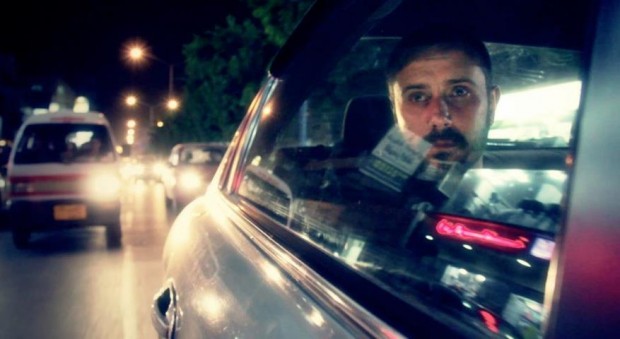
Jeremy Scahill…looking for the story
“DIRTY WARS” My rating: B (Opens June 28 at the Tivoli)
90 minutes | No MPAA rating
“Dirty Wars” might be termed a “documentary thriller.”
Rick Rowley’s film follows freelance journalist Jeremy Scahill, who has covered Iraq and Afghanistan for The Nation and written the book Blackwater: The Rise of the World’s Most Powerful Mercenary Army).
Scahill is attempting to get the story behind an increasing number of disturbing execution/massacres of apparently innocent civilians in Afghanistan and, later, Yemen.
Unlike most embedded journalists, who live with American troops and tend to unconsciously adopt their perspective, Scahill is fiercely independent. He talks to the villagers who have lost family and friends in mysterious nighttime raids or sudden missile strikes. He tracks down local warlords. And through his dogged reporting, he clearly is a threat to this unseen conspiracy.
At one point we see footage of a TV appearance in which Jay Leno asks Scahill: “Why are you still alive?”
The first half of “Dirty Wars” takes place prior to the killing of Osama Bin Laden. It is during this time that Scahill catches wind of a massive secret U.S. apparatus taking directions from the White House. This Joint Special Operations Command apparently operates free of the usual rules of engagement, shrugging off civilian deaths — even massive ones — as simply an unavoidable by-product of the War on Terror.
With Ben Laden’s death, however, the JSOC stepped into the spotlight and took its bow. And with its new semi-transparency Scahill realizes that the organization’s efforts are far more massive and widespread than even he imagined.
 This is how future American wars will be fought, apparently…not by regular uniformed soldiers but with bearded “specialists” who dwell in the shadows and make up the rules as they go along.
There are plenty of facts scattered throughout “Dirty Wars,” but the film also plays as a sort of real-world “Parallax View.” The music is ominous. The camerawork often worthy of a feature film. The editing fluid and dramatic.
But there are problems. Scahill, who narrates, is undoubtedly a terrific journalist. But he’s not a performer. He goes through the film with a worried look that never changes. I don’t believe he smiles once.
We see him briefly in his Brooklyn apartment, but we learn very little about who he is as a person. Scahill might be married. Probably not. When he’s not sleuthing out war crimes, does he indulge in Sandra Bullock comedies? It would be good to know.
But “Dirty Wars” does leave us wondering about the morality of our government and the Obama administration, and whether our national policy is one of institutionalized ruthlessness that would sacrifice innumerable innocents for the chance to kill one genuinely bad man.
| Robert W. Butler
 Butler's Cinema Scene
Leave a comment