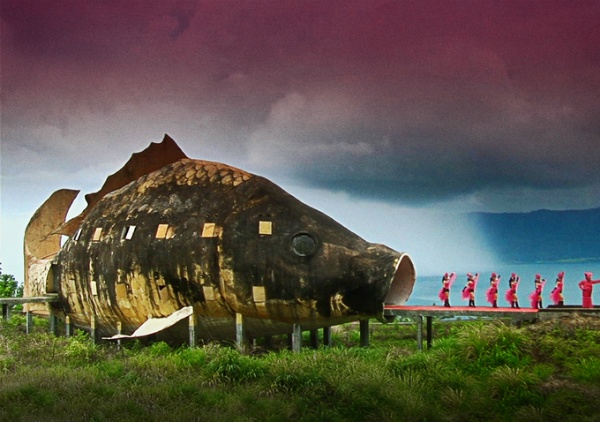
Murder as a musical number
“THE ACT OF KILLING” My rating: A- (Now at the Alamo Drafthouse Cinema)
116 minutes | No MPAA rating
Mind boggling.
Horrifying.
Astonishing.
Joshua Oppenheminer’s “The Act of Killing” is unlike any other documentary you’ve seen.
Other films have explored the “banality of evil.” Other films have looked at war crimes. But I can recall no other film that so effectively rubs our faces in brutality and the human capacity for violence.
In outline “The Act of Killing “ sounds like some sort of twisted comedy skit.
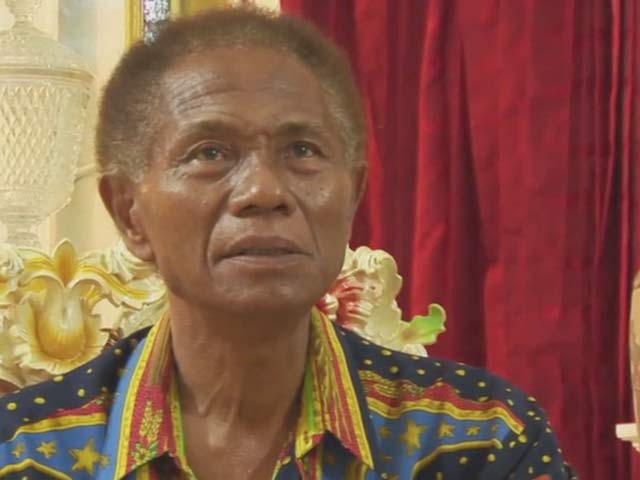
Anwar Congo
Oppenheimer’s subjects are the old men who nearly 50 years were members of the death squads that turned Indonesia into a bloodbath. In the wake of a 1965 military coup more than 1 million people were murdered for being communists…though there’s no way of knowing if these were real communists or simply folk unfortunate enough to run afoul of the ruling junta.
The filmmakers offer these graying killers – they describe themselves as “gangsters” and have spent most of their lives operating outside the law — a chance to make short movies re-enacting their glory days of murder and torture. Now in their 60s, these death squad veterans jump at the opportunity with the eagerness of children playing dress-up.
Told they can make any sort of film, some emulate an American crime melodramas, complete with double-breasted suits and fedoras. Some create a cowboy picture. There’s even a big Hollywood musical with pink-gowned dancing girls emerging from the mouth of a gigantic carp (a building in the shape of a fish) to the strains of “Born Free.”
The killers play both the executioners – demonstrating the preferred methods for taking a life without ruining your clothes – and the victims. They take great delight in being doused with stage blood and re-enacting the death throes of their victims.
The central figure here is Anwar Congo, a thin, white-haired grandfather who looks a bit like Nelson Mandela. He personally was responsible for killing 1,000 people, usually with a strangulation method of his own devising: “At first we beat them to death but there was too much blood…it smelled awful. To avoid the blood I used this system.”
Congo is proud of his violent past and happy to recreate it for the camera: “This is who we are. This is history. Step by step we tell the story of what we did when we were young.”
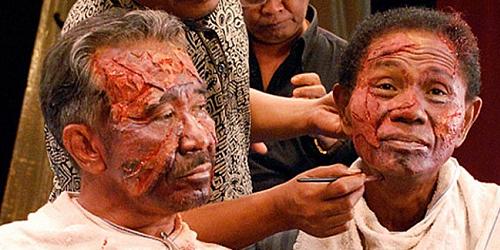
Killers getting into character to play their own victims
Though the families of the victims continue to agitate for justice, there’s little likelihood of that happening. In Indonesia the anti-communist killers are widely viewed as national heroes. Oppenheimer takes us to a rally of the Pancasila Youth, a 3 million-strong right wing organization that seems to have been plucked directly from Nazi Germany.
“We have too much democracy. It’s chaos,” grouses one Pancasila supporter. “Things were better under a military dictatorship.”
We watch slack-jawed as the killers prepare for their moments before the camera. They hold rehearsals for “actors” who will play both victims and killers. Congo decides that for authenticity’s sake he should dye his white hair black. One particularly disgusting fellow always gravitates to women’s roles.
At one point there’s an on-the-set discussion of the difference between cruelty and sadism. But there’s little talk of guilt…only resentment that their efforts were not fully appreciated.
“War crimes are defined by the winners,” one shrugs.
Adds another: “Americans killed the Indians. Has anyone been punished for that?“
Only late in the process and after repeatedly denying that he has any regrets does Congo seem to confront the enormity of his sins.
“I did this to so many people, Josh,” he says to the filmmaker, tears running down his face. “Is it all coming back to me? I really hope it won’t. I don’t want it to, Josh.”
Maybe he finally feels guilty. Maybe it really torments him.
Of course it’s not enough. Nothing will ever be enough.
| Robert W. Butler
 Butler's Cinema Scene
Leave a comment