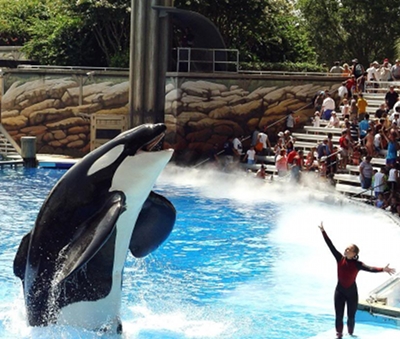
 “BLACKFISH” My rating: B+ (Opening Aug. 16 at the Tivoli )
83 minutes | MPAA rating: PG-13
Let’s assume that the documentary “Blackfish” – about killer whales in captivity – is an honest effort, that it doesn’t manipulate the facts for propaganda purposes.
Granted, that’s a big assumption. We all got burned a couple of years back by “The Cove,” a doc that blamed marine theme parks for the annual mass slaughter of dolphins in Japan.
Later, after “The Cove” had won the Oscar for best feature documentary, we learned that Japanese fishermen have been rounding up and killing dolphins for at least a century because the mammals compete with them for fish. Moreover, marine theme parks no longer capture wild dolphins, relying instead on breeding programs. Which meant that the film’s entire premise was pretty much bogus.
“Blackfish” also condemns the marine theme park industry, but by focusing exclusively on the biggest animals in these menageries – the magnificent black-and-white orcas – Gabriela Cowperthwaite’s film stands on much firmer journalistic ground.
But at the same time it’s a hugely emotional experience. Don’t be surprised if you find yourself bawling. I’ m talking about a full-bore, nose-blowing rush of pathos.
The main subject here is a whale named Tilikum who made headlines in 2010 when he killed his trainer, Dawn Brancheau. SeaWorld-Orlando claimed that Brancheau, an experienced whale handler, was targeted by Tillicum because she wore her hair in a ponytail.
But as “Blackfish” shows, Tillicum was a killer long before that. In fact, this one whale was already responsible for two other human deaths.
The first, in 1991, was of a young trainer at the now-defunct Sealand of the Pacific in Victoria, Canada. The second, in 1999, was a man who visited SeaWorld in Orlando, Fla., hid at closing time, and after hours apparently disrobed and tried to swim with Tillicum.
The thesis advanced by “Blackfish” is that Tillicum, like many a human prison inmate, has been driven mad by captivity. The logical extension of this premise is that orcas are sentient beings and should not be imprisoned and made to do tricks for the entertainment of humans.
Perhaps the most convincing thing here is the seemingly endless stream of former marine theme park employees who give their personal testimony about what they saw and felt while working with these animals. Virtually all of them claim to love and admire the killer whales, but most regret having profited from a system that exploited the orcas.
(Yeah, we know all about “disgruntled” employees…but the sheer number who were willing to go before the camera is impressive.)
This is also a story of human exploitation. I naively thought that people who work with these large seagoing mammals were all marine biologists. Hah. And then there’s the shameful posthumous treatment of Brancheau by SeaWorld -– the park claimed she caused her own death, when experienced trainers testify that she did everything right.
We hear from salty old men who used to engage in orca hunts, and whose voices break as they describe their actions as the worst thing they’ve ever participated in. Sea park employees describe the “weeping” of mother whales separated from their calves.
Orcas are born into a family and live with that group their entire lives. It’s like a moveable village where everyone’s related to everyone else. Tillicum’s madness, the film argues, is the result of the trauma of separation from his pod and isolation from life in the sea.
The film maintains that SeaWorld’s publicity machine regularly disseminates institutional falsehoods about how their animals fare in captivity.
For instance, there’s the theme park’s insistence that their orcas live twice as long as those in the wild, thanks to better food and medical care. In fact, the film asserts, just the opposite is true.
And then there’s the issue of the collapsed dorsal fin in virtually all captive male orcas. The official line is that this condition is common in the wild as well, but the film gives us experts who say otherwise. It may be a physical sign of mental distress.
There’s a lot that “Blackfish” doesn’t address. For example, is the murderous Tillicum an aberration or indicative of all whales in captivity? If captivity is so bad, why aren’t there more orca mental cases?
And of course dolphins and other kinds of whales (belugas, for instance) aren’t dealt with at all, although you’ve got to assume they’re just as smart as orcas and just as vulnerable to prison-like conditions.
Here’s what I know for sure. After seeing “Blackfish” I won’t be seeing any marine park shows. It just doesn’t feel right.
| Robert W. Butler
 Butler's Cinema Scene
I am mortified that Seaworld still has these magnificent creatures in captivity. When will be learn to respect that all life is precious, and that includes that of other species. We just do not have the divine right to exploit these magnificent creature in such a demeaning and barbaric way. They should all be set free and returned to their natural habitats!!
I hate SeaWorld now. Why aren’t there any laws in place to protect these animals? Why aren’t they freed after a certain amount of time in captivity. Can they adjust after life in SeaWorld?
Sea World is for whales what Gaza is for Palestinians.