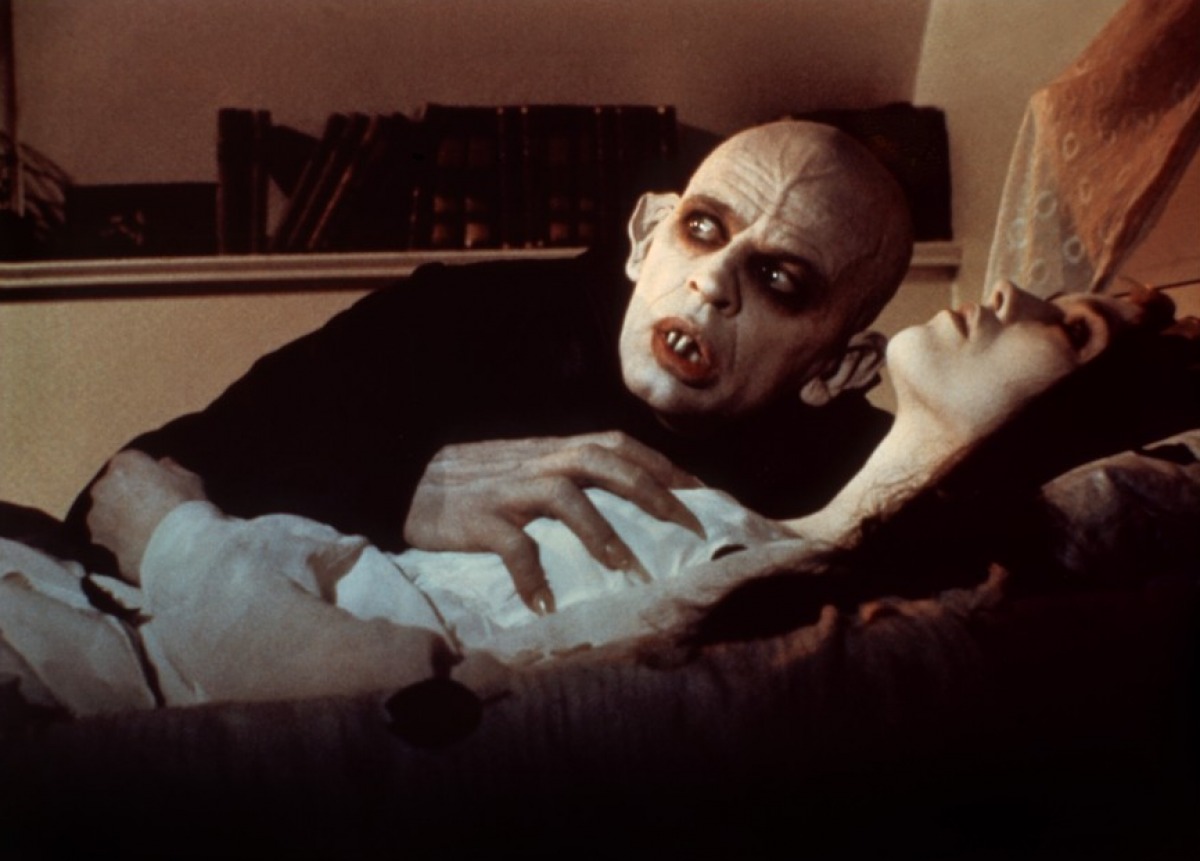
 “NOSFERATU: THE VAMPYRE” My rating: B (Opens Nov. 8 at the Tivoli)
107 minutes | MPAA rating: PG
Remaking a classic movie is generally a futile and thankless task, and you’ve got to wonder about Werner Herzog’s hubris in even attempting a color redo of the silent black-and-white vampire classic “Nosferatu.”
The original, directed by F.W. Murnau in 1927, is a masterpiece of German expressionism and is rightly regarded as one of the greatest horror movies of all time. The very first vampire film, it also contained the creepiest bloodsucker ever, a bald, ratlike nightmare played by the mysterious Max Schrek.
How do you top that?
Herzog’s 1979 “Nosferatu” doesn’t top it, but it offers a perfectly valid alternate telling of the story. Herzog is, after all a cinematic genius (yeah, yeah, often a really irritating cinematic genius) and his version has many strengths.
The newly digitized “Nosferatu” being shown at the Tivoli is in German. The film was shot in both German and English, and only the English version has previously played in the U.S. This was unfortunate, since those who have seen both believe the largely German cast gave superior performances when delivering their lines in their native language.
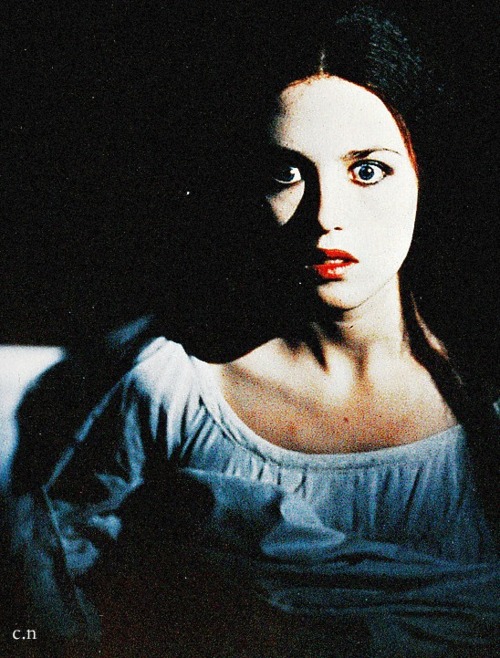
Isabelle Adjani
Herzog’s film is a tribute to Murnau – at times he perfectly recreates scenes from the original — yet establishes its own quirky self. Its strength lies in the superb melding of sight and sound. The results are creepy/gorgeous.
Herzog filmed primarily in the rugged Carpathian Mountains and in Delft, Holland. The latter provides a picture-book-pretty historic city, one which the filmmaker gleefully populates with thousands of plague-bearing rats. There are some haunting scenes of the dying citizens taking to the squares to dine and dance amid the ruins of their fallen city.
As drama this “Nosferatu” tends toward the stiff and stylized. The acting ranges from the scenery-gnawing melodramatic to the near somnambulant.
The three leads –Bruno Ganz as Jonathan Harker, Isabelle Adjani as his wife Lucy, and Klaus Kinski as the feral Count – walk a fine line between conventional acting and a pre-sound style that sometimes feels like Kabuki.
The ethereal Adjani is almost painfully beautiful, but her near somnambulant style feels extremely dated. Kinski’s vampire, on the other hand, is an unexpected bundle of suffering. Clearly, this vampire is sick of his existence but powerless to end it; as horrible as he is, he’s also terribly compelling.
Other players seem amateurish or, in the case of the madman Renfield, played by French artist Roland Topor, cartoonishly over the top.
The drama is presented more as a pageant than gripping drama – heavy stylization is one way of dealing with material that everybody already knows by heart.
Yet in the end Herzog’s “Nosferatu” sticks with us.
| Robert W. Butler
 Butler's Cinema Scene
I’ve never seen this one, but I love the 1927 one. It is still legitimately scary, even after 86 years.