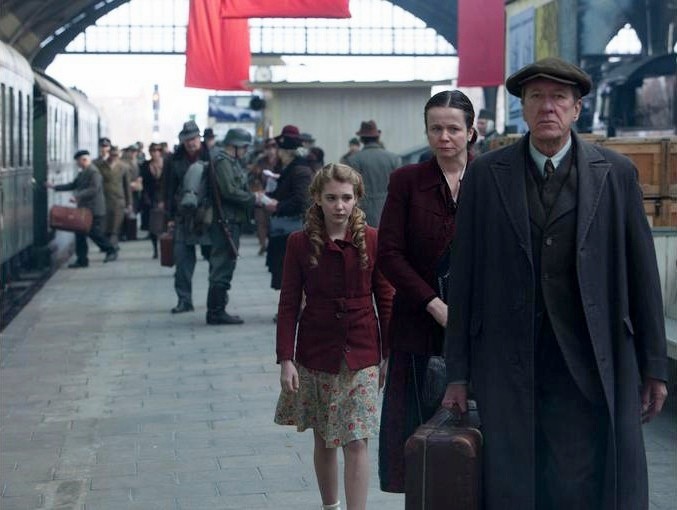
Sophie Nelisse, Emily Watson and Geoffrey Rush in “The Book Thief”
“THE BOOK THIEF” My rating: B- (Opening wide on Nov. 22)
131 minutes | MPAA rating: PG-13
There is much to admire in the new film “The Book Thief.” But something’s missing.
Fans of the novel will tell you that quite a bit is missing, but they’re talking about plot points jettisoned on the way to the screen. I’m referring to the film’s curious emotional neutrality…this should be a Class A tear-wringer, but it failed to evoke in me even a whimper.
Still, “The Book Thief” offers an interesting lesson on the difference between literature and movies.
Markus Zusak’s novel — categorized as lit for young people but drawing a far wider audience — is a variation on Anne of Green Gables set in Nazi Germany.
A young girl is adopted by a kindly man and his severe wife. She becomes so obsessed with reading that she risks much to “borrow” books from the local mayor’s private library. Thus the title.
She witnesses Nazi madness: book burnings, torch-lit rallies, Hitler Youth songfests. The family harbors a fugitive Jew. Her new papa, though far too old for action, is conscripted into the army.
The most amazing thing about the novel, though, is its narrator: Death. Yep, the Grim Reaper himself, who observes human life from a distance and comments – often sardonically – on his limited (though final) interactions with homo sapiens. Death is the novel’s most interesting character.
He’s hardly in the movie at all.
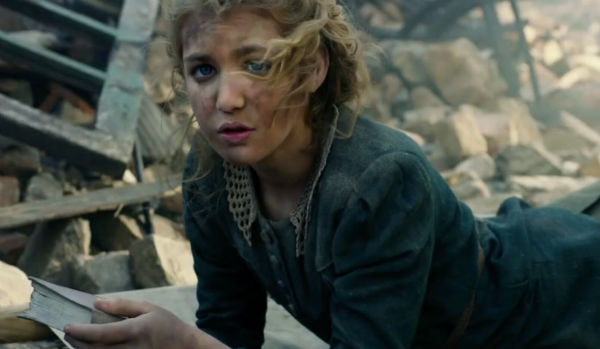
Soophie Nelisse as Liesel
Young Liesel (the breathtakingly beautiful Sophie Nelisse), is given up for adoption by her Communist mother. She goes to live with Hans (Geoffrey Rush), a sweet, funny, and chronically underemployed house painter, and his no-nonsense wife Rosa (Emily Watson), who exudes all the warmth of a Marine Corps drill instructor.
Liesel becomes best friends with Rudy (Nico Liersch), the blonde, soccer-mad boy next door. Illiterate despite her advanced age, she is humiliated in school but privately tutored by Hans, who allows her to cover the cellar walls with the new words she has discovered.
The little family’s life is put in jeopardy with the arrival of Max, the Jewish fugitive whose father saved Hans’ life in World War I. Max (Ben Schnetzer) is deathly ill from life on the run, but befriends the book-crazy Liesel and even converts a copy of Mein Kampf into a diary for her use.

Emily Watson
Though a newcomer to feature film after a career in Brit TV (including “Downton Abbey”), director Brian Percival has cannily grasped the possibilities of the big screen. There are some sequences – a smoke-spewing locomotive plowing across a snowy landscape, a chorale performance that begins on Liesel’s face and then opens up to reveal a small army of children in tan uniforms and Nazi armbands, a nighttime bombing run viewed through the open belly doors of an Allied aircraft – that are wonderfully cinematic.
But he and screenwriter Michael Petroni have been stymied by the novel’s richness. There’s just too much there to shoehorn into a 2-hour movie, and as a result the film feels tentative, incomplete.
Much of that is due to their inability to compellingly present Liesel’s shift from illiteracy to book obsession to, finally, a storyteller in her own right. These stages are paid lip service, but they generate little real power – a real problem in a story in which celebrating the magic of the written word is a central theme.
The reduction of Death (voiced by Brit actor Roger Allam) to an infrequent commentator is a major sticking point. The device seems so poorly used and arbitrarily imposed (we don’t hear the Grim Reaper for long stretches) that I would have preferred to eliminate it altogether … that is until Death’s final spoken coda, which generates an emotional power lacking elsewhere in the production.
 In the novel the fugitive Max is a fist fighter, but there’s no mention of that avocation in the movie. Schnetzer’s Max is smart and inquisitive with dreamy dark eyes, but without knowing of his violent background he comes off mostly as a victim.
Reduced to a mere afterthought is the Mayor’s wife (Barbara Auer), who is still raw over the death of her son in the first war and encourages young Liesel to read in her home library.
And Hans and Rosa’s son – an ardent Nazi at odds with his peace-loving father – has been eliminated entirely.
The bulk of the acting honors go to Rush and Watson, two consummate professionals who give the movie its moral center.
Rush does the difficult by making decency interesting. His Hans is whimsical, empathic, and has a sly sense of humor, often at the expense of his exasperated wife. What orphan wouldn’t want him for a Papa?
Watson gets the juicier part, though, opening up over the course of the tale from a grim, stony taskmaster to a fiercely protective and, yes, loving mother. The role is a cliché, but it gives the film a bit of heart we can hang on to.
And then there’s young Miss Nelisse. As I said before, she’s gorgeous, with big blue eyes worthy of a Keane Kid and a rosebud mouth. Most of us would be content just to watch her face in repose.
Problem is, her beauty masks a limited range. I’m not dumping on the kid – she’s was only 12 when she made the film – but she doesn’t show us much. This is not to suggest she’s bad in the role, or that I would have preferred a show-offy child’s performance. Just that, like so much of “The Book Thief,” Nelisse dever quite delivers the killer punch.
One of the film’s curiosities is that the didalogue alternates between subtitled German (for minor characters) and English. This makes no sense (the characters are German, after all, and in reality would all be speaking that language), but this bilingual approach wasn’t particularly off putting. In fact, I liked hearing the spoken German. More authenticity.
| Robert W. Butler
 Butler's Cinema Scene
I’m trying to decide whether or not to see this film. Based on trailers I’ve seen, these actors were asked to use fake German accents. Fake foreign accents (spoken by natives of other countries in their own countries) is a pet peeve of mine which was used in circa 60s films that fortunately isn’t used in most films anymore. Foreign accents make sense ONLY when a character is speaking a second language.
As magical eavesdroppers, film goers should be hearing speech that draws no special attention to itself, except to portray the emotional expression of the characters. The fake accents are distracting, they make the dialogue more difficult to follow, and the practice adds to our general American ignorance of foreign languages. There must be something wrong with those languages because they have a faulty pronunciation!
This was taken to an outlandish extreme in The Sound of Music where decent Austrians spoke with British accents, while Nazi Austrians spoke with fake German accents. You mentioned that in this film they went to an equally outlandish extreme by switching between English and German, both portraying the German language.
Ideally if this film was set in Germany, the language would have been entirely German with English subtitles. If the decision was made to cast English speakers, the entire film should have been in English. And the variety of English, Australian, American accents of the actors could have been explained as representing the wild diversity of regional German accents.
…. Am I being overly picky to think this was a bad decision on the part of the director?