
“Prison Terminal”
This program of the 2013 Oscar-nominated documentary shorts opens Jan. 30 at the Tivoli.
“PRISON TERMINAL: THE LAST DAYS OF PRIVATE JACK HALL” (directed by Edgar Barens; USA: 40 minutes) My rating: A-
Nearly three decades ago Jack Hall – a decorated veteran of World War II who spent time in a German POW camp – murdered the drug dealer who had hooked Jack’s teenage son, leading to the boy’s suicide.
Jack has spent the last 12 years of his life sentence in the infirmary of the Iowa State Penitentiary in Fort Madison. But his chronic heart and lung ailments now have reached the point that he’s moved to the prison’s hospice facility.
There other inmates – many of them serving life terms for murder – will bathe Jack, massage him, lift him, and pray with him. It’s volunteer work – the state has no money to staff the hospice. None of these men has much chance of dying outside the prison walls – the best they can hope for is to reclaim some of their humanity by caring for each other.
“Prison Terminal” follows the 82-year-old Jack through his last days. The cinema verite style adopted by director Edgar Barens certainly captures the grimy reality of life behind prison walls.
The down side is that without a narrator, the film seems a bit stingy with facts. I wanted to know more about Jack’s crime and his earlier life. He seems harmless now, but there are hints of multiple marriages, post traumatic stress disorder, alcoholism, and regular run-ins with the law.
But as a purely emotional experience, “Prison Terminal” is powerful, gut-wrenching stuff. Dare you not to shed a tear over the death of this killer.
FYI: “Prison Terminal” debuts on Jan. 13 on HBO.
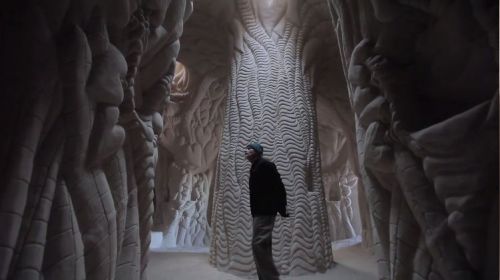
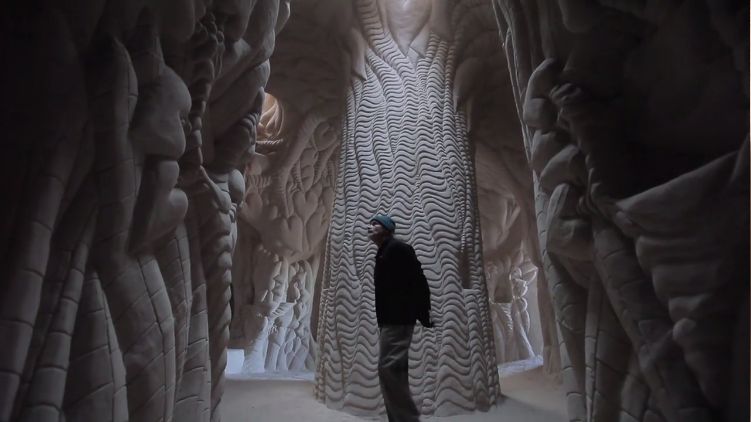
Ra Paulette in one of his creations
“CAVE DIGGER” (directed by Jeffrey Karoff ; USA; 37 minutes) My rating: B
Art and artists come in many forms. But Ra Paulette and his work are one of a kind.
Paulette, 65, digs caves in the sandstone near his New Mexico home. He’s been doing it for 30 years, creating astonishing underground spaces – they’ve been called cathedrals – of soaring columns, winding corridors and intricately carved friezes. He does it working alone with just hand tools and a wheelbarrow. No blasting. No power tools.
He calls his work “a celebration…I want to create a space that is transformative.” Well, mission accomplished.
But as Jeffrey Karoff’s documentary shows, it’s not an easy vocation. Though obviously smart and well spoken, Paulette is driven to “uncover something that’s already there.” He doesn’t work from plans, but feels his way through his growing subterranean spaces. He knows when it’s time to stop, but more often than not his projects end when their sponsors – folks who think it would be cool to have a shrine-like cave on their property – grow short of cash and patience.
“I am not the paintbrush,” he says, “and my client is not the painter.” In other words, Ra Paulette is always in charge.
Unlike the artist Andy Goldwsworthy – famous for installations using materials from nature – Paulette has never figured out how to earn a living from his art. He survives largely through the good graces of his oft-exasperated wife.
And yet like all good artists, he does it because he must. His purpose in life, he says, is “digging a hole in the ground and finding God in that hole.”
Amen.
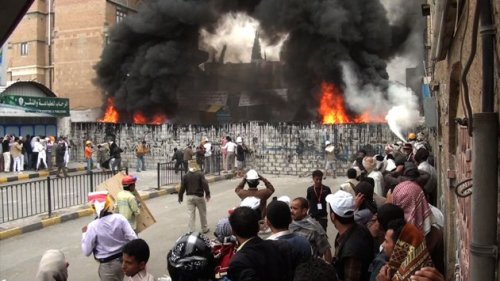
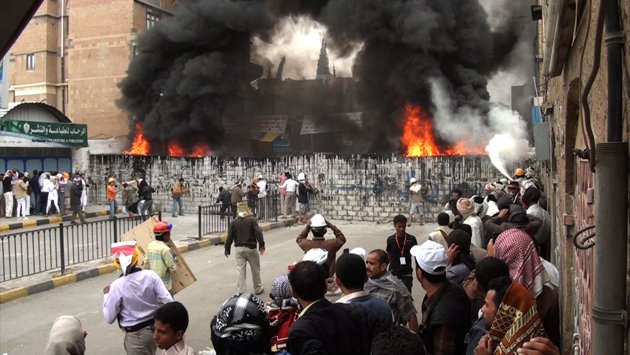
“Karama Has No Walls”…the charge against the barricade
“Karama Has No Walls” (directed by Sara Ishaq; Yemen; 27 minutes) My rating: B+
In March 2011 thousands of protestors gathered in Change Square in the center of Yemen’s capitol city. Inspired by the Arab Spring that was fomenting revolutionary movements all over the Islamic world, the protestors demanded the retirement of the president who had ruled for 33 years.
Sara Ishaq’s documentary – drawing heavily from footage shot by two young cameramen – follows the growing peaceful protest and expanding tent city. Watching the dancing, singing, and drum playing, you can’t help but be reminded of Occupy Wall Street movement in NYC and elsewhere.
But the president’s security forces weren’t giving up easily. They built a wall blocking one street into the square, and from behind this barricade launched a wave of burning gasoline while snipers fired into the crowd from rooftops.
It’s at this point that “Karama Has No Walls “ (“Karama” is the Arabic word for “dignity”) kicks into high gear. The two cameramen were targeted by the snipers, and they captured extraordinary footage of unarmed protestors charging and toppling the barricade, even as people around them were mowed down by bullets meant for the journalists.
Ishaq peppers her film with talking-head interviews with the fathers of two of the incident’s young fatalities, and with the testimony of the cameramen. It’s touching, but nothing can match the hair-raising footage of the confrontation itself. (more…)
Read Full Post »














 Butler's Cinema Scene