 “JIMMY P.”My rating: B (Opening March 7 at the Screenland Armour)
117 minutes | No MPAA rating
Mental health movies tend to run in well-established ruts.
The theraputic breakthrough. The hellish hospital. Indifferent doctors and sadistic aides/nurses.
“Jimmy P.” isn’t having any of that. This drama from French director Arnaud Desplechin (his last movie was 2008’s “A Christmas Tale,” a fondly remembered family drama with Catherine Daneuve as the head of a troubled but still tight family) is fiercely, stubbornly realistic. As well it should be, since Desplechin adapted it from a memoir by psychiatrist George Devereux, who worked for years at the famous Menninger Clinic in Topeka.
Jimmy Picard (Oscar winner Benicico del Toro) is a Blackfoot Indian from Montana, recently returned from World War II. While in France he suffered a severe head injury in a fall from a moving truck. Now he’s suffering from what today we’d call PTSD, which manifests itself in crippling headaches, blindness, and visual and auditory hallucinations.
The Veterans Administration sends him to Topeka, Kansas (it was shot in Michigan and Montana), where the doctors conclude there’s nothing wrong with him physically. Conventional psychiatric therapy seems the best option.
But Jimmy won’t talk. Though he can be perfectly lucid and even eloquent, something in his Native American background gets in the way of the probing that is part of therapy.
As a last resort, clinic head Karl Menninger (Larry Pine) calls an old friend, Romanian anthropologist and psychiatrist Devereux (Mathieu Almaric), who might be described as an Indian groupie. He’s fascinated with all things Native America and just spent two years living with a tribe in the Mojave Desert.
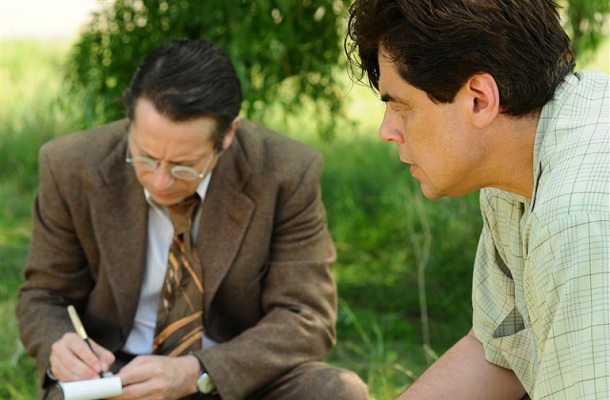
Maathieu Almaric, Bencio del Toro
Professionaly, Devereux appears to have some cloud hanging over him and will not be able to do real psychiatric therapy, only what Meninger calls “counseling.” But since he has an understanding of the Native American mind that few white men have bothered to develop, he’s brought on part time. He has one patient — Jimmy — and he’ll get to talk to him for one hour a day.
At least half of this film consists of Devereux asking questions and Jimmy hesitantly answering. It’s all pretty quiet, measured, and cautious. No big dramatic displays — heck, even when he’s describing something terribly traumatic, Jimmy takes the matter-of-fact approach.
When the two leads aren’t talking the film may offer some dramatic recreations from Jimmy’s past, and it frequently follows the eccentic Devereux during his off-duty hours. Especially intriguing is his affair with an English woman (Gina McKee) who pays him a visit in the heartland.
And though Devereaux and Jimmy make tremendous headway in sorting out the patient’s tangled psyche, it’ takes place not with a clash of cymbals but with the slow accumulation of details that allow a person to change just a bit more with every previously suppressed revelation.
In a way, this film feels like therapy, which makes it inappropriate viewing for the short-attnetion-span crowd. But if you enjoy tremendously insightful acting and a realistic approach to a material that usually is painted with a broad melodramatic brush, “Jimmy P.” is an achingly human experience.
| Robert W. Butler
 Butler's Cinema Scene
Leave a comment