
Bette Davis, Brian Ahern
“Juarez” screens at 1:30 p.m. Saturday, May 24, 2014 in the Durwood Film Vault of the Kansas City Central Library, 14W. 10th St. Admission is free. It’s part of the year-long film series Hollywood’s Greatest Year, featuring movies released in 1939.
The makers of “Juarez” went out of their way to ensure the film would be as historically accurate as possible.
The Warner Bros. research department amassed a 300-volume library of volumes about Mexico in the mid-19th century. Two historians were hired to vet the script being written by Aeneas MacKenzie. When MacKenzie was finished he had a screenplay long enough for two films, so other writers (especially John Huston, who was yet to make his directing debut) were called in to trim it.
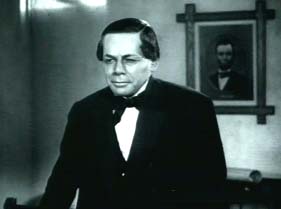
Paul Muni
Well, “Juarez” may be historically accurate. But this 1939 release is also an inflated bore, a history lesson in which the history smothers all the drama.
For starters the film has no center. It’s named after Benito Juarez, who served five terms as president of Mexico and who was the leader of the revolution that overthrew the French-imposed reign of Emperor Maximilian.
The studio brass thought they had a sure thing in Paul Muni, the Oscar-winning actor who was famous for disappearing into the roles of real-life figures like Louis Pasteur and Emile Zola.
But Muni’s Juarez is wooden and stiff, less a human being than a stuffed owl. You’ve got to admire the makeup job that transforms him into a Mexican Indian (it took two hours in the makeup chair every morning), but this performance is borderline robotic.
Juarez comes off not as the film’s hero, but simply as one of several characters vying for attention.
There is, for example, Napoleon III of France (Claude Rains in one of his patented villain roles), a slimy conniver who wants to establish a foothold in the Americas and rigs a Mexican election so that it appears that Mexican people want a king to rule them.
Then there’s Maximilian (Brian Aherne, who was nominated for a best supporting actor Oscar), an Austrian who is tricked by Napoleon into accepting the Mexican crown. Maximilian is portrayed as a decent but easily fooled gentleman. It takes him forever to realize that he’s a puppet monarch being lied to and manipulated by both the French court and wealthy (i.e., anti-democratic) Mexicans.
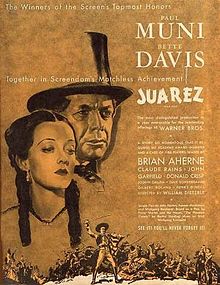 Maximilian’s wife, Carlota, is played by Bette Davis. It’s not much of a part, but at least she gets to go mad toward the end of the film. (Ironically, Davis was going through a bad bout of depression during the filming…perhaps her personal misery informed the performance.)
Porfirio Diaz, one of Juarez’ generals, is played by newcomer John Garfield, who within a few years would emerge as a major star.
And there are other characters portrayed by reliables like Donald Crisp, Gale Sondergaard, Gilbert Roland, and Louis Calhern.
Doesn’t matter. The film is stillborn. Director William Dieterele, who that same year gave us the wonderfully cinematic The Hunchback of Notre Dame, here sticks with a predictable, unimaginative, studio-bound look. One could easily believe he had been assigned to the project against his will.
The film features a big, epic score by Wolfgang Korngold, but mostly it feels phony…like the movie is trying to achieve with music what it can’t pull off in genuine drama.
Warners knew they had a problem when audiences at a test screening panned the picture. “Juarez” was recut, with scenes reshuffled and a new ending shot to make Juarez seem more sympathetic.
Didn’t work.
| Robert W. Butler
 Butler's Cinema Scene
Leave a comment