 “Gone With the Wind” screens at 1:30 p.m. Saturday, August 2, 2014 in the Durwood Film Vault of the Kansas City Central Library, 14W. 10th St. Admission is free. It’s part of the year-long film series Hollywood’s Greatest Year, featuring movies released in 1939.
In the wake of “12 Years a Slave,” is it still possible to enjoy “Gone With the Wind” with the same enthusiasm with which it traditionally has been received?
That’s the question I asked myself as I sat down to watch the film for the umpteenth time…but the first time since seeing “12 Years a Slave.”
Steve McQueen’s 2013 historic drama – based on the true story of a free black man from New York who in the years before the Civil War was shanghaied by slave traders and sold to a Southern plantation owner – was a grueling experience.
Making it particularly effective was the movie’s emphasis not only on the agonies slaves endured, but on the corrosive effect of the “peculiar institution” on the attitudes and personalities of wealthy whites who owned other human beings.
Overnight, “12 Years…” became the definitive cinematic statement about American slavery.
Not that “Gone With the Wind” – either in the form of Margaret Mitchell’s novel or the 1939 Oscar-winning film – was about slavery. In fact, to the extent to which it was possible, the issue of slavery was avoided, glossed over, and trivialized.
The film isn’t history or sociology. It’s a melodramatic page-turner about spoiled rich hellcat Scarlett O’Hara (Vivien Leigh) and her love/hate affair with courtly scoundrel Rhett Butler (Clark Gable).
Watching the film with an eye to how slavery is handled, I’ve concluded that Mitchell and especially the makers of the film had it both ways.
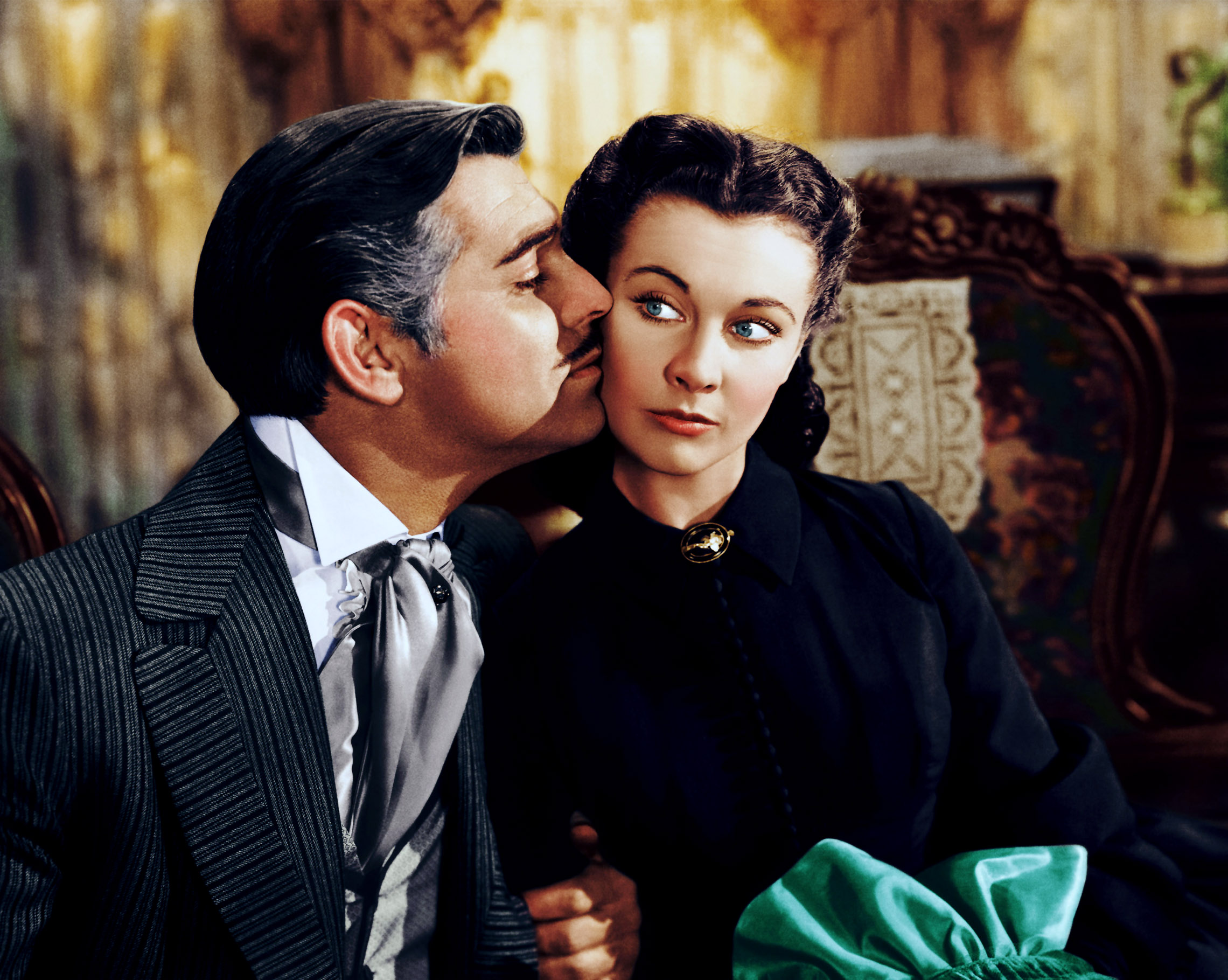
Clark Gable, Vivien Leigh
One the one hand, “GWTW” simply ignores the nasty side of slavery. Neither the book nor the film depicts the physical cruelty that was inherent in slavery – the chains, the forced labor, the whippings. Nor is there even a hint of the sexual exploitation of female slaves by their white masters.
(The O’Haras’ white overseer, played by Victor Jory, is clearly a sadist, but we don’t seem him mistreating the help – though we can imagine the worst.)
Slave owners are presented as genteel, cultured folk. Late in the movie that poor noble dope Ashley Wilkes (Leslie Howard) protests that his clan never harmed their slaves. Apparently they were all one big happy family.
Certainly the master/slave relationships depicted in “GWTW” are amazingly copacetic. The slave foreman, Big Sam, remains inexplicably devoted to Scarlett even after emancipation, saving her from rape by white trash carpetbaggers.
And Mammy (Hattie McDaniel, who won an Oscar for her performance but isn’t even listed in the top tier of cast members in the film’s credits) is Scarlett’s surrogate mother. She may chide and scold, but it’s obviously coming from a loving place. And you must give Mitchell props for creating a black character who spends much of her time bossing around white folk. As the iconoclastic Rhett says of Mammy, she is “one of the few people I know whose respect I’d like to have.”
Historically there were cases of slaves regarded by their owners as family members. But those were exceptions.
Are we really to believe that forced servitude was so benign and fulfilling a way of life that slaves would stick with it without the threat of mistreatment or coercion? Would slaves cooperate without the whip?
In fact, “GWTW” offers just enough hints of slavery’s dark side that you cannot call it a complete whitewash. That’s especially true in the character of Scarlett, who may love her Mammy but who is a ruthless economic exploiter.
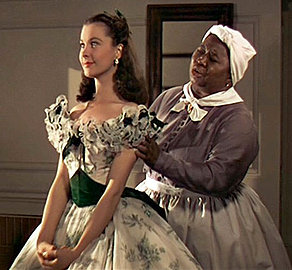
Vivien Leigh, Hattie McDaniel
In her determination to never be hungry again, Scarlett mans her sawmill with cheap prison labor. She countenances the mistreatment of these white men in chains, telling her foreman to do anything necessary to get the maximum results from the poor wretches. Holy cow! It’s white slavery!
And let’s not forget that in Rhett Butler we are given a cynical counterpoint to all the “glorious South” nonsense. The film’s opening credits promise (to the accompaniment of an off screen heavenly chorus) a yarn about “a land of cavaliers and cotton fields…a civilization gone with the wind.”
Yet throughout the picture that rascally realist Rhett scoffs at these fairy-tale notions of chivalry: “All we’ve got is cotton and slaves and arrogance.”
To the extent that they are depicted at all, the film’s black characters are pretty much there for comic relief.
To this day I’m not sure whether I’m appalled or amused by Butterfly McQueen’s helium-voiced ninny Prissy (“I don’t know nuthin’ about birthin’ no babies!!!”). Eddie “Rochester” Anderson plays a coachman who in one slapstick scene chases a rooster around a farmyard. Even Big Sam, Scarlett’s rape-savior who mostly gets neutral treatment, engages in an early conversation with other field hands that smacks of “dumb darkie” humor.
As a daughter of the South, Mitchell was recycling the same attitudes with which she had been raised. She dropped a course at Smith College rather than share the classroom with a black student.
But she was also a party girl and a flapper, and her views about race did evolve. In the 1990s researchers were stunned to discover that in her last years – she died in 1949 at the age of 48 — Mitchell had been a major contributor to a fund to prepare black students for medical school. Apparently she got involved after an Atlanta hospital refused to treat her cancer-stricken housemaid.
As a novel and as a film, “Gone With the Wind” remains popular not because we agree with its racial viewpoint, but at least in part because it is a snapshot of the way most Americans used to think.
And let us not forget that the film is – despite its shortcomings in matters of race – hugely entertaining, with great acting, compelling characters and production values capable of impressing even those of us raised on computer-sweetened cinema (for example, that fantastic crane shot revealing hundreds of dead and dying Confederate soldiers covering the Atlanta rail yard).
The movie is so good, in fact, that it forces us to overlook its faults.
| Robert W. Butler
 Butler's Cinema Scene
I’ve never been the biggest fan of Gone with the Wind.
Don’t get me wrong–it’s a good movie. I have it in my collection, and I occasionally watch it (occasionally, because I can never watch too many 3 hour movies in one sitting. And I don’t watch this in one sitting. I don’t watch my extended Lord of the Rings in one sitting. I can’t. I have to do something else.)
But, I find this movie overrated. Maybe because it, like Citizen Kane, was introduced to me as “the best movie ever made!” So when I watched it (actually, both GwwW and Citizen Kane) I was expecting to watch the best movie ever made!
Having said that, I have most of Vivian Leigh’s movies (I think she made only 12), and I love Clark Gable. GwwW is a gorgeous film. But, it’s another one I watch detached.
(On the other hand, the Carol Burnett show’s “Went with the Wind” is about the funniest thing I’ve ever seen!)
Kat
The portrayal of white slaveholders as normal, even admirable people is GWTW’s biggest fault. Southerners always believed the myth that they treated their slaves humanely. After Margaret Mitchell, Northerners believed it, too, forgetting “Uncle Tom’s Cabin” and the slave narratives published in the 19th century.
Steve McQueen has done something to balance the scales, but “12 Years A Slave” will perhaps be seen by 1% of the number who have seen GWTW. So the myth will continue.
The evil effects of slavery on the slaves are fairly well known, or at least imagined. Little known is the way slavery made monsters out of white overseers and masters, both male and female. Torture, rape, branding, beating, forced marriages and pregnancies, starvation, overwork, chaining … and finally selling down the river. All were used to preserve a privileged lifestyle of people who imagined themselves cavaliers and their ladies. That lifestyle required Southerners to distort Christianity into a creed that justified behavior more in tune with Satan than Christ. It required them to invent a new logic that suppressed the fact that black people are human beings.
And Margaret Mitchell and David Selznick made Americans mourn the passing of that lifestyle and the peculiar institution.