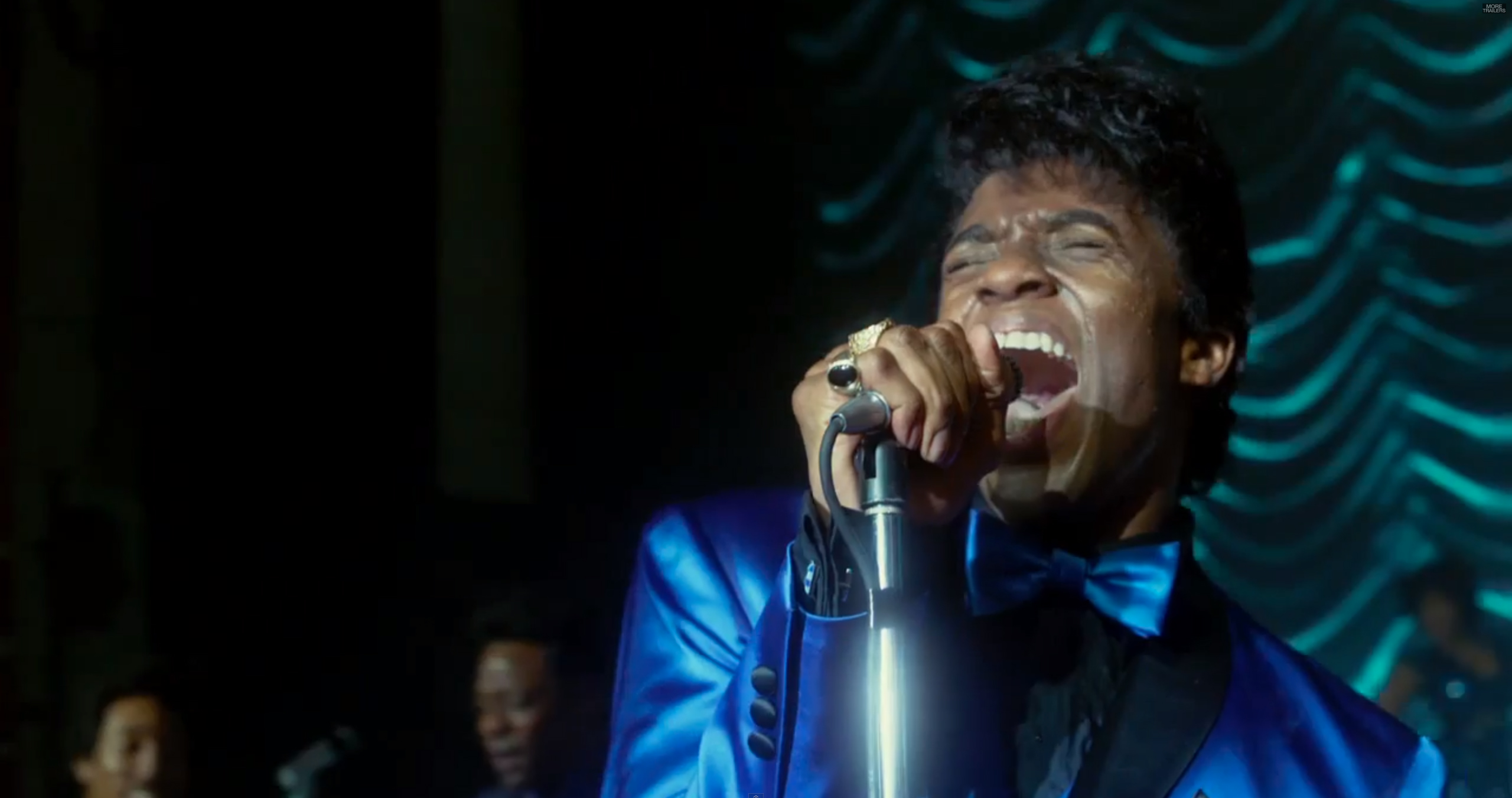
Chadwick Boseman as James Brown
“GET ON UP” My rating: C+ (Opening wide on August 1)
138 minutes | MPAA rating: PG-13
Actor Chadwick Boseman doesn’t look much like James Brown.
They’re both African Americans, yeah, but that’s about as far as the resemblance goes.
But Boseman, who a couple of years back wowed us with his performance as baseball great Jackie Robinson in “42,” pulls off an impressive transformation in “Get On Up.”
He gets some help from a closet full of wigs and funky period clothing, but mostly he acts his way into Brown’s shoes, capturing the movements, the physical attitude, the facial expressions of the late great Godfather of Soul. Viewed from the right angle, illuminated with dramatic stage lighting, Boseman convinces us that he’s the real deal.
Too bad the film of which he is the centerpiece can’t decide what deal it’s talking about.
James Brown was a musical genius, an exacting boss, a wandering and frequently violent husband. He was a bundle of contradictions — compelling and caustic, inspiring and irritating — and the makers of “Get On Up” clearly don’t know what to make of him.
Should they idolize him? Should they knock him off his pedestal?
Perhaps screenwriters Jez and John-Henry Butterworth were limited by the dictates of Brown’s estate and heirs. Or perhaps they simply were unable to find a coherent take on a guy whose rags-to-riches life is the stuff of American legend and whose personal failings were damn near Sophoclean.
They try to mask their wishywashy approach by employing a time-bending narrative that is forever zigging and zagging between Brown’s impoverished (emotionally and financially) childhood and his adult triumphs and misadventures. But without a clear point of view running throughout the picture, “Get On Up” runs out of dramatic steam long before the final credits.
Thank heavens for that superb James Brown songbook, which allows Boseman to perform such killer hits as “It’s a Man’s World,” “Please Please Please,” “Cold Sweat” and “Papa’s Got a Brand New Bag.” I can’t tell if Boseman is doing his own singing here or lip-syncing to original Brown tracks, but the results are mesmerizing. At the very least you’ll come away from the film marveling at Brown’s musical contributions and continuing influence.

Nelsan Ellis
The film begins with the 1988 incident which resulted in Brown spending three years in prison. The Hardest Working Man in Show Business — possibly high — carries a shotgun into an insurance seminar being held in the same strip mall in which one of his many businesses has its headquarters. Holding everyone at gunpoint, Brown demands to know which of the seminar participants has dared to use his private bathroom to make a No. 2.
The scene is played mostly for laughs — though if you were one of those being held hostage by an armed, ranting man you might feel otherwise — and ends with Brown being chased by police.
The movie then zaps back to his childhood in the Georgia woods, growing up in a shack with his mother (Viola Davis) and, when she flees an abusive marriage, his no-good father (Lennie James). Eventually we learn that young James was farmed out to an aunt (Octavia Spencer) who operated a bordello.
There are youthful run-ins with the law, and a friendship with fellow musician Bobby Byrd (Nelsen Ellis) that will survive decades before finally running aground on the rocks of the formidable Brown ego.
But to tell the truth, there is only one real character here…James Brown. Davis, Spencer, Dan Aykroyd and other familiar faces portray characters whose names we never catch and who matter only to the extent that they are hangers on in the grand Brown legend.
How many times was he married? How many children did he have? You won’t find out here.
Director Tate Taylor (“The Help”) and his crew do a fine job of establishing a sense of time and place. The musical numbers have real bite.
But something essential is missing. Maybe one movie isn’t enough to encompass the life and music of James Brown. Maybe it requires one film in which he is a hero, and another in which he’s a heel.
But however you approach it, it needs to be a film with soul. Not just soul music, but genuine soul. And “Get OnUp” hasn’t much.
| Robert W. Butler
 Butler's Cinema Scene
Leave a comment