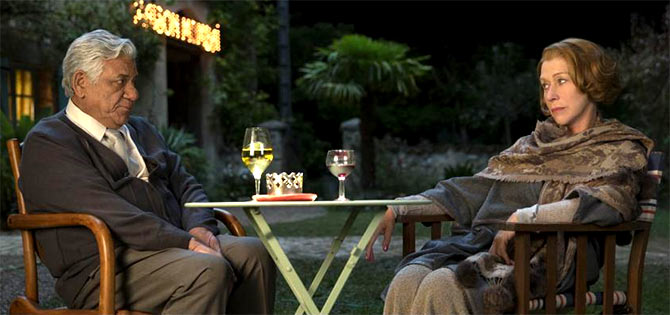
Om Puri and Helen Mirren
“THE HUNDRED-FOOT JOURNEY” My rating: B (Opening wide on Aug. 8)
122 minutes | MPAA rating: PG
Moviegoers are forgiven for approaching “The Hundred-Foot Journey” with foreboding. From the ads one might reasonably conclude that this is yet another middlebrow movie tailor-made to soothe (but never challenge) the sensibilities of the art house blue-hair brigade.
Well, Lasse Hallstrom’s film is definitely middlebrow, and it is certainly soothing — but it’s also very well acted and emotionally potent. It introduces two newcomers (quite possibly the handsomest couple I’ve seen on screen in ages) who will, if there is any justice, become overnight stars. And they are perfectly complemented by two cinema veterans at the top of their game.
Plus, “The Hundred-Foot Journey” is, God help me, life-affirming, albeit without feeling manipulative. (I don’t mind when a movie makes me cry…only when it twists my arm to achieve that effect.)
The widower Kadam (Om Puri) has fled political upheaval in his native India and with his five children has opened a restaurant outside London. But the weather sucks and now they are driving around Europe, trying to find a place to settle down. (Granted, this doesn’t sound like a terribly smart business plan, but since Kadam still converses regularly with his dead wife, you’ve got to assume cosmic forces are in play.)
The family’s van breaks down in a postcard-perfect French burg (it’s got a river, rolling hills and a view of the mountains) and Kadam gloms onto an abandoned building that he believes could become the home for his new Indian restaurant.
Problem is, it sits just across the road (100 feet away, to be precise) from a Michelin-starred French restaurant operated for decades by the widow Madame Mallory (Helen Mirren). Mallory is a shrewish lady who lives and breathes haute cuisine, and she is appalled by the Kadam family’s blaring Bollywood music, the garish colors of their restaurant’s decor, and the heavily-spiced odors that drift across the road and into her stuffy establishment. (“If your food is anything like your music, I suggest you tone it down.”)

Charlotte LeBon
Before long Madame Mallory and Papa Kadam are engaged in a legal and cultural war, employing local ordinances and sneaky practices (she buys up the entire local supply of certain foodstuffs) to undermine the competition. Madame Mallory isn’t necessarily racist, but she is undoubtedly an elitist.
That’s the setup, but it isn’t really the story.
Rather, “The Hundred-Foot Journey” is a coming-of-age yarn about Kadam’s oldest son, Hassan (Manish Dayal), who with no formal training has become a quite brilliant chef. Early in the film he meets Marguerite (Charlotte LeBon), an aspiring chef in the employ of Madame Mallory who, lacking the snobbism of her kitchen colleagues, lends Hassan her collection of French cooking books. He begins toying with classic Gallic recipes, often adding a dash of the exotic spices hauled by the Kadams like precious heirlooms during their quest for a new home. Hassam’s a natural — so much so that he’s offered a gig in Madame Mallory’s kitchen.
This development results in a truce in the Mallory-Kassam feud. Once united in their appreciation of Hassan, the two grown-ups begin to see each other in a more positive, even affectionate light.
Alas, his new job puts Hassam on the outs with Marguerite, who quite rightly sees him as a threat to her own ascension.
In adapting Richard C. Morais’ best-selling novel, screenwriter Steven Knight (whose resume usually runs to gritty/violent yarns like David Cronenberg’s “Eastern Promises,” “Dirty Pretty Things,” and the Jason Statham actioner “Redemption”…but also the uplifting historical drama “Amazing Grace”) has taken a gentle yarn with relatively little conflict and worked the tiny human moments to create a satisfying story about aspiration.

Helen Mirren and Manish Dayal
The film is at heart two love stories — the mature Kassam/Mallory friendship, and the achingly erotic (because it isn’t consummated) romance between Hassam and Marguerite.
Given characters that could easily slide into caricature, Puri and Mirren show why they are among the best actors of their generation.
Puri — whose impressive nose looks like an asteroid that has survived a meteor storm — starts out as a bombastic sort determined not to be taken advantage of. He’s suspicious of foreigners (the irony, of course, is that in France he’s the foreigner) and in his desire to keep his family together he often plays the domineering patriarch. But his heart is in a good place (in a film like this, just about everybody’s heart is in a good place), and given the chance to see his son become a world-class culinary innovator, he gives the boy up. By movie’s end he’s a big sweet puppydog.
Mirren’s Madame Mallory goes through a similar evolution, moving from brittle taskmaster and first-class snob to something like a mother (the character apparently has no children of her own). Mirren actually seems to have made herself gaunt for the performance…Mallory may be a champion of French cuisine but she doesn’t look like she takes much pleasure in eating.
We expect good stuff from the likes of these.
What’s totally disarming are the understated, totally captivating performances of the young lovers. Dayal and LeBon are so pretty — in a natural, non-glamourpuss way — that you could sit them in front of a camera reading cookbooks and they’d still keep our attention. Both possess incredibly big, soulful eyes — now we know what happens to Keane kids when they grow up. Most of all, from their first scene together they have us rooting for them to give way to their emotions and fall head-over-heels in love.
Director Hallstrom, whose specialty has always been character-driven, humanist drama (“My Life As a Dog,” “The Cider House Rules,” “An Unfinished Life,” “What’s Eating Gilbert Grape,” “Salmon Fishing in Yemen”), is perfectly at home with this sort of material, using laughs to leaven a few clunky moments. He can’t quite keep the picture from losing momentum when late in the proceedings Hassam goes off to Paris to make it big, but he pulls out a nice recovery, sending us home in a warm romantic glow.
And while “The Hundred-Foot Journey” has too many different strands to qualify as pure foodie-porn, there are enough scenes of cooking and eating to generate a healthy appetite.
| Robert W. Butler
 Butler's Cinema Scene
Interestingly enough, the indy arthouse filmmakers are young enough to be some people’s grandchildren. Sad to think only blue hairs see their films.