Feeds:
Posts
Comments

Archive for September, 2017

Hugh Bonneville, Gillian Armstrong

“VICEROY’S HOUSE” My rating: B 

106 minutes | No MPAA rating

Gurinder Chadha’s “Viceroy’s House” is more history lesson than viable drama. But it’s compelling history, told with insight, cinematic savvy and a sense of scale that would make David Lean proud.

The screenplay (by Chadha,  Paul Mayeda Berges and Moira Buffini) concentrates on the last days of British rule in India in 1948, and the efforts of the last Viceroy of that country, the famous Lord Louis Mountbatten, to juggle dozens of competing interests to ensure that the new Indian republic gets off to a good start.

As it turns out, this is a fool’s errand, thanks to the perfidy of Mr. Churchill’s government (represented here by actors like Michael Gambon and Simon Callow). which is pulling strings behind the scenes.

But Mountbatten, a supremely decent man as played by “Downton Abbey’s” Hugh Bonneville, is a hopeful, sincere and largely selfless warrior doing what he thinks will be best for millions of Indians.

The film follows two trajectories.  First there’s the arrival of Mountbatten and his Lady Edwina (Gillian Anderson) and his installation as Viceroy amid all the pomp and ceremony of a royal coronation. Unlike virtually all of the Viceroys who served in India over three centuries,  Mountbatten and his wife are concerned mostly with the common good.

While Lord Mountbatten spars and cajoles with the leaders of various factions — historic figures like Mahatma Gandhi, Jawaharlal Nehru and Muhammad Ali Jinnah — his wife turns to humanitarian concerns. Both work to eliminate the Brit racism that seeped through previous administrations. Both seriously try to understand the culture and ethos of the great continent which they are charged with giving away. (more…)

Read Full Post »

“BEACH RATS”  My rating: B

95 minutes | MPAA rating: R

Thirty years ago a film dealing with the subject matter of “Beach Rats” would have been labeled a “gay” film and aimed specifically at audiences looking for  a satisfying coming out story.

Well, that was then.

Eliza Hittman’s second feature (after “It Felt Like Love”) is about a young man who is probably gay, but it’s less obsessed with his sexuality than with his general cluelessness.

Frankie (Brit actor Harris Dickinson) lives in Brooklyn with his mother, younger sister and soon-to-be-dead cancer-riddled father. He’s out of school and jobless, and spends his summer hanging out on the beach with a few of his childhood friends, know-nothings whose world view is limited to vaping and the availability of pot and pussy.

Frankie has a secret. He’s been visiting online gay chatrooms, tentatively exploring the possibilities. Every now and then he’ll arrange for a tryst with one of these men, who are clearly smitten with Frankie’s body and all-American good looks.

Writer/director Hittman takes it for granted that Frankie’s gay.  But like a lot of young people he’s not sure what he is.

Early in the film he’s picked up by a local girl, Simone (Madeline Weinstein), who spots him at a Coney Island fireworks display and zooms in.  Frankie begs off that he’s too tired to have sex, but over several weeks he and Simone will get intimate.   It’s hard to say whether he enjoys the sex or simply views it as good camouflage, throwing off any friends or family members who suspect he swings another way.

If our protagonist were, say, a middle-class suburbanite, he’d probably find himself in an LGBT teen support group.  But Frankie’s living in a macho-drenched working-class corner of Brooklyn. About all he knows about being gay is that it’s majorly uncool with his vaguely criminal buds. (more…)

Read Full Post »

Karolina Gruszka

“MARIE CURIE: THE COURAGE OF KNOWLEDGE” My rating: B

100 minutes | No MPAA rating

Well, this certainly isn’t your Greer Garson version of physicist Marie Curie.

Marie Noelle’s film is about the trials the brilliant Curie endured because she was a woman in a man’s world; it’s also about the  affair with a married co-worker that nearly scuttled her chances for a second Nobel Prize and admission to the French Academy of Science.

This combination of feminism and heavy breathing could have been a recipe for diaster.  But Noelle and co-writer Andrea Stoll keep all the parts in narrative and emotional balance, with the result that “Marie Curie: The Courage of Knowledge” feels low-keyed and classy even when its leading lady is lounging about in the altogether.

The film begins with the idyllic marriage of Marie (Karolina Gruszka) and Pierre Curie (Charles Berling), partners both in life and in the lab. They’re raising a large family, experimenting with radium as an anti-cancer therapy, and sharing a Nobel Prize for science. In just a few quick, impressionistic scenes director Noelle depicts their blissful, fulfilling lives.

Then Pierre is killed in a street accident, and Marie is left to continue her work alone.  Well, not exactly alone.

Her colleague Paul Langevin (Arieh Worthalter)  provides intellectual and, to a degree, moral support as Marie comes to terms with Pierre’s death. Eventually the attraction gets physical.

Paul has a rather common wife who wants him to give up pure science for a well-paying job in industry. Eventually the wronged spouse steals love letters between her husband and Marie and launches a very public scandal. Marie’s sexual transgression only proves to the stick-in-the-muds of academia and science that a woman has no business in their calling. (That plenty of male scientists keep a mistress without anyone raising an eyebrow is just one more example of the double standard at work.)

(more…)

Read Full Post »

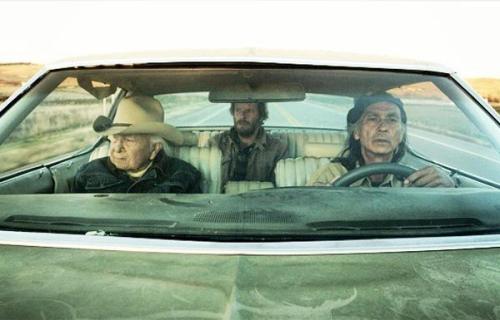
David Bald Eagle, Christopher Sweeney, Richard Ray Whitman

“NEITHER WOLF NOR DOG” My rating: B-

100 minutes | No MPAA rating

In attempting to de-romanticize white notions of Native Americans,  “Neither Wolf Nor Dog” often comes perilously close to having just the opposite effect.

You can only hear so many words of wisdom from a 95-year-old Lakota elder before the mind starts wallowing in cliches about the noble red man.

Happily Steven Lewis Simpson’s film sidesteps most of the major cultural traps that make negotiating this particular landscape so dangerous.

This low-budget effort — filmed mostly on South Dakota’s Pine Ridge Reservation — is one of the more perceptive films about white/Indian relationships.

Based on Kent Nerburn’s semi-autobiographical novel, the bulk of “Neither Wolf…” is a reservation road trip in which an outsider gets a crash course in modern Indian ethos.

(more…)

Read Full Post »

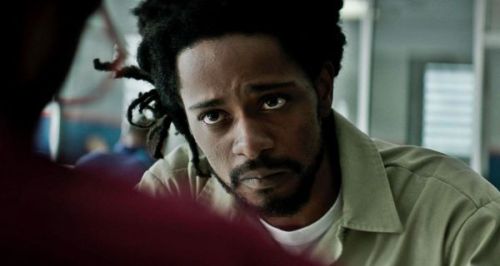
Lakeith Stansfield

“CROWN HEIGHTS” My rating: C+ 

94 minutes | MPAA rating: R

The real-life miscarriage of justice depicted in Matt Ruskin’s “Crown Heights” is both outrageous and all too common.

In 1980 Colin Warner, a native of Trinidad living in Brooklyn, was implicated in the shooting death of another young man. A witness claimed that Warner drove the killer’s getaway car; the victim’s brother said Warner’s mug shot (Warner had a history of car theft) looked like one of the shooters.

Warner had never met any of these individuals and was at a loss to explain his predicament. Even the detectives who arrested him  suspected that he probably didn’t do it…but they needed to clear the case and move on.

As a result, Colin Warner spent nearly two decades in prison before an extraordinary effort on the part of one of his friends led to his release.

“Crown Heights” is basically a legal procedural that takes a docudrama approach. This is both its strength and its weakness.

Writer/director Ruskin appears to hew closely to the facts of the case. But he also refuses to speculate on his characters’ inner lives…with the result that the film, despite its incendiary nature, feels emotionally neutral.

It’s easy enough to become furious about what happened to Colin Warner; but as drama “Crown Heights” leaves us wanting.

(more…)

Read Full Post »

“IT” My rating: B-

135 minutes | MPAA rating: R

First, let’s all take a slow, non-hyperbolic breath.

Rarely has a mere horror movie gotten the advance raves and widespread cultural attention being lavished on “It,” the new film based on Stephen King’s novel (it was filmed once before, for a 1990 TV miniseries).

Well, it’s a good movie. Not great. It’s way overlong and trips over a few narrative dead ends.

It’s not as interesting or satisfying as either “It Follows” or “Get Out,” two recent groundbreaking examples of the horror genre.

But “It” — written by Chase Palmer, Cary Fukunaga and Gary Doberman and directed by Andy Muschietti (“Mama”) — does hit the sweep spot between jump-in-your-seat thrills and the sort of Spielberg-influenced 1980s adolescent adventure most recently championed by Netflix’s hit series “Stranger Things.”

Basically you’ve got a group of pre-pubescents taking on a supernatural evil that resurrects every three decades or so to snatch unwary children. This creature is a sinister circus clown called Pennywise (Bill Skarsgard) who lives in a small town’s sewers and marks his approach with red balloons.

There’s no explanation of Pennywise’s back story; the screenplay presents him as the pure embodiment of every child’s deepest fears (making him a clown was a brilliant stroke on King’s part) and pretty much leaves it at that.

Dramatically, “It” is a deft balancing act between growing creepiness, an often hilarious examination of youthful behavior, and a compassionate (but superficial) look at adolescent angst.

The leader of these young misfits is Bill (Jaden Lieberher, so terrific in “St. Vincent” and “Midnight Special”), whose little brother vanished a year earlier when he ventured too close to a street grating during a rainstorm. Motivated by sibling love, the stuttering Bill is determined to face his own fears to stop Pennywise’s quiet rampage. (more…)

Read Full Post »

« Newer Posts