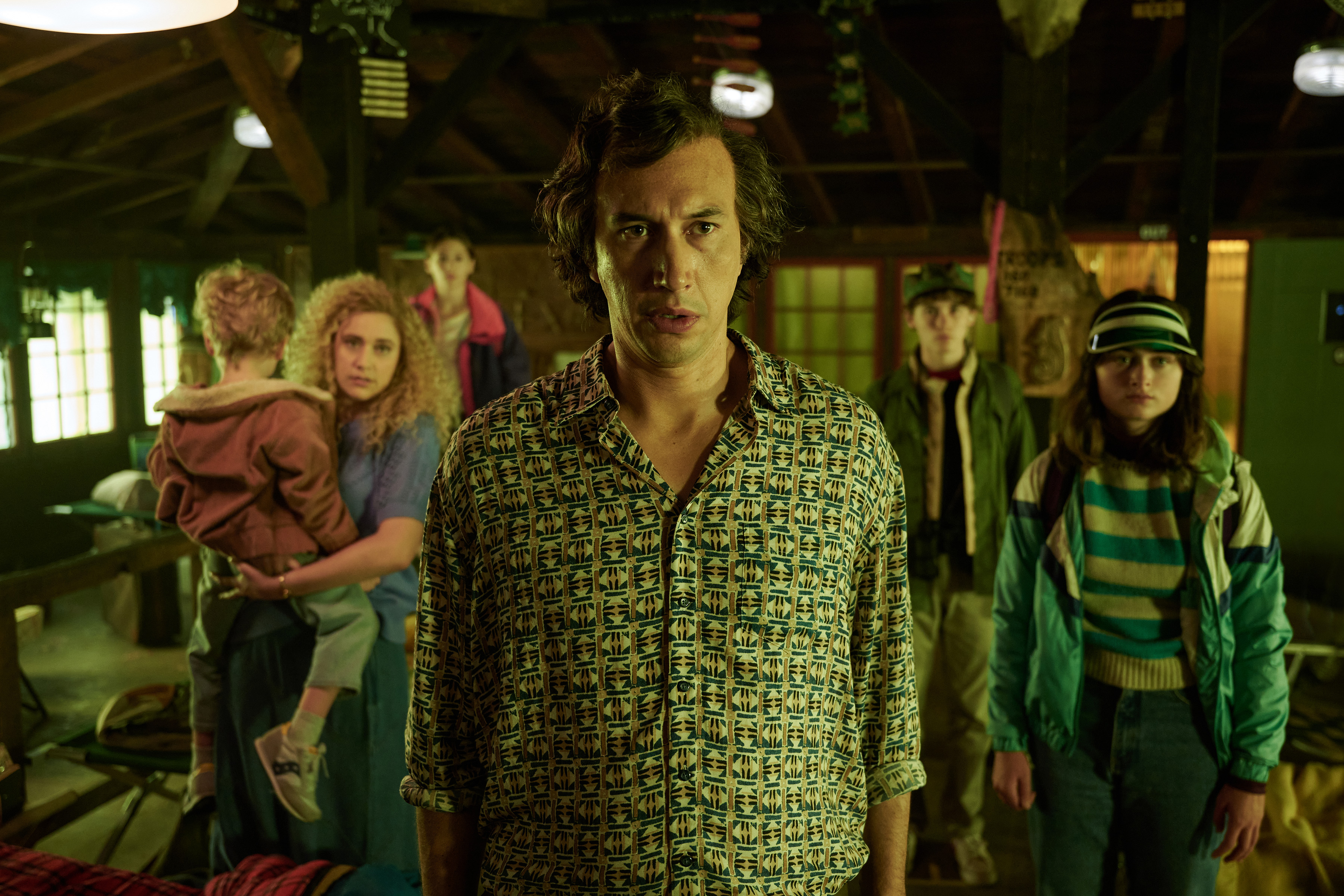
Greta Gerwig, Adam Driver and family
“WHITE NOISE” My rating: C+ (Netflix)
136 minutes | MPAA rating: R
The consensus has long been that Don DeLillo’s novel White Noise defies movie adaptation.
Now we have writer/director Noah Baumbach’s take on the 1985 book and…well, the consensus was right.
There are several passages in this long meandering effort that grab the viewer by the eye and the ear and won’t let go.
But by the end most watchers will shrug and wonder, “What was that all about?”
Set in the early 1980s, the film follows a middle-class American family. Father Jack (Adam Driver) teaches at the picturesque College on the Hill where he has pioneered the field of “Hitler studies” despite his inability to speak, read or write German.
Mom Babette (Greta Gerwig) convenes exercise classes for seniors. And there are four kids, the most interesting of whom is Heinrich (Sam Nivola), a teen whose encyclopedic knowledge of a wide variety of subjects makes him some sort of ambulatory information retrieval system. (This is an era before personal computers, much less smart phones.)
The gently mocking tone is set early on as we eavesdrop on a classroom presentation by one of Jack’s colleagues (Don Cheadle), who maintains with a straight face that movie car crashes epitomize American optimism, that despite the carnage they are “brimming with the spirit of innocence and fun.”
It’s a nonsensical argument that only seems plausible because of the seriousness and erudition with which it is delivered…indeed this college community is crammed with chatty pedants, many of whom inexplicable wear their academic gowns not only to classes but to the campus cafeteria, and all of them so wrapped up in their arcane specialities that it’s a wonder they can dress themselves.
If Jack’s academic world flirts constantly with the absurd, his family situation is cozy. They’re a loving if eccentric bunch.
“Life is good” Babbette says during a post-coital cuddle.
Yeah but that won’t last. The collision of a tanker truck and a freight train releases a cloud of …well, something. Everyone at College on the Hill and in its environs are told to get out of Dodge, like yesterday.
So family members pile into the sedan, only to find themselves in the world’s biggest traffic jam. Baumbach conjures up some pretty interesting imagery here while delivering an homage to Godard’s “Weekend” (home of the traffic jam to end all traffic jams).

When they’re not outrunning the “airborne toxic event,” Jack and crew are establishing a new world order at a series of refugee camps for the dislocated.
In its third act the film shifts into a mystery of sorts, with Babette addicted to a new and untested antidepressant, and Jack going Sherlock Holmes to find her dealer.
By the time “White Noise” reaches the two-hour mark many a viewer will be tempted to bail. Baumbach’s effort is kinda funny, kinda romantic but way too diffuse to really grab our emotions.
But wait…he’s saved the best for last. The film’s final title sequence is a long, massive dance number set in the town’s A&P where the products appear not to be organized by type but rather by the colors of their packaging. It’s a marvelously entertaining, giddily addictive passage that somehow celebrates American consumerism while satirizing it. And it will send you out with a big stupid grin on your mug.
| Robert W. Butler
 Butler's Cinema Scene
I’d give it a D at best. Couldn’t last beyond the first 15 minutes, which is very unusual for me. The dialogue was overly theatrical and poorly timed.
BTW, thanks for your continuing reviews. I hit 80 this year and still editing poetry and fiction/nonfiction. You used to be in the exercise class at Landon Center.
Why are so many films these days done in that sardonic self-conscious tone? And where are the character-driven films?
Thanks again,
Maril Crabtree
http://www.marilcrabtree.com http://www.marilcrabtree.com