Feeds:
Posts
Comments

Archive for January, 2023

Zen McGrath, Laura Dern, Hugh Jacckman

“THE SON” My rating: C+ (In theaters)

123 minutes | MPAA rating: PG-13

The performances are strong. The subject matter is important. The execution is, well, fine.

But “The Son” is the most unpleasant, upsetting two hours I’ve spent watching a movie in months. For all of its strong elements, the damn thing is so disheartening and joyless that I’m loathe to revisit the memory just so I can write this review.

The latest from director Florian Zeller (like last year’s “The Father” it is adapted from a Zeller play, once again with an assist from Christopher Hampton) addresses the issue of teen depression. It’s almost brutally insightful, and not the least bit encouraging.

Peter Miller (Hugh Jackman) is an executive with a Manhattan-based charity. He has recently married his second wife, Beth (Vanessa Kirby) and together they have welcomed to their lives a baby boy.

But Peter’s cozy world comes crashing down when he is approached by his ex, Kate (Laura Dern), who reports that their teenage son Nicholas (Zen McGrath) is in trouble at school. More specifically, he hasn’t been to class in a month. The kid leaves home every morning and God knows where he spends the day.

Peter doesn’t need this, but he’s a decent guy who genuinely loves his firstborn and wants to do the right thing. He invites Nicholas to move into his place (new wife Beth is surprisingly amenable…she’s a decent person, too) and enrolls him in a new school.

But here’s the thing. Nicholas is tormented, unhappy, friendless. He cannot find words to express his feelings, and rather than share them he prefers isolation.

Peter tries to put an optimistic face on all this, but he’s simply denying the inevitable. And the pressure is starting to unravel both is career and his marriage.

Zeller’s narrative nails the pain and frustration of parents incapable of alleviating their child’s misery. And young McGrath delivers a borderline brilliant depiction of a kid whose unhappiness has led him down an antisocial path (among other things he’s a genius at parental manipulation). Watching this performance we’re jerked back and farther between compassion and indignation — exactly the emotions the adults in his life are experiencing.

Though Nicholas is the clockwork that makes the movie tick, “The Son” also serves as a personality study. Jackman has spent so much of his career in Spandex that it’s easy to forget that he’s a solid dramatic actor. A scene in which Peter visits his semi-estranged father — played by Anthony Hopkins as a sarcasm-dripping capitalist elitist — goes a long way towards establishing why Peter operates in the not-for-profit sphere and why he’s determined to be a genuine father to Nicholas.

But sometimes broke cannot be fixed.

“The Son” does contain one spectacularl improbability. Ask yourself…if you were the parent of a suicidal adolescent, would you keep a loaded firearm in the laundry room?

Didn’t think so.

| Robert W. Butler

Read Full Post »

WOMEN TALKING” My rating: B + (Theaters)

104 minutes | MPAA rating: PG-13

True originality in filmmaking may be impossible. After a century plus of cinema most of the easy fruit has been picked; it takes something pretty special to make us sit up straight and pay attention.

“Women Talking” does that with regularity. It’s a mix of poetic parable and docudrama that hits an emotional/intellectual sweet spot, leaving the viewer with a heady mix of feelings unlike anything I’ve experienced.

Written and directed by Sarah Polley (it’s based on the nonfiction book by Miriam Toews, who shares screenplay credit), “Women Talking” is inspired by real-world events. A decade ago in Bolivia the women of a Mennonite community realized that some of their menfolk had been dosing them with animal tranquilizers and raping them in their sleep.

This film (the setting appears to be rural Canada) imagines how those women — purposely uneducated but by no means unintelligent — might gather to decide whether to stick with their religious community or seek lives in the greater world few know much about (they’ve had no radio, no TV, no Worldwide Web).

“Women Talking” opens with a disturbing image, an overhead shot of the maiden Ona (Rooney Mara) awakening to find her legs and bedclothes smeared with blood.

Cut to a man cowering in a corncrib and being beaten by the furious Salome (Claire Foy); other men have to pull her off the miscreant lest she kill him.

In just a few carefully selected moments the film gives us the lay of the land. The men have gone off to town to bail out their lecherous brothers arrested by the cops. For a few hours the women are left alone to make a choice.

Do they forgive the transgressors and carry on as if nothing had happened? Do they stay in the colony and fight the societal structure that has always limited their ambitions? Or do they pull up stakes and move out, taking with them the younger children?

The bulk of “Women Talking” is exactly that. A dozen or so women retreat to a hayloft overlooking the fields to debate their future. Interestingly enough, none exhibits religious doubts; rather, their beef is with men who don’t live up to their half of the bargain.

Some women — embodied by the scar-faced Janz (Frances McDormand) — will stay no matter what the others decide. They simply cannot fathom a life other than the one they’ve experienced in the colony.

Salome, whose violent temper we have already witnessed, bristles with defiance, sneering at admonitions to behave with traditional feminine submission and restraint. “I’ll stand my ground and deal with God’s wrath if I have to,” she seethes.

Mariche (Jessie Buckley) is torn between fury and fear. Her husband (like the other men, we see him only glancingly, as if out of the corner of our eye) enforces household rules with his fists. If she attempts to leave with their children might be the last thing she ever does.

Striking a more conciliatory tone is Ona, now pregnant by one of her nocturnal molesters. Despite this she exudes a preternatural calm — you can’t help thinking of another virgin who found herself with child.

Ben Whishaw, Rooney Mara, Claire Foy

The debate is overseen by Agata (Judith Ivey), the oldest of the women. There are some teenage girls eager to bail on the colony if given the chance. A bit of a wild card is Greta (Sheila McCarthy), a benign eccentric who mostly wants to talk about her beloved buggy horses.

There is but one man to witness all this. August (Ben Whishaw), the colony’s school teacher, has been brought in to take notes on the proceedings (apparently none of the women can read or write). This gentle soul offers advice when asked and quietly worships Ona from afar…clearly he is hopelessly in love.

“Women Talking” could feel claustrophobic and stage bound, but Polley periodically takes us outside to mingle with the colony’s children who are awaiting their mothers’ decision. Sometimes the camera roams the rows of corn or lifts overhead like a hovering bird.

Luc Montpellier’s photography employs a desaturated color scheme; the absense of bright hues somehow focuses our senses on the issues and personalities at hand. Similarly, Hidur Gudnadottir’s quietly evocative musical score suggest a world of simple pleasures — acoustic guitar, hammered dulcimer and chimes that ultimately subsume into a piece for string orchestra.

Polley and Toews string it all together with voiceover narration provided by one of the colony’s adolescent girls (I was reminded of Linda Manz’s narration for Terrence Malick’s “Days of Heaven”). This monologue is in the form of a letter to Ona’s unborn child.

All this masterfully builds into a quietly devastating emotional crescendo, sending us off with a rare mingling of sadness and hope.

| Robert W. Butler

Read Full Post »

“A MAN CALLED OTTO” My rating: B (In theaters)

126 minutes | MPAA rating: PG-13

Marc Foster’s “A Man Called Otto” is a remake of the 2015 Swedish film “A Man Called Ove,” which was based on the international best-seller by Fredrik Backman.

Aside from being set in America instead of Sweden, “Otto” feels like a shot-for-shot copy of the earlier film, with only a few minor variations (a gay character is now trans, an Iranian woman in the European version is Latino this time around).

Both films juggle black comedy and heart-tugging sentiment, both feature a Scrooge-ish fart who in old age discovers a sense of compassion for his fellow man.

Given the overwhelming similarities between the two films, one might reasonably ask the point of a remake. Well, here it is in four words:

Tom Hanks.

Mariana Trevino.

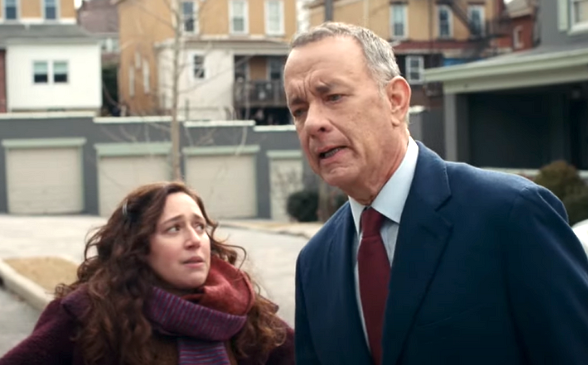
Hanks, among our most affable actors, is cast against type as a dour grinch. A recent widower, Hanks’ Otto fills his days with routine, patrolling the housing estate of which he is de facto manager. He’s continually calling his fellow residents to task for parking improperly, failing to sort their trash, and for just being hopeless morons in general.

Otto, you see is a proudly competent American male (he’s got a garage full of tools for any crisis, and he keeps his 50-year-old Ford humming in tip-top shape). He’s utterly contemptuous of everyone else, an attitude that has only grown stronger in the year since his beloved wife Sonya passed.

Early on we discover that Otto is bent on self-destruction. He’s given suicide a lot of thought, and before the film is over he’ll have tried to off himself with a rope around the neck, with poisonous car exhaust, and with a faceful of buckshot.

But every time he’s ready to do the deed (having laid out plastic sheeting to minimize cleanup) Otto is interrupted by one of his neighbors who needs something of him.

Mariana Trevino, Tom Hanks

Enter Mariana Trevino as Marisol, who moves in across the street with her adorable kids and doofus husband. From his first cranky insult, Marisol has Otto’s number, and over the course of the film she will be the prime mover in his reluctant reclamation (you know Otto’s on the mend when he’s adopted by a stray tomcat…you can’t fool animals).

A Mexican actress with mostly TV credits, Trevino delivers a star turn which should earn her an Oscar nomination. She’s funny, soulful, wise and about as sexy as her pregnant state will allow. And absolutely believable. The complete package.

A good chunk of the film is devoted to the courtship decades earlier of Otto (played as a young man by Truman Hanks — yep, Tom’s kid) and Sonya (Rachel Keller); we learn that the guy has always been socially awkward but that Sonya excelled at drawing out his tender side. If I have a major complaint it’s that I’m not sure I can square the young Otto with the misanthrope he’s become.

But that’s a minor qualm. For the most part “…Otto” works quite well, allowing us to bask in Hanks’ reassuring presence while introducing us to a fresh face who could very well become an audience favorite.

| Robert W. Butler

Read Full Post »

Brendan Fraser

“THE WHALE” My rating: B- (Theaters)

117 minutes | MPAA rating: R

Yes, Brendan Fraser is terrific in “The Whale.” So terrific that his stellar performance accentuates the picture’s overall shortcomings.

The latest from director Darren Aranofsky (“Pi,” “Requiem for a Dream,” “Black Swan,” “The Wrestler”) is a claustrophobic pressure cooker of a drama.

Adapted by Samuel D. Hunter from his decade-old Drama Desk Award-winning play, “The Whale” unfolds almost exclusively in the living room of a suburban home occupied by Charlie, an immense blob of a man who survives on pizza and weighs so much it’s a struggle to stand up.

Charlie pays the rent by convening an on-line literature class, imparting his hard-earned wisdom about writing to college kids who have never laid eyes on him. Ashamed of being seen, he lies that his computer camera has gone haywire.

Over the course of the film Charlie will interact with several individuals.

The first of these is Liz (Hong Chau), a registered nurse and the sister of the man Charlie loved and lost. The compassionate but tough-loveish Liz is the closest thing he has to family or friends; she drops by almost daily to deliver food and observe Charlie’s physical deterioration. His blood pressure is off the charts, he wheezes with every breath, and Liz urges him, without success, to check into the hospital.

And there are unexpected guests.

Thomas (Ty Simpkins) is a young missionary from a nearby church — Charlie regards it as a cult — who drops by to proselytize and, despite Charlie’s rejection of his religious message keeps coming back.

Sadie Sink

Then there’s Charlies teenage daughter Ellie (“Stranger Things'” Sadie Sink), an angry young woman who hasn’t seen her father for a decade (not since he ran off with another man) and now observes his blubbery state with a jaundiced eye and a sharp tongue. Charlie is thrilled to see his offspring (Ellie’s mom cut him out of her life). He attempts to soften her up by noting that he has more than $100,000 in savings earmarked for her use.

Finally there’s a late appearance by Charlie’s ex, Mary (Samantha Morton), who is furious at the thought of a father/daughter reconciliation — not the least because she believes Ellie’s cynical snideness is outward manifestation of an evil soul (!!??!!).

With its single set and clockwork introduction of new characters, “The Whale” is more a filmed play than a fully cinematic experience.

Which is fine. My beef with the material is that the characters are more representative of points of view than of individuals, and their introductions into the story feel so carefully thought out and manipulative that there’s little or no sense of spontaneity. It all feels a little canned and preordained.

On the plus side, the story — and Fraser’s performance — humanizes the sort of individual who carries a boatload of societal shame and disapproval. “The Whale” suggests that Charlie wasn’t always morbidly obese, that he began binge eating after the death of his lover. Now in failing health, he’s desperate to rebuild bridges with his estranged family.

Despite a bulbous fat suit and layers of prosthetic jowls, Fraser uses his voice and expressive eyes to bring Charlie’s interior world to life. It’s an extraordinary performance, sad but knowing and leavened with bursts of self-deprecating humor.

| Robert W. Butler

Read Full Post »