Feeds:
Posts
Comments

Archive for March, 2023

Nigel Thatch as Malcolm X, Forest Whitaker as Bumpy Johnson, Giancarlo Esposito as Rep. Adam Clayton Powell

“GODFATHER OF HARLEM” (Hulu): The great thing about our current streaming situation is that if you’re willing to wait, just about everything you want to see eventually pops up on one of your subscription sites.

So it is with “Godfather of Harlem,” which debuted in 2019 on Epix (I wasn’t going to subscribe for just one show). Now the first two seasons have migrated to Hulu.

Based on the career of real-life gangster Ellsworth “Bumpy” Johnson, the show’s title deliberately  references that greatest of American crime movies, “The Godfather.”

Like that Francis Ford Coppola landmark this is a sprawling saga that contrasts its protagonist’s bloody profession against the shifting currents of his family situation. What makes “Godfather of Harlem” special is its setting — the early 1960s — and its emphasis on Civil Rights and the black experience.

Bumpy is portrayed by Forest Whitaker, whose onscreen charisma helps sell a character who, let’s face it, is getting rich off the suffering of his own people. Bumpy used the notorious French Connection to funnel heroin into the inner city; he seems to have had no qualms about this, even when his own daughter became an addict.

Indeed, my biggest beef with Season 1 is that it totally blows off the moral implications of its hero’s choices.  I’m happy to report that Season 2 finally digs into Bumpy’s moral ambivalence.

What makes the show noteworthy is not its gangster cliches but its rich depiction of an era.  

Bumpy’s main nemesis is Mafia crime boss and dyed-in-the-womb racist Chin Gigante (a marvelously loathsome Vincent D’Onofrio). His two greatest allies are a U.S. Congressman, the womanizing, heavy-drinking Rev. Adam Clayton Powell (portrayed with palpable glee by Giancarlo Esposito) and the Nation of Islam maverick Malcolm X (Nigel Thatch), perhaps the most ethically grounded character in sight.

Season One also features a Romeo & Juliet love affair beetween Gigante’s daughter (Lucy Fry) and a black r&b singer (Kelvin Harrison Jr.). Race relations being what they were, the description “star-crossed” is wholly appropriate.

The performances are top notch.  Especially loved Chaz Palminteri as mob bigewig Joe Bonanno and the late Paul Sorvino as boss of bosses Frank Costello. Look also for Deric Augustine’s turn as young Cassius Clay.

Jason Segel, Harrison Ford

“SHRINKING” (Apple TV):  How’s this for a pedigree?  

“Shrinking” was created by actor Jason Segel, screenwriter/actor Brett Goldstein (“Ted Lasso”) and veteran TV producer Bill Lawrence (“Scrubs,” “Cougartown,” “Ted Lasso”)…and as you might guess from that lineup, it is wickedly funny with a big ol’ heart.

Segel stars as Jimmy, a recently widowed psychiatrist struggling to serve his patients (among them KC’s Heidi Gardner) while bringing up a teenage daughter (Lukita Maxwell) who sees through his every pathetic ruse.

Sadsack Jimmy shares the mental health suite with his mentor Paul (Harrison Ford…way funnier than I thought possible) and the adorably chatty Gaby (Jessica Williams). Those who maintain you have to be a bit crazy to succeed in the psychology racket will find ample confirmation.

(Just occurred to me…”Shrinking” is the old Bob Newhart-as-psychologist show on steroids…with a Viagra chaser.)

Jimmy’s circle also includes his sardonically-inclined neighbors (Christa Miller, Ted McGinley),  a War on Terror veteran with anger issues (Luke Tennie) and Jimmy’s enthusiastically out attorney (Michael Urie).

As was the case with both “Scrubs” and “Ted Lasso,” I’ve fallen in love with the show’s characters — not to mention its vaguely stressed-out  humanism and its intriguing look into the behind-the-scenes nuts and bolts of psychiatry.
Mark Addy (center)

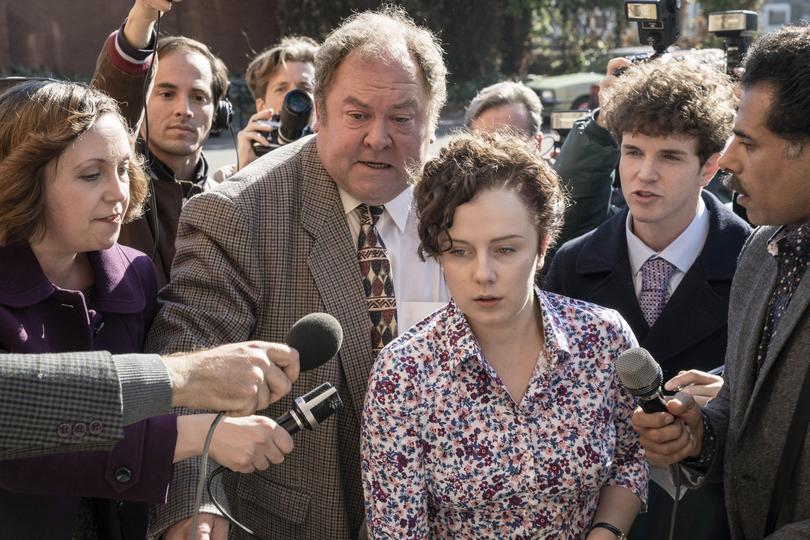
“THE MURDERS AT WHITE HOUSE FARM” (HBO Max): The 1985 murders of five members of an Essex farm family are the basis for this six-episode series featuring the great Mark Addy (Robert Baratheon for you “GoT” geeks) as a rumpled police detective who bucks his superiors and public opinion to dig into the case.

In real life things were resolved with the conviction of a family member, but the series has just enough flexibility to leave us wondering if, in the end, they got the right guy.  

In any case, the show offers a pantry full of interesting characters and a whole slew of good perfs.

| Robert W. Butler

Read Full Post »

“WOMEN AT WAR”(Netflix):  Four French women — a prostitute, a nun, a fugitive from the law and a well-to-do wife and mother — find their world upended with the outbreak of World War I in this impeccably produced eight-parter.

“Women…”  (in French the title is “Les Combattantes,”  which I much prefer) seamlessly blends brutal realism with soap opera-ish plotting;  the results are wildly entertaining.

Set in the Vosges region of France in the early days of the conflict (this was before things bogged down in the awful limbo of trench warfare), the series gives us female protagonists struggling to survive in the absence of their menfolk.

Caroline (Sofia Essaidi) is left to run the family’s truck factory while her husband goes off to war. Plus she struggles to hide her disreputable past from his disapproving family.

Nurse Suzanne (Camille Lou) is on the run from the law after a patient dies during an illegal abortion; she takes the identity of a dead woman and begins treating wounded soldiers at the convent/hospital run by the tormented Mother Agnes (Julie De Bona), who finds herself questioning her vows when she falls for a shellshocked patient.

Meanwhile prostitute Marguerite (Audrey Fleurot) silently watches over the son she abandoned twenty years earlier…the kid is now a soldier stationed nearby. 

The series is crammed with intrigue, romance, close calls and some very well staged battle scenes. What you’ll remember most is the ghastly parade of mutilated bodies.

Staunchly feminist without making any big speeches, the series gives us menfolk who range from a decent army surgeon to a skin-crawling pimp, a predatory priest, a revenge-obsessed police detective and a dissipated rich boy. Even the villains are presented as complex characters.

Toss into the mix French cinematic royalty like Tcheky Karyo and Sandrine Bonnaire, and you have an absorbing historic piece that blends the epic and the intimate.

Itzuiar Ituno

“INTIMACY” (Netflix): Also carrying a feminist cudgel is the Spanish eight-parter “Intimacy.”

Part political thriller, part angry dissection of contemporary male privilege, the show centers on Malek (“Money Heist’s” Itziar Ituno), deputy mayor of Bilbao. She’s a tough, talented woman aiming to run the city, but her plans are threatened with the release of a video showing her having sex on a French beach with a man not her husband.

The crisis has implications for both her career and her family, but is only the starting point for a half-dozen subplots centering on wronged women.

A high school teacher (Patricia Lopez Arnaiz) looks for answers to the suicide of her sister (Veronica Echegul), who was humiliated when a years-old sex video goes viral among her coworkers at a factory.

Malek’s teen daughter (Yune Nogueiras) is dealing with a jerk boyfriend who has shared their sexting photos with classmates.

And a female police detective specializing in sex crimes (Ana Wagener) — smells a bigger conspiracy in Malek’s sexual outing.

“Intimacy” offers some great roles for women.  The guys — not so much.  The male characters are much less nuanced, ranging from outright thuggery to bland nice guys.

At least there’s Malek’s husband Alfredo (Marc Martinez), torn between anger at his newfound status as poster boy for cuckoldry and his rueful continued support of his wife’s ambitions.

“Behind every great woman,” he shrugs, “is an emasculated man.”

“THE INVESTIGATION”(Hulu):  That old reliable the police procedural gets an inspired overhaul in this Danish miniseries, a docudrama recreation of one of that country’s most notorious murder prosecutions.

2017’s “submarine case” centered on the death of Kim Wall, a journalist who was last seen getting onto a homemade submarine owned and operated by a Copenhagen industrialist.  Days later her torso — sans head and limbs — was found floating in Koge Bay.

The six episodes from writer/director Tobias Lindholm center on the efforts of a homicide detective and a public prosecutor  (Soren Malling and Pilou Asbaek, both veterans of the excellent “Borgen”) to find enough evidence to indict the rich creep.

But “The Investigation” departs from every other crime drama in never depicting either the criminal or the victim.  We hear about the cops grilling the suspect…we never see it. As for the dead woman, we meet her grieving parents, but only see a photograph of her during the closing credits of the final episode.

Mostly the show zeroes in on the nuts and bolts of police investigation and the case’s flabbergasting million-to-one payoff:  the cops placed cadaver-smelling dogs on boats that crisscrossed the bay for days until they picked up the telltale gases of human body parts decomposing beneath the waves.

Driving the whole enterprise is the dogged determination of the homicide detectives, who fight through numerous reversals and dead ends — along the way risking their own mental/emotional stability — to get justice for the dead woman.

| Robert W. Butler

Read Full Post »

Charlbi Dean, Harris Dickinson

“TRIANGLE OF SADNESS” My rating: B+ (Hulu)

147 minutes | MPAA rating: R

In 1974’s “Swept Away”  filmmaker Lena Wertmuller  pondered the romantic and political implications of two wildly dissimilar individuals — a spoiled rich woman and a proletarian sailor — becoming castaways on an uninhabited Mediterranean isle.

Ruben Ostlund’s Oscar-nominated “Triangle of Sadness” (it’s competing in the best picture, best original screenplay and best directing categories) takes that idea and expands it tenfold.

Instead of just two individuals representing different castes we get a dozen characters whose societal prejudices and economic backgrounds collide in a heady mashup of satiric comedy… and no small amount of seasickness-induced vomit.

It takes a while before we get a handle on what “Triangle…” is all about.  

It starts with dozens of shirtless male models gathered to audition for a major advertising campaign. Among these desperate hopefuls (all of whom are working desperately not to to look desperate) is Carl (Harris Dickinson), who tries to remain upbeat and positive even after one of the agents doing the hiring comments on his features exhibiting a “triangle of sadness,” whatever the hell that might be.

Anyway, Carl doesn’t get the job.  Later the depressed hunk is joined at dinner by his gorgeous model girlfriend Yaya (Charlbi Dean).  The pair get to bickering…Carl points out that Yaya, despite having the more successful career, always finds ways not to pick up the check. It’s pretty clear that she’s always looking out for No. 1.

Ostlund’s film only kicks into truly comic mode when the couple are invited to cruise on an ultra-high-end yacht. The other passengers  are a mix of old and new money — one genteel British couple turn out to be international arms dealers with much blood on their hands. But, hey, it’s a chance for our young protagonists to eat well and soak up rays on somebody else’s tab.

But clearly something’s off.  The boat’s captain (Woody Harrellson) is undergoing a mental breakdown; he refuses to leave his cabin and appears to be on a world-class drug-and-drink bender. He’s joined in these dissipations by one of the passengers, a rags-to-riches  Eastern European entrepreneur (Zlatko Buric). Between shots and snorts the two carry on a friendly socialism-vs.-capitalism debate.

Woody Harrellson

Ostlund takes immense pleasure in quickly reducing the pampered passengers to wretched wraiths. A raging storm turns the ship into a roller coaster awash in puke; an attack by pirates sends the boat to the bottom of the sea and a handful of survivors flopping on a deserted beach like so many washed-up fish.

It’s in this castaway sequence that the film really pulls out its knives.  The only person with any survival skills is middle-aged Abigail (Dolly De Leon),  a crew member whose specialty was  cleaning the passengers’s toilets. Now, by virtue of being able to catch and cook fish, Dolly ascends to the status of tribal queen.  If the others want to eat, they’d better satisfy her whims…including her sexual demands.

“Triangle of Sadness” might be dismissed as misanthropic; it takes for granted that we’re all self-deluding and selfish fools, no matter where we stand on the economic spectrum.

But it takes such obvious glee in bringing its characters down to the same miserable state that we cannot help but get caught up in the proceedings.  Even a non-ending that tends to dribble away with little closure can’t undo the malevolent pleasures here exhibited.

| Robert W. Butler

Read Full Post »