“TOM & HARRY” My rating: C+ (Opening Oct. 19 at the Screenland Crown Center, Screenland Armour and Glenwood Arts)
115 minutes | No MPAA rating
“Tom & Harry,” area documentarist Terrence O’Malley’s latest feature, explores the relationship between future President Harry Truman and the Pendergast political machine that ruthlessly ran Kansas City for more than three decades.
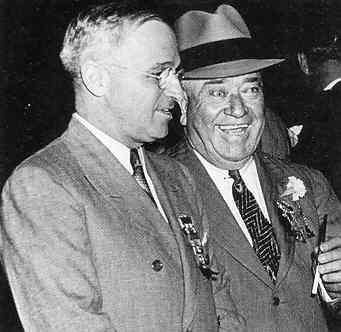
Harry Truman and his mentor Boss Tom Pendergast
It’s an exhaustive dip into local historyl and a genuinely amazing gallery of images from our city’s past.
O’Malley is an impressive collector of facts and photographs. My main beef is that he’s not much of a dramatist.
There’s a ton of information presented here (often at breakneck speed…O’Malley’s narration is breathless, as if he’s trying to cram as much data as possible into our brains before time runs out) but no emotional hook. Too often “Tom & Harry” feels like an antiseptic classroom presentation.
Part of the problem lies with O’Malley’s role as a virtual one-man movie studio. That pretty much by his lonesome he’s been able to turn out three feature docs is nothing short of miraculous. (His earlier efforts are “Nellie Don: A Stitch in Time,” about a family member, ‘30s fashion icon Nell Donnelly, and “Black Hand, Straw Man,” an encyclopedic history of organized crime in KC.)
Actually “Tom & Harry” is less the story of two men than a history of the Pendergast political machine, formed at the turn of the century by big brother Jim Pendergast, who became the Irish kingpin of the West Bottoms and saw his influence extend to the entire city. With Jim’s early death his much younger brother Tom stepped up, perfecting patronage politics and exploiting the ward system to seize control of much of city government.
Under Pendergast (never elected to anything, his official title was chairman of the Jackson County Democratic Club) police tolerated drinking during Prohibition and thus inadvertently encouraged the city’s jazz subculture. Of course, you wouldn’t want to be around on election days, when armed thugs patrolled the polling places, beating up anyone who objected to the ballot-stuffing perpetrated by “dead” voters recruited by Big Tom.
Harry Truman, failed haberdasher, got his political start thanks to the Pendergast machine. But “Tom & Harry” falls short in never asking one burning question: To what extend was Harry Truman (county judge, U.S. Senator, Vice President and President) complicit in Pendergast’s corrupt regime?
The film suggests (tangentially) that Truman was his own man and never used his elected position to do anything illegal or morally questionable on behalf of Pendergast (at least nothing beyond day-to-day patronage deals, commonplace back then though considered tawdry today).
O’Malley interviews for the film a scholar who has written a book about Truman and Pendergast. This would have been a perfect opportunity to ask an expert to address that question. But, no, the talking head comments from the historian (as well as a Pendergast descendant) are bland and not particularly informative.
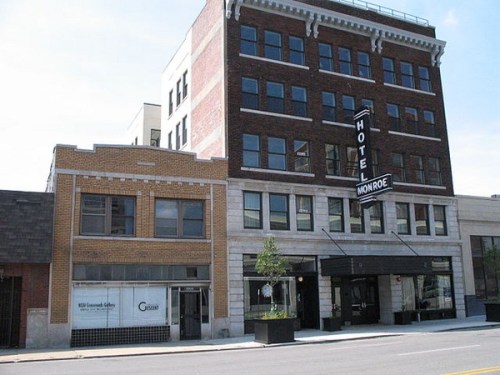
Pendergast headquarters, 19th and Main
I’ve also got a few concerns about the doc’s organization, which jumps back and forth in time. Hard to follow.
And while the film is crawling with factoids, it never really lets its two leading men emerge as real personalities. Precisely what kind of men were they to deal with? The film could have used some of that sort of color.
Still, “Tom & Harry” is a crash course in Kansas City’s political past and a useful tool in understanding how we got where we are today.
| Robert W. Butler
Read Full Post »
 “DETROPIA” My rating: B (Opens Oct. 26 at the Tivoli)






 Butler's Cinema Scene