Feeds:
Posts
Comments

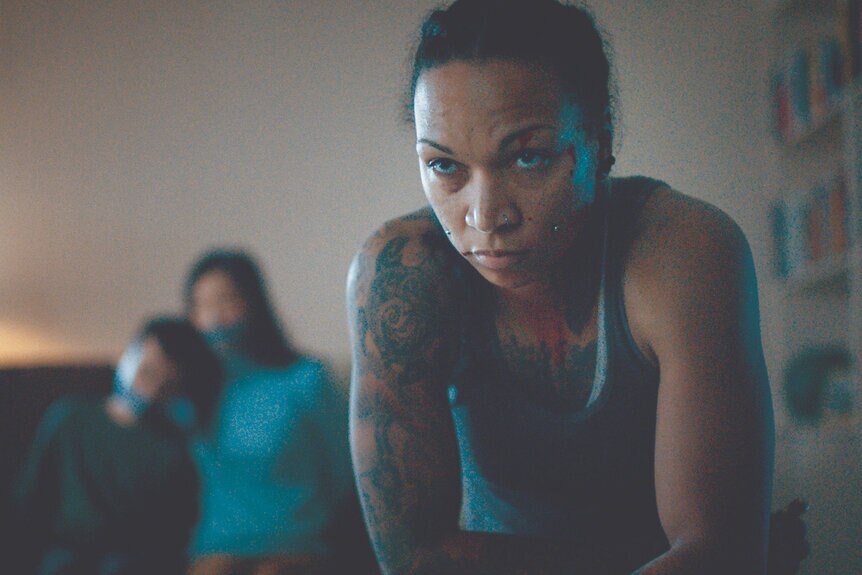
Daryl McCormack, Ruth Wilson

“WOMAN IN THE WALL”(Paramount+):  Brit thesp Ruth Wilson has been so good in so many varied roles (“Mrs. Wilson,” “Luther,” “The Affair”) that it’s easy to take her for granted.

But her lacerating work in “The Woman in the Wall“ cuts so deep that viewers cannot escape the madness at the core of her compelling/prickly character.

Wilson plays Lorna Brady, a middle-aged resident of a small Irish burg  where she’s regarded as a local oddity.  Lorna lives alone, is prone to epic episodes of sleepwalking (one morning she awakens on a country road surrounded by sheep) and is majorly depressed, the result of a long-ago encounter with the Magdalene Sisters.

The Magdalene system, of course, was the Church- and state-sanctioned enterprise which for more than a century in Ireland took in unmarried pregnant girls and put them to work as laundresses. These unfortunates were usually disowned by their scandalized families; most gave their children up for adoption and many lived their entire lives as Magdalenes in circumstances approaching slavery.

Wilson’s Lorna is haunted by the traumas of her youth. She is anti-religious and anti-authoritarian and so angry she cannot see straight.

And sad. God, is she sad.

“The Woman in the Wall” follows Lorna’s quest to discover what happened to the child she birthed decades earlier, but it’s mixed in with a murder mystery.

A priest once involved with the local Magadelene laundry is found murdered.  Suspicion quickly falls on Lorna, whose hatred of the sisterhood is local legend.

Investigating is a police detective from the big city, Colman Akande (Daryl McCormack), who, as fate would have it, was himself born to one of those fallen women and adopted by a loving family — but not before living several years in an orphanage about which he still has Dickensian-level nightmares.

Lorna and Colman form an unlikely alliance; even though she’s a prime suspect in the murder, the cop feels a kinship because of their shared horrors.

But we know something about Lorna that the other characters don’t…Lorna has had a fatal encounter with a former Magdalene nun, whose body she deposits behind the wall of her parlor.

Shades of Edgar Allan Poe! 

Well, the dead woman’s heart doesn’t beat so loud you can hear it, but Lorna, consumed by guilt and fear, is nonetheless pushed to the edge of sanity.

Truth be told, the titular woman in the wall is one of the few elements in the series from creator Joe Murtagh that feels forced and phony. It’s too melodramatic and coincidental by half.

The rest of the show, though, is a brutally honest look at one of Ireland’s recurring bad dreams (hardly a year goes by without some new horrifying revelation about the now-defunct Magdalenes) and the fallout that continues to upend lives.

One leaves the series feeling that some small mysteries have been solved, but that true accountability for decades of abuse may never arrive.

But watching Ruth Wilson do her thing almost makes all the trauma worthwhile.

Donald Glover, Maya Erskine

“MR. AND MRS. SMITH”(Prime): Poised between dark humor and pulse-pumping action, “Mr. and Mrs. Smith” is so watchable that for most of its first season you may not notice it’s really not going anywhere.

Or anyway it sometimes seems it’s going nowhere. Just wait until Episode 8.

This is just the latest spinoff of a concept — a marriage of two deadly assassins — that began with a 1996 TV series starring Scott Bakula and Maria Bello and was resurrected as a 2005 feature with real-life items Brad Pitt and Angelina Jolie.

Our happy-ish couple are John and Jane (Donald Glover, Maya Erskine) who are recruited by a massively secret espionage operation, are ordered to marry one another and become John and Jane Smith (they don’t even know each other’s real name) and are regularly sent off on missions that test not only their secret agent skills but their marital tolerances.

Glover (who produced the series) and Erskine are hugely watchable, and the fact that they represent racial minorities gives “Mr. and Mrs. Smith” a little extra oomph in the sociological fallout department.

Here’s the weird thing…although they are given a posh Manhattan townhouse and a big salary, John and Jane know next to nothing about their employers.  They communicate with their boss — they call him Hi-Hi — exclusively through the internet. 

Nor are they told why they’re doing what they’re doing. No time for ethical hair-splitting. Just get the mission over with, go home and heat up the bedroom with post-homicidal passion.

Most of the episodes in Season One are placeholders, adhering to a similar setup and essentially repeating the same notes with different supporting characters.

Keeping things interesting is an impressive array single episode co-stars (Sharon Horgan, Alexander Skarsgard, Billy Campbell, Sarah Paiulson, Parker Posey, Ron Perlman, John Turturro, Paul Dano).

And with each episode we get a few more intimations about just what our amoral lovers have gotten themselves into. Apparently the only way to get a divorce in this world is with a well-placed bullet.

The season climaxes with the niftiest episode yet, in which the Smiths turn their weaponry on each other, not realizing they’re being set up by powers unseen. And smack dab in the middle is a great stretch of dialogue in which the title couple, under the effect of a potent truth serum, finally come clean with each other, laying bare the essentials of their greasy little hearts.

It all ends on a cliffhanger, but even if we don’t get a Season 2, this one is worth checking out.

| Robert W. Butler

Paul Mescal, Andrew Scott

“ALL OF US STRANGERS” My rating: B+ (Hulu)

105 minutes | MPAA rating: R

It’s just about impossible to describe Andrew Haigh’s deeply moving “All of Us Strangers” without either giving away the film’s big reveal or making it sound like a half-baked dive into armchair psychology.

Yet “…Strangers” got under my skin unlike any other film of 2023. It’s a downer…but we walk away from its all-consuming sadness with filled with hope for our capacity for love.

Andrew Scott, the “hot priest” of “Fleabag,” stars as Adam, a lonely writer living in a London high-rise so recently opened that there’s hardly anyone else in the building.

One fellow resident who does catch his eye is Harry (Paul Mescal); they spot each other during a fire drill and Harry almost  immediately shows up at Adam’s door with a bottle and a too-eager desire to be let in.

Nothing immediately comes of Harry’s advances (both men are gay), but over the course of the next week the two strike up a relationship that moves quickly from the physical to the romantic.

Meanwhile the screenplay by Haigh (adapting Taichi Yamada’s novel Strangers) tosses a head scratcher into the mix. 

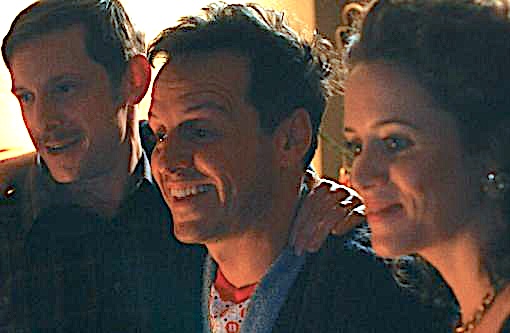
One day Adam boards a train and gets off in a suburb where he is reunited with his parents (Jamie Bell and Claire Foy)…an impossibility since (a) Mom and Dad appear to be the same age as their son and (b) we have already learned from Adam’s conversations with Harry that his parents died in a car crash when he was a young teen.

Jamie Bell, Andrew Scott, Claire Foy

What’s happening?  Well, apparently Adam has constructed a fantasy world in which he can receive the parental love denied him in reality. In this world he can touch and be touched. He can reveal to his parents his homosexuality (Dad is cool with it; Mom is  a bit slower to get on board).  He can take comfort in the warmth of his boyhood home.

Obviously Mom and Dad don’t exist anywhere but in Adam’s head. Yet so spectacularly convincing is Scott, so quietly desperate is his need for affection, that we end up buying into his delusion. And as delusions go, this one is pretty damn seductive.

At the same time the Adam/Harry relationship is deepening…at one point Adam takes his new boyfriend out to meet the folks, only to be confronted with an unoccupied house. Harry quite naturally gets a little creeped out.

“All of Us Strangers” is forever whiplashing us between the real and the imagined. It probably shouldn’t work, but the players are so astoundingly convincing that we find ourselves believing despite the craziness.

And is it really craziness?  “Strangers…” isn’t into psychoanalyzing Adam; that sort of real-world attitude is at odds with the film’s near-poetic approach.

The moral here: We humans need love. Even if we have to invent it. There’s madness there, but a kind of nobility, too.

| Robert W. Butler

Nicole Kidman

“EXPATS”(Prime Video): The arrogance of Western culture gets toasted and roasted in “Expats,” a six-part miniseries about rich foreigners living lives of miserable affluence in modern-day Hong Kong.

Created by Lulu Wang, “Expats” is repellant to about the same degree as her “The Farewell” was warm and life-affirming. At least a half-dozen times while watching this series I turned to the Missus and asked aloud: “Are we supposed to like anybody in this show?”

Given that, why bother?  Well, because the damn thing has been so well acted, that’s why.

From its first episode one might conclude that “Expats” is a mystery waiting to be solved.

American couple Margaret and Clarke (Nicole Kidman, Brian Tee) reside in a posh mountaintop high-rise overlooking the city.  Both geographically and emotionally they seem to be above it all.

Except…they are each tormented in their own individual ways in the wake of a staggering loss. Months before their youngest child, Gus, was snatched off the street.

“Expats” isn’t about the search for Gus, whose fate is speculated on but never solved. Rather, Wang probes the mentality of rich white folk who live privileged existences in a foreign country.

It’s not pretty.

Among the various characters are Margaret and Clark’s neighbors, a spectacularly dysfunctional pair played by Soraya Blue and  Jack Huston.  There’s the young Korean American woman (Ji-young Yoo), a party girl who was supposed to be watching Gus when he vanished.

If the series was devoted only to these arrogant (inadvertent and otherwise) strangers in a strange land it would be rough going. 

Happily we also eavesdrop on the lives of Hong Kong teens (some of whom are risking prison by protesting  mainland Chinese governance of the city).  And the final episode spends time with the Filipino cooks, housekeepers and sitters who have left their own children behind to tend to the offspring of their wealthy employers.

Well made, but not exactly a heart warmer.

“MASTERS OF THE AIR” (Apple+):  More like “Masters of Cliche.”

My anticipation was high upon learning that the same folk who brought us the brilliant WWII miniseries “Band of Brothers” and “The Pacific” were turning their attention to the flyboys who carried out bombing missions over Europe.

The first couple of episodes of “Masters of the Air,” though, were borderline unwatchable. It was as if the writers had immersed themselves in every old movie ever made about the subject and were determined to copy them.  

This result was dialogue neck deep in creaky cliches. I wanted to throw something heavy at my TV.

The good news is that “Masters of the Air” gradually loses its aw-shucks Andy Hardy attitude and gets into the horrifying meat and potatoes of aerial combat. Once off the ground, the show becomes a gripping survival drama…terrifying, even.

One can only come away in awe of the kids (some of the pilots were still in their teens) who rode these thin metal tubes through skies filled with flying shrapnel, blasted away at German fighter planes, all the while freezing their asses off in unpressurized compartments. (I cannot imagine a more horrifying gig than manning a ball turret on the belly of one of these flying fortresses.)

As time goes by one cannot even be assured that lead characters played by the likes of Austin Butler (“Elvis”) and Callum Turner (“The Boys in the Boat”) will return from their ghastly missions.

(Three-fourths of U.S. airmen were killed, seriously injured or became POWs. Their average age of death was only 23.)

My advice: Start with Episode 3.  But brace yourself.

| Robert W. Butler

“FOR ALL MANKIND”(Apple+):

Most of what we call science fiction is in fact science/fantasy.  But “For All Mankind” is sci-fi in its truest sense. The show, which recently dropped its fourth season, offers an minutely detailed alternative history of the space race.  

In this version the Soviets get to the moon first and the Americans must play catch-up. Communism more or less flourishes with a repressive regime in Moscow still railing against capitalism well into the 21st century.  Al Gore is elected President; so is a  woman—a closeted gay woman.

(“For All Mankind” sees women as key figures in the space program. One could almost call this feminist sci-fi.)

Meanwhile astronauts and scientists from all countries are working to explore the vastness of space, with international colonies established on the moon and Mars. Of course, our conflicts as human beings don’t magically go away when we relocate to distant planets. There are labor issues, rebellions, sabotage.

Basically the series explores where we might be now if only we hadn’t put space exploration on the back burner.

The special effects are utterly convincing and the science completely plausible.

I’m especially impressed at how well certain characters — an original NASA flyboy played by Joel Kinnaman, a genius engineer/supervisor played by Wrenn Schmidt — age over the course of several decades.

The series deals not only in space exploration but in the lives of its many characters.  There are failed marriages and affairs. Generational disputes. Political gamesmanship.

The has led some to complain that there’s too much soap gumming up the science. I must disagree…our humdrum human foibles do not evaporate just because we are confronted with the vastness of space.

Throughout, the series never abandons the idea of real science.  No laser guns, shape-shifting aliens or woo woo transcendentalism. Just people designing and making machines that reflect the real possibilities of our technology, imaginations and capacity to hope.

Naomi Watts, Tom Hollander

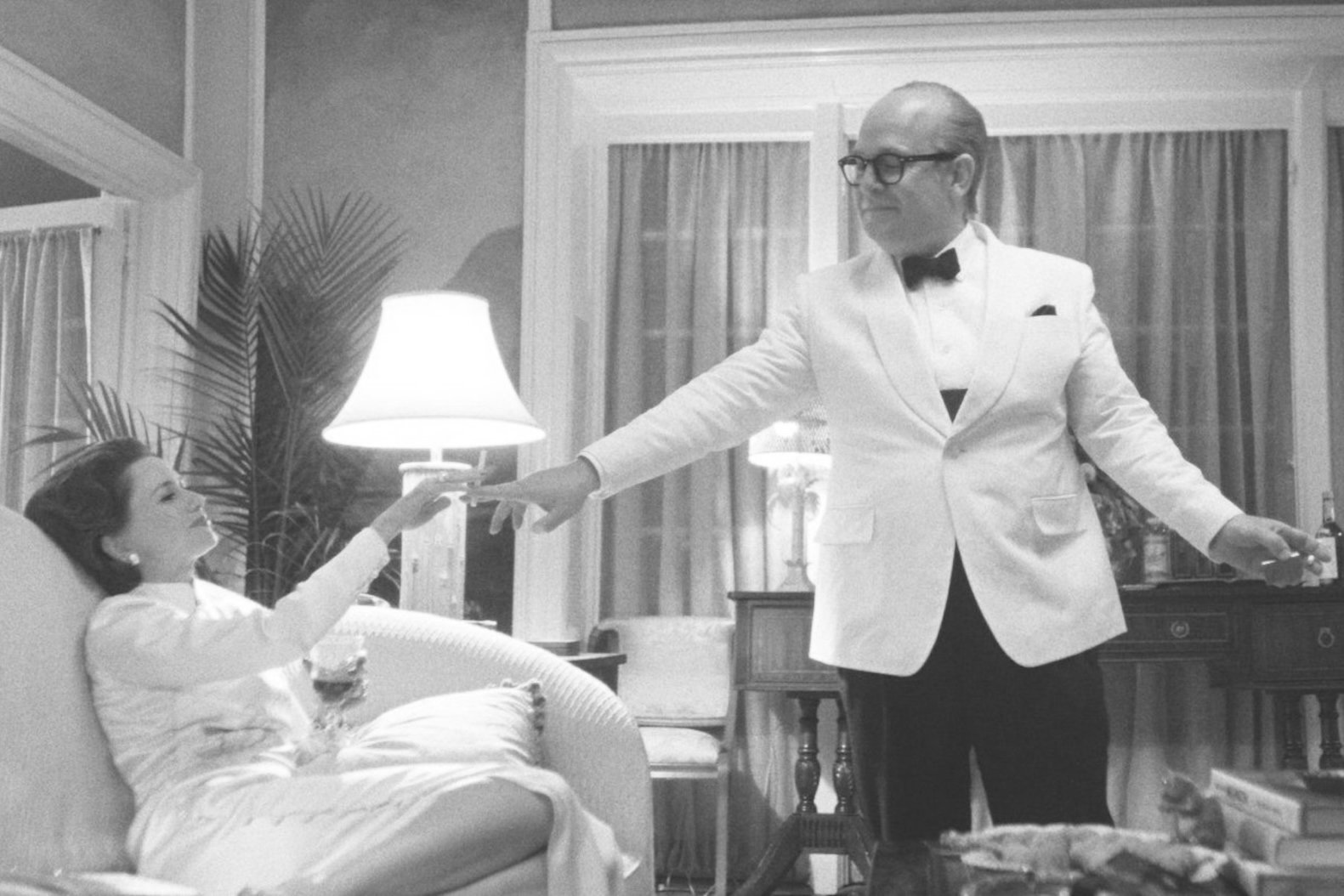
“FEUD: TRUMAN CAPOTE VS. THE SWANS” (Hulu):
For its second season (the first, in 2017, focused on the antipathy shared by Bette Davis and Joan Crawford during the filming of “Whatever Happened to Baby Jane?”) Ryan Murphy’s “Feud” concentrates on writer/raconteur Truman Capote.

Set in the 1960s and ‘70s, “Capote and the Swans” delves into the novelist’s relationships with a half dozen or so society wives, women married to powerful movers and shakers who, from the outside anyway, appeared to live lives of pampered opulence and studied hautiness.

Capote (portrayed by Brit Tom Hollander with a helium-and-molasses voice and fierce attention to his character’s fey mannerisms) calls his gal pals “the swans” because, he says, they seem so graceful on the surface, while below the water line they are desperately paddling. 

These ladies who lunch are portrayed by the likes of Naomi Watts, Diane Lane, Chloe Sevigny, Calista Flockhart and Demi Moore — all of whom appear to be having one hell of a good time mining the bitchiness.

Not that it’s all fun and games. For all their affluence these women are fairly miserable, saddled with philandering hubbies and thankless children.  The openly gay Capote becomes their best friend, shrink, confidant and shoulder to cry on.

“I play the part. It’s all a performance,:” he admits in an unusually honest moment. “They pick men who are rich but cannot act.”

Of course Capote —his creative juices dried up — also betrays these women by turning his intimate knowledge of them into a scandalous novel…thus the feud of the title.

Now I’m only halfway trough the season, but the fourth episode, “Masquerade 1966,” is so freaking good — and so beautifully sums up what the series is about — that it’s practically a stand-alone experience.

John Robin Baitz (who has scripted the entire series) has come up with a brilliant idea. He tells the story of Capote’s famous Black-and-White Masked Ball (one of the most memorable if overhyped society events in Manhattan history) by using “found footage” reputedly made by documentary giants Albert and David Maysles.

The entire episode — directed by the great Gus Van Sant — is shot with handheld cameras and captured in grainy black-and-white and in a classic square frame. The Maysles Brothers not only observe the preparations with fly-on-the-wall intimacy, but conduct interviews Capote and with the Swans…each of whom is convinced that she will be the secret guest of honor to be named at the big event.

Clearly, they can’t all be queen for a day, but master manipulator Capote knows how to exploit each woman’s insecurities and desires to his will.

The result is 60 minutes of absolutely brilliant television.  

| Robert W. Butler

“THE ZONE OF INTEREST” My rating: B+ (In theaters)

105 minutes | MPAA ratin: PG-13

In its own perverted way, Jonathan Glazer’s “The Zone of Interest” is a sick parody of that heartwarming musical “Meet Me In St. Louis.”

Both films are about families living idyllic and comfortable lives, and what happens when the father of the clan must for his job relocate to another city.

What makes Glazer’s film so deeply twisted is that the family in question is that of Rudolf Hoss, the commandant of the notorious Auschwitz death camp.

When we first encounter the Hoss family they are picnicking on a sun-dappled hillside beside a beautiful river or lake.  They swim, bask in the sun. Reduced to their old-fashioned bathing outfits, there’s no way of knowing that Poppa is a high-ranking Nazi officer.

They return to their home, a comfortable modernist abode with a greenhouse and a huge walled-in garden with its own swimming pool.  

As we observe the mundane day-to-day life of Rudolf (Christian Friedel), his wife Hedwig (Sandra Huller, an Oscar nominee this year for “Anatomy of a Fall”) and their brood, little ripples of uneasiness creep in.

Occasionally we can hear gunshots. A distant smokestack belches black clouds.  And now and then we can see over the wall or in the gap between buildings the familiar shape of the tower over the camp’s main gate.

Talk about the banality of evil!  

Sandra Huller

Rudolf goes to work each morning like any other breadwinner…only usually in a uniform of the Reich.  He comes home for lunch. He reads his children bedtime stories.

We never actually see what goes on beyond the wall, but in one painfully haunting scene Rudolf sits down in his study to discuss an expansion of the camp with a couple of architect/engineers from Berlin.  They talk about product flow and increased production without ever acknowledging that their job is to kill their fellow human beings as efficiently as possible. 

Meanwhile Mother Hedwig goes about her business of making the perfect home.  She has help…every now and then someone arrives from the camp with a cart full of clothing, jewelry and household objects for Hedwig to pick from.  We don’t need to be told that these were confiscated from Jews marching to their deaths.

For that matter, Hedwig has several quietly efficient and utterly deferential young women working as maids and cooks.  One can only assume that they are inmates given a reprieve to serve their Teutonic masters.

As written by Glazer (“Under the Skin”) from Martin Amis’ novel, “The Zone of Interest” is less about plot than dispassionate observation.  Most of what unfolds is utterly commonplace: Hedwig’s mother comes for a visit. Hedwig plans improvements for the garden. Rudolf enjoys an after-dinner smoke on the porch as the sun goes down.

Only late in the film does a real crisis develop: Rudolf is to be transferred and Hedwig puts her foot down.  She loves her home and refuses to move after all she’s done to make this the perfect place to raise their kids.

The unspoken subject of “The Zone of Interest” is the human capacity to compartmentalize, to spend evenings contentedly nurturing one’s children and to spend days murdering the children of others.

| Robert W. Butler

Emma Corrin

“A MURDER AT THE END OF THE WORLD” (Apple+)

It starts out with such promise that the last episode was almost bound to be a letdown.  

Yet there are moments in Zal Batmanglij and Brit Marling’s  “A Murder at the End of the World” that have struck with me for weeks.

Young true-crime writer Darby (Emma Corrin) is one of a dozen international movers and shakers invited by an eccentric tech billionaire (Clive Owen) to spend a long weekend at his latest brainstorm, a luxury hotel in the snowy wastes of Iceland.

Among the guests is Darby’s old flame, the graffiti artist Bill (Harris Dickinson). A decade earlier Darby and Bill were young lovers working to identify a serial killer who had left a trail of dead women across the Southwest…their adventure became the basis for Darby’s first best-selling book.

As the title implies, one of the guests is murdered.  There’s a blizzard which keeps the local authorities from reaching the scene. Another guest dies mysteriously.  Then another.

The setup is basically post-modern Agatha Christie.  With the exception of Darby, everyone’s a suspect (at least until they’re killed). 

But the mystery aspect of “A Murder…” is far less interesting than the extended flashbacks of a young Darby and Bill cruising around in an old car trying to identify a killer who has eluded capture for years. There’s a lovers-on-the-run sadness and fatality percolating through their relationship; it’s both tender and troubling. Not to mention an undercurrent of dread.

Holding it all together is Corrin, much praised for her work as the young Princess Diana on Netflix’s “The Crown.”  Her Darby is the daughter of a rural county coroner much more at home at an autopsy than a pajama party. She’s intellectually strong, but there’s an intriguing fragility to her physical and emotional selves. It’s a haunting performance.

Ron Livingston (top), Anja Savcic and Will Sasso

“LOUDERMILK” (Netflix): Addiction has long been the stuff of lacerating drama. But comedy?

Without having any info to back up my suspicions, I’m going to declare that “Loudermilk” could only have been made by people intimately familiar with addiction and recovery. 

It’s as if the show’s creators (Peter Farrelly and Bobby Mort) jotted down every outlandish story ever shared in AA meeting and built a subversive comedy around them. It’s authentic. It’s weirdly touching. 

And it’s funny as hell.

Ron Livingston gets what may be his finest role since “Office Space” as Sam Loudermilk, a fairly miserable example of humanity who runs an AA meeting in a Seattle church.

Sam is dour and cynical.  A former rock critic who only listens to vinyl, he’s contemptuous of just about everyone else’s taste in music. He refuses work that requires a degree of responsibility (mostly he polishes the floors at a downtown bank). He loves picking fights, whether it’s with a lady in line at the coffee shop or the priest who gives Sam’s motley collection of alkies a place to gather.

Beneath the bitterness, though, he’s genuinely concerned about keeping his charges on the straight and narrow. It’s just that sometimes it’s hard to tell.

“Loudermilk” is on one hand a sort of pervy family sitcom. Sam shares an apartment with two other recovering addicts, his sponsor Ben (Will Sasso), who is secretly back on the sauce, and the twenty something Claire (Anja Savcic), who exudes millennial irony for the two old creeps with whom she is housed. 

Over  the course of three seasons other members of the AA group come to the fore.  Usually these digressions are insightful and amusing.  An exception is a long-running subplot about a glowering ex-cop who declares himself the tough-love sponsor of an ineffectual advertising copy writer; thing is, the writer isn’t an addict at all. No matter. Now he’s got this big thug watching his every move. Don’t be surprises when in the middle of their story arc these two characters vanish without comment.

For the most part, though, “Loudermilk” is so eye-rollingly good that I’m amazed I’d never heard of it before.  I find that it debuted in 2017 on the AT&T Audience Network…yeah, that explains it.

“BLUE EYE SAMURAI” (Netflix): Classic Mouse House-style animation meets decidedly un-Disney subject matter (blood-spurting violence, kinky sex) in the six-hour “Blue Eye Samurai.”

I’ve never been a big fan of Japanese anime. After about 40 minutes my eyes glaze over and I lose interest…largely because the human characters in anime seem so stiff and visually uninteresting. (Not to mention those semi-creepy big eyes.)

But here we have human figures that look, move and express facial emotions pretty much like live actors would.  Place them in impeccably rendered environments and you’ve got magic.

The title character is Mizu, a blue-eyed outcast born of an unknown European interloper and a Japanese mother.  Mizu becomes a self-trained samurai whose quest for revenge puts this skilled fighter on a collision course with a brutal British adventurer (voiced by no less than Kenneth Branagh) planning to use Western weaponry to overthrow the shogunate.

Oh, yeah…the series has a major plot twist which I won’t reveal here.

“Blue Eye…” is populated with archetypes clearly inspired by pop culture. There’s a fugitive princess slumming with the lower classes (“The Hidden Fortress,” “Star Wars”).  Mizu’s sidekick is a handless small town oaf with dreams of heroism (very much like Sam in the Ring Trilogy). There’s an ancient blind sword maker (George Takai) who becomes a mentor to our heroes (nobody is actually addressed as “Grasshopper,” but you get the idea).

References to the cinema of Akira Kurosawa abound.  Mizu’s physicality — tall, almost painfully thin, astonishingly graceful  — is clearly patterned after Kyuzo, the swordsman portrayed by Meiji Miyaguchi in “Seven Samurai.” The Season One finale is an extended battle sequence mirroring the castle siege in “Ran.”

“Blue Eye Samurai” is a story that could have been done in live action…had anyone the money to undertake such a massive project.  But things are made affordable when you only have to paint a picture of a castle instead of building one.

Of all there is to admire in this series, I believe it’s the action sequences that most grabbed me.  I kept thinking of the term “blood ballet” that was used to describe Sam Peckinpah’s handling of mayhem in “The Wild Bunch.” “Blue Eye Samurai” lives up to that description.

| Robert W. Butler

Jeffrey Wright

“AMERICAN FICTION” My rating” B (In theaters)

117 minutes | MPAA rating: R

Cord Jefferson may have just made the season’s most impressive directing debut with “American Fiction,” a whip-smart dramady that savagely satirizes the racial assumptions that keep us apart while exploring the experiences that make us all the same.

When we first meet novelist/teacher Thelonious “Monk” Ellison (Jeffrey Wright) he’s conducting a lit class on Southern writers.  A young woman (white) protests that any mention of the “n” word makes her so uncomfortable she cannot function.

Shoots back Monk (who is black): “I got over it.  You can, too.”

For that justified but arrogant retort the curmudgeonly Monk finds himself on mandatory leave until things cool down.  

Monk is that rarest of individuals, a race-blind American. A snob at heart, he’s most comfortable in an ivory tower; soon he’ll be straddling a cultural fence.

His prose style is polished and too academic for popular tastes. If Monk wants success, advises his sympathetic agent (John Ortiz), his writing needs to be “more black.”

Thing is, Monk is disgusted by the new black fiction.  Particularly appalling is a reading by best-selling author Sintara Golden (Issa Rae), whose new novel We’s Lives in Da Ghetto he dismisses as a pandering amalgam of racial cliches.

Traces Ellis Ross, Leslie Uggams

The clever conceit at the heart of Jefferson’s screenplay (co-written with Percival Everett) finds the frustrated Monk writing a deliberately bad novel about ‘hos and players under the nom de plume Stagg R. Leigh. 

Thing is, his satire of terrible African American literature becomes the most popular thing he’s ever produced, with publishers and critics (all white) proclaiming it a modern masterpiece.  This even after Monk, hoping to scuttle the project, insists that the title be changed to Fuck.

Desperately in need of the cash the book will generate but but determined to keep  his academic reputation, Monk creates a life for the non-existence Stagg R. Leigh.  The writer, he decides,  is an ex-con currently on the run from the law (a fabrication that allows the “fugitive” to turn down all offers of in-person media interviews). That last invention may be one too many…to Monk’s dismay the FBI launches a national manhunt for the criminal turned celebrity.

The film’s bleakly funny passages set in the world of publishing (and, later, movies) are interspersed with more somber interactions between Monk and his long-estranged family. So there’s an effortless back-and-forth between dark humor and everyday trial and tribulations.

Monk’s sister (Tracee Ellis Ross) has long been taking care of their aged mother (Leslie Uggams) and now expects the essentially antisocial Monk to take over. Things are complicated by the fact that Momma is quickly sliding into dementia.

Their brother Cliff (Sterling K. Brown) is no help; he has recently left his wife and is devoting himself to exploring life as a gay man.

Monk finds himself in a romantic relationship with the nice lady who lives across the street from Mama’s (Erika Alexander) and is even sucked into participating in the late-in-life wedding of the family’s long-time cook and housekeeper (Myra Lucretia Taylor).

All of this slowly opens up Monk’s long-ignored humanity.  Like it or not, circumstances may force him into becoming a good person. But he’s still too ashamed to let loved ones know that he’s Stagg R. Leigh.

“American Fiction” ends with one of the more mind-blowing tricks in recent cinema.  Basically the filmmakers turn the movie into a choose-your-own adventure experience, offering three different resolutions to Monk’s story and allowing viewers to settle on the one that seems most appropriate.

It should come off as a gimmick, but instead it feels just right.

| Robert W. Butler

pilgrim’s progressEmma Stone

“POOR THINGS” My rating: B+ (In theaters)

141 minutes | MPAA rating: R

Yorgos Lanthimos’ “Poor Things” delivers such a unique vision, so elaborate a palette of visual wonders, so much wickedly sly humor that one is willing to forgive a padded running time and a draggy third act.

Although its literary sources are obvious enough (“Frankenstein” is a biggie; so is
“Candide”) the film’s wondrously weird sense of self is unlike that of any movie I can think of.

And it gives Emma Stone, the star of Lanthimos’ “The Favourite,” the role of a lifetime.

Here she plays Bella, a grown woman who behaves like an infant. 

“Her mental age and body are not quite synchronized,” explains Godwin Baxter (Willem Dafoe), the hideously scarred eccentric whose home/laboratory is populated with bizarre animal hybrids (like a duck with a dog’s head). 

Godwin — Bella addresses  him as “God” — views  his ward as both his daughter and as an experiment.  He will educate this blank slate, raise her to be a reflection of his own genius.

Willem Dafoe, Emma Stone

He tolerates her childlike misbehavior (Bella routinely smashes dishes and plates just for the thrill of noisy destruction), having determined that she has an incredibly high learning curve.

In just a matter of weeks she goes from syntax-twisted baby talk to more-or-less full sentences.

Sometimes she stares in birdlike fashion off into space (reminds of Elsa Lanchester as the Bride of Frankenstein); at other times she devotes all her faculties to examining (and often destroying) some new object in God’s cluttered abode.

Now would be a good time to mention the astounding production design courtesy of Shona Heath and James Price.  “Poor Things” begins in London circa 1900 and later moves to the Continent, but historical accuracy is jettisoned in favor of a sort of Gaudi-inspired steampunk ethos.  The picture is filled with weirdly shaped and decorated rooms, bizarre ships (both seagoing and aerial), and city environments that ooze fanciful theme park artificiality.  

The sumptuous photography by Robbie Ryan (“American Honey,” “The Favourite”) embraces both crisp black and white and pastel-infused color, and his frequent use of wide-angle lenses captures a visual warp that nicely echoes the gnarly subject matter.

The great joy of “Poor Things” lies in watching Stone’s Bella blossom into her own person.

She’s abetted along the way first by Max (Rami Youssef), a sincere medical student hired by God to be Bella’s companion, teacher and possible husband, and later by  unprincipled lawyer Duncan Wedderburn (Mark Ruffalo), who spirits Bella away for a European debauch and introduces her to the wonders of sex. (Or, as she calls it, “furious jumping.”)

(Ruffalo’s comic performance falls just short of mellerdramer mustache-twirling; his depiction of Duncan’s selfish pomposity is hugely amusing, and almost makes me forget his terrible turn in “All the Light We Cannot See.”)

Bella learns and grows. Initially she moves with the jerky tentativeness of a newborn colt; before long she’s doing a funky dance of her own creation. Her vocabulary blossoms.

Emma Stone, Mark Ruffalo

What doesn’t change is her singular outlook.  Her intellect rockets right past societal norms. She has no filter and so invariably utters the truth in situations which call for discretion.

She even develops a sense of empathy and is distraught at the plight of the urban poor she discovers on her sojourn (this passage is a nifty parody of the Buddhist legend in which the privileged Prince Siddhartha ventures from his palace to discover for the first time the plight of his aged and diseased subjects).

Eventually her adventures lead to a stint in a Paris brothel where she succinctly identifies what each customer needs (men are so pathetically transparent) and delivers with a minimum of fuss, becoming rich in the process. (It’s not that Bella is immoral; she’s utterly amoral.)

Eventually the yarn returns to London where we learn of Bella’s origins and her life as the wife of a thuggish noble (Christopher Abbott).  Happily, her world-expanding experiences have prepared her to deal even with the most rampant and institutionalized chauvinism.

For its first 90 or so minutes “Poor Things” is like a birthday party in which every minute delivers a new present to unwrap. It’s a cinematic feast that just keeps on giving.

But things start to bog down in the Paris section…Lanthimos aims for raunchy laughs, with lots of nudity and cartoonish coupling (the easily offended should steer clear). But after a while the film starts to repeat itself. Yeah, yeah, we get it. Men are swine or arrested adolescents. The effect could be had in a fraction of the time it’s given here.

In fact, “Poor Things” would benefit hugely from some tightening. Less is more.

Nevertheless, the movie is a fantastic achievement. And you leave with a newfound sense of respect for the artistry and adventurousness of Emma Stone.

| Robert W. Butler

Mahershala Ali, Ruth Scott, Julia Roberts, Ethan Hawke

“LEAVE THE WORD BEHIND” My rating: B- (Netflix)

138 minutes | MPAA rating: R

The latest from writer/director Sam Esmail, creator of TV’s mind-twisty “Mr. Robot,” has been getting equal parts love and hate from Net-dwellers. 

 I’m stuck in the middle.

It’s an end-of-civilization movie, sort of, with a family from the Big Apple (Mom and Dad are Julia Roberts and Ethan Hawke) retreating to a rental home on Long Island for a little R&R, only to find the world falling apart around them.

Cell phones stop working. Cable TV goes out. The Internet is down.

There’s still running water and electricity…but for how long?

And then there’s the huge oil tanker that has run aground on a nearby beach and the passenger airplanes that are dropping out of the sky.

The highways are impassable (in one haunting scene dozens of driverless Teslas pile up in the roadway in a suicidal demolition derby) and the local deer seem to be suffering from a mass psychosis.

Emotions accelerate when the owner of the rental house (Mahershala Ali) shows up with his surly college-age daughter (Ruth Scott). Mom immediately becomes suspicious of these interlopers, especially since Ali’s high-powered businessman brings with him vague reports of a mass terrorism event.

What’s it all about? Keep guessing. Like Hitchcock’s “The Birds,” which it resembles on many levels, “Leave the World…” isn’t about providing answers. Its emphasis is on the reactions of the characters, who respond to undefined threats by turning on one another.

To say that the film delivers an ever-tightening sense of dread is an understatement.  The acting is about as good as what you’d expect from such a high-powered cast, but I was especially taken with Farrah Mackenzie as the couple’s daughter, a tweener with the face of a 35-year-old and a need to see the final episode of “Friends” that transcends even the end of the world.

Joel Fry, Roy Kinnear

“BANK OF DAVE” (Netflix)

107 minutes | PG-13

Dave Fishwick is the real-life George Bailey (the character played by James Stewart in “It’s a Wonderful Life”).  

More than a decade ago Fishwick, who runs several van and recreational vehicle dealerships in northern England, decided to create a small bank for local residents whose loan applications had been rejected by the established financial institutions.

Over the years Fishwick had found that whenever he loaned money to needy citizens, they invariably paid him back. Often with interest although Fishwick, a wealthy fellow, didn’t ask for that.

So why not make it official?

“Bank of Dave” stars Roy Kinnear as the irrepressible and astonishingly altruistic Dave, and Joel Fry as the young London attorney who comes to the boonies to help him overcome the many legal hurdles in his path.

Because the world of British banking was, until Dave Fishwick, a closed shop. No new bank charters had been approved in more than 150 years, and the powers that be — represented here by Hugh Bonneville as a titled (and entitled) elitist — didn’t want a guy like Dave offering an alternative to their tight-fisted and probably corrupt monopoly. They were ready to play dirty.

Fishwick’s story was the subject of a three-episode Brit documentary back in 2012. Now, under Chris Foggin’s workmanlike direction, this David-and-Goliath fictitious version delivers a whole lot of feel-good.

There’s a subplot in which the lawyer falls for an idealistic M.D. (Phoebe Dynevor), lots of  colorful locals who ooze community and a self-help ethos, and even an appearance by Def Leppard, the famous hair metal rockers who gave a free concert to raise startup money for the Bank of Dave. 

None of this is terribly surprising dramatically, but “Bank of Dave” sucks you in.

Sandra Huller

“ANATOMY OF A FALL” My rating: B+  (Rent on Prime, Apple+, etc.)

151 minutes | MPAA rating: R

A man plummets to his death from an upper story of his house.  His wife is charged with his murder.

That’s the setup examined with procedural detail in “Anatomy of a Fall,” but this description barely scratches the surface of writer/director Justine Triet’s methodical drama.

The body of Samuel Maleski (Samuel Theis) is discovered by his vision-impaired son Daniel (Milo Machado Graner) lying below a balcony of the family’s chalet in the French Alps.  

The cause of death is a blow to the head, but whether Samuel suffered the injury in the fall or was struck on the noggin before going down cannot be determined. There’s a chance this was a suicide.

The authorities, though, charge Samuel’s wife Sandra (Sandra Huller) with his murder. 

At least half the film unfolds in a courtroom where Sandra’s attorney (and one-time flame) Vincent (Swann Arlaud) struggles to counter the grim portrait of his client painted by the aggressively, red-gowned prosecutor (Antoine Reinartz).

It’s not like the state doesn’t have a lot to work with. 

Sandra is a German whose grasp of French is tenuous enough that she asks that the trial court to be conducted in English. So that’s pissing off the jingoists in the courtroom.

She’s a successful novelist who may have borrowed/stolen the idea for her last book from her husband. She is admittedly bisexual. 

Most damning of all, Sandra is emotionally aloof. Is she an unfeeling cold fish? Or is she simply reluctant to air her innermost feelings for public consumption?

On the other hand, Samuel was despondent over his own failed career and his responsibility in the unexplained accident that led to young Daniel’s blindness. He was toying with his meds. He may have attempted suicide by pills a few weeks earlier.

In the film’s most dramatic passage the prosecution plays a recording of a family argument made by Samuel shortly before his death (we see it unfold in flashback). It’s brilliant stuff, with Samuel arguing from his emotional viewpoint and Sandra rebutting with cool (and infuriating) rationality.

A verdict is finally reached, but even then we’re left wondering just what happened.

The acting is off the charts.  Huller (“Toni Erdmann” and the upcoming “The Zone of Interest”) exudes sexual, moral and emotional ambiguity. It’s not like we like her, but we are definitely invested.

Young Garner is astonishingly fine as the blind son, while a border collie named Messi gives a jawdropping perf as Snoop, the family pooch.  The dog is so good that director Triet often films from his vantage point just a couple of feet above the floor.

 | Robert W. Butler

Gary Oldman, Jack Lowden

“SLOW HORSES” (Apple+)

In the same way that the novels of John LeCarre epitomized Cold War espionage, the spy stories of Mick Herron nail the rudderless amorality of our current situation.

In Herron’s Slow Horses series (read them…they’re the best spy novels EVER) the enemy is not so much the Russkies or Jihadists as it is the power-hungry politicians and behind-the-scenes manipulators who would bend Britain’s espionage apparatus to their own twisted ends.

Going in I doubted that a TV adaptation could match the wonders of Herron’s prose, but I’ve been proven wrong.  “Slow Horses” is utterly captivating…hilarious, infuriating and suspenseful.

And it offers Gary Oldman at his absolute best.  Oldman’s Jackson Lamb is a disheveled, flatulent alcoholic who after a career as a field agent has been demoted to lead Slough House, a dead end posting for spies who have screwed up.

Lamb is unrelentingly cruel to his loser minions (the show is a veritable cornucopia of inventive insults), but he remains a master spy, and even from the bitter exile of Slough House (whose inhabitants are contemptuously dismissed as “slow horses”) he has the brains and inventiveness to run circles arounds his corrupt “betters.” 

This perf has “Emmy” written all over it.

Our main “good guy” is River Cartwright (Jack Lowden) who came to the service as the grandson of a legendary spy master and shamed his family by flunking a training test in a very public way.

But all of the horses have their own morosely funny backstories (substance abuse, hacking, gambling) which are examined over the show’s three seasons (there’s at least one more to go). 

And as their nemesis we have the magnificent Kristin Scott Thomas as Diana Taverner, second-in-command of His Majesty’s spy service and determined to move into the top slot by any means necessary.

Sebastian Manicalco, Omar J. Dorsey

“BOOKIE” (MAX)

The same sort of freewheeling capitalism-on-steroids energy that propelled HBO’s “Ballers” is a big factor in “Bookie,” a drop-dead funny half-hour comedy about a couple of LA oddsmakers who aren’t nearly tough enough for their chosen line of work.

Danny (standup Sebastian Manicalco) is more or less joined at the hip with Ray (Omar J. Dorsey). Danny is the brains of the outfit; Ray, a former footballer, provides the muscle.

Only problem is they’re all bluff…basically they put on a threatening show, but panic when it comes to actual violence.  

Which means that the degenerate gamblers who owe them money are always squirming out of paying up. (Charlie Sheen appears in several episodes, portraying a smarmy gambling addicted version of himself.)

It’s sort of a criminal version of the “Odd Couple.” Danny and Ray spend WAY more time with each other than with their womenfolk, have their own zinger-heavy language, and share a dread of taxes, responsibility and 9-to-5 jobs.

The revelation for me was Maniscalco’s performance. He was really good in his brief turn as Crazy Joe Gallo in Scorsese’s “The Irishman,” but that didn’t prepare me for the superb timing and subtlety of expression he displays in every episode of “Bookie.”

This is laugh-out-loud stuff.

Brie Larson

“LESSONS IN CHEMISTRY” (Apple+)

Oscar-winner Brie Larson makes a rare trip to the small(er) screen to embody the alluring/austere heroine of Bonnie Garmus’ best seller.

Her Elizabeth Zott is a brilliant chemist who, alas, is the wrong sex.  The series begins in the 1950s and the chauvinists who run the big research lab where she works cannot see Elizabeth doing anything more challenging than making the perfect cup of coffee for the “real” scientists.

Her prickly personality doesn’t help.  Elizabeth doesn’t flirt, is indifferent to the usual standards of femininity and has been cursed with the need to speak truth to conventional manliness, even when not in her best interest. She suffers from a form of social autism.

But love finds her in the form of nerdy Calvin Evans (Lewis Pullman), the firm’s top chemist, who becomes her lover and lab partner.

Fired when she becomes  an unwed mother, Elizabeth ends up at a local TV station where, in a page from the Julia Child playbook, she becomes a sensation with an afternoon cooking show that breaks down recipes to their molecular basics. (She’s a chemist, after all.)

Covering nearly 15 years, “Lessons in Chemistry” carries not only a strong protofeminist message, but deals with the growing  Civil Rights movement (Elizabeth lives in a  predominantly black neighborhood).

There’s a huge supporting cast, but this is essentially Larsen’s show…she takes a stand-offish, brittle character and somehow makes her inspirational and aspirational. 

| Robert W. Butler