Feeds:
Posts
Comments

everestmaxresdefault“EVEREST” My rating: B 

121 minutes | MPAA rating: PG-13

Very few of us have the skill, the will or the financial wherewithal to tackle Earth’s tallest peak.

After watching “Everest,” though, don’t be surprised if you feel as if you’ve been to the top of the world, where the human form is ill-prepared to survive at the cruising altitude of a 747.

Based on the disastrous day in 1996 when Mount Everest claimed the lives of eight climbers — the same tragedy described in Jon Krakauer’s best-selling book “Into Thin Air” and a 1998 IMAX documentary — the film eschews Hollywood hokum for a [hugely] realistic depiction of what happened.

The first hour focuses on New Zealander Rob Hall (Jason Clarke), operator of a commercial guide service,  as over a month he prepares a party of clients for an expedition up the mountain.

Most of the customers are like Beck Weathers (Josh Brolin), a Texas businessman with pockets deep enough to handle the $65,000 Hall charges for a climb. They’re middle-aged, wealthy men of commerce determined to push themselves to the limit before age interferes.

An exception is Doug Hansen (John Hawkes), a working-class guy who failed to reach the summit on an earlier attempt. This will be his last chance … and Hall has given him a discount so that he can afford this climb.

The film’s second hour is the ascent itself, which found most of the party going all the way up, only to be ravaged by a fierce storm on the way down.

Written by William Nicholson and Simon Beaufoy and directed by Baltasar Kormakur, “Everest” features a star-heavy cast.

Among the familiar faces  behind bushy beards are Jake Gyllenhaal as Scott Fischer, aka “Mr. Mountain Madness,” a rival guide who joins forces with Hall because the mountain is so crowded with 20 expeditions. Michael Kelly plays Krakauer, the well-known outdoor writer who was a member of the team. Sam Worthington is a fellow climber helpless to effect a rescue.

Continue Reading »

Elisabeth Moss

Elisabeth Moss

“QUEEN OF EARTH” My rating: C+ (Opens Sept. 11 at the Screenland Crossroads)

90 minutes  | No MPAA rating

The first shot of the ironically titled “Queen of Earth” pretty much sums up what we’ll be getting for the next 90 minutes.

The face of actress Elisabeth Moss as Catherine fills the screen in massive closeup.  Her mascara is smeared, giving her a raccoon-ish look. Her nose is red from crying. Her hair is wet and stringy.

And she’s angry/wheedling/pathetic as she hurls insults and accusations at her offscreen lover, who is in the process of dumping her.

Moss may be best known for playing Peggy, the office girl-turned-account executive in cable’s “Mad Men” but — as shown by her work in the miniseries “Top of the Lake” and indie films like “The One I Love” — she’s a fiercely adventurous actress willing to go out on the edge.

In writer/director Alex Roth Perry’s “Queen of Earth” she starts on the edge and swings wildly into the “out there.”

Emotionally bruised and battered, Catherine turns to her oldest and best friend, Virginia (Katharine Waterston), whose parents own a ritzy vacation lake house. The two women will share the idyllic place while Catharine tries to get her head together.

Continue Reading »

Patrick Wilson, ****

Patrick Wilson, Dianna Agron

“ZIPPER” My rating: B- 

103 minutes | MPAA rating: R

“Zipper” is an astonishingly dour thriller with a torn-from-the-headlines premise.

Patrick Wilson stars as Sam Ellis, a federal prosecutor with a squeaky-clean reputation who is contemplating a career in politics.

He’s a white knight in the courtroom and has what appears to be an ideal family life with his charity maven wife Jeannie (Lena Headey) and their young son.

When a comely office intern (Dianna Agron) makes a pass at him, Sam throws on the brakes after one kiss. Arriving home late at night, though, he cruises porn sites. When a case brings to his attention a high-end escort service,  he begins doing “research.”

Next thing you know he’s paying big bucks for a few hours with these smart, beautiful, sexually talented young women.

Sam apparently can’t control himself. Part of him hates what he’s doing; another part is coming up with all sorts of devious ploys to allow him to keep on doing it.

There comes a moment, of course, when the noose of revelation tightens around Sam’s neck (thanks to a sleazy journalist played by Ray Winstone). Are his marriage and career on the chopping block?

Continue Reading »

phoenix-thumb-630xauto-53973“PHOENIX”  My rating: B 

98 minutes | MPAA rating: PG-13

“Phoenix” relies on outrageous coincidence to a degree that would prove fatal to a lesser film.

But Christian Petzold’s claustrophobic German drama somehow absorbs and defuses our objections,  thanks to some fine acting and an atmosphere of post-war loss and desperation that sinks into the bones.

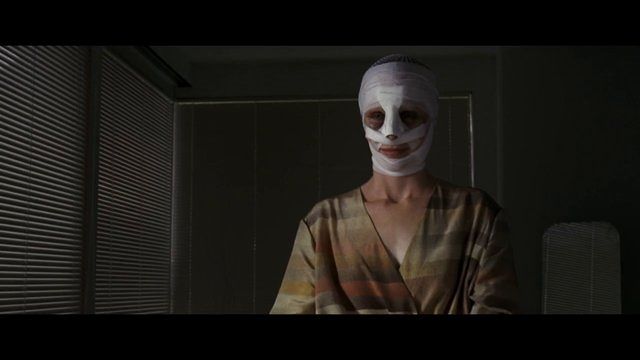
When we first see Nelly (Nina Hoss), she’s fresh from a recently liberated Nazi concentration camp. Her head is wrapped in bloody bandages, the result of a German bullet that tore up her features.  Now she’s facing months of plastic surgery to restore her face to something resembling its original form.

Nelly is obsessed with finding Johnny, her husband, with whom she had a vocalist/pianist act.  Lene (Nina Kunzendorf), the Jewish relief worker who is handling Nelly’s case, says that most likely it was Johnnie who turned his Jewish wife in to the Gestapo to save his own skin.

But Nelly won’t be swayed. Once the bandages come off  she walks the streets of Berlin at night. One evening, in a nightclub called Phoenix, she sees Johnny (Ronald Zehrfeld). He’s not playing the piano. He’s bussing tables and mopping floors.

But he notices this quiet woman who bears a vague resemblance to his former wife and he proposes that they team up to work a scam on the authorities.

As the last surviving member of her large family Nelly has a small fortune waiting for her in Switzerland.  Johnny has been rebuffed in his efforts to claim the money as Nellie’s widower.

Now he proposes that this woman pose as his wife. After all, she looks a bit like Nelly. He’ll teach her all she needs to know about Nelly, even provide her with items of Nelly’s clothing.  Together they will stage a heartbreaking reunion and later split all that money.

Continue Reading »

Barry Ward as Jimmy Gralton

Barry Ward as Jimmy Gralton

“JIMMY’S HALL” My rating: A- 

109 minutes | MPAA rating: PG-13

Brit filmmaker Ken Loach always has lept in where Hollywood fears to tread. For a quarter century he has been making overtly political films reflecting his leftist/humanist point of view. He’s never been a major box office force, but he’s always been a true artist.

“Jimmy’s Hall” is in many ways the perfect Loach film, a fact-based story depicting the external struggle of left-vs.-right without stooping to caricature or shrillness and overflowing with Irish song, dance and language.

Paul Laverty’s screenplay (based on Donal O’Kelly’s play) begins with the return to Ireland in 1932 of Jimmy Gralton (Barry Ward), who has spent the last decade in exile in New York City. As we see in flashbacks, at the time of “the troubles” Jimmy ran afoul of the authorities for operating a “hall” on his rural property, a place where local folk could go to take classes in art and music, discuss literature and politics, and hold community dances.

Doesn’t sound particularly insidious, but Jimmy’s sin was to run his hall free of the control of the Church,  for centuries (and for another 80 years) the dominant force in Irish life.

Once back in the neighborhood Jimmy is reunited with his mother (Aileen Henry) and with Oonagh (Simone Kirby), the girl he left behind who has since married and started a family. But it isn’t long before the rural folk are urging Jimmy to spruce up the dust-covered hall and start once again providing a place for common folk to gather  to expand their minds  and open their hearts.

Turns out that life in the new republic hasn’t improved appreciably for these hard-working but underemployed Irishmen. The owners of the big estates can still evict poor tenants for the slightest infraction or uppity behavior, and the Catholic Church — as embodied by Father Sheridan (Jim Norton) — once again is prepared to take on any challenge to its authority.

The film’s villains: masters and pastors.

Continue Reading »

Jason Schwartsman, Olympia Dukakis

Jason Schwartsman, Olympia Dukakis

“7 Chinese Brothers” My rating: C+ 

76 minutes | No MPAA rating

When we first meet Larry, the main character (one is loathe to call him a protagonist) of “7 Chinese Brothers,” he’s being fired from his bottom-scraping job in the kitchen of a trendy Austin restaurant for stealing from the tip jar and siphoning off liquor from the bar.

Caught red handed, his response is basically a shrug and a wise-guy remark.  Out in the parking lot he keys the car of his chief accuser.

Larry is, not to put too fine a point on it, a slacker asshole. A jerk. he should be intolerable.

Except that Larry is portrayed by Jason Schwartzman, one of those actors who manages to bring to every role a modicum of empathy and insight.

In Bob Byington’s shambling comedy Schwartzman walks a fine line between creepy and compelling.

This is one of those movies that goes nowhere fast. There’s not a whole lot of plot.

Continue Reading »

steve-jobs-man-in-the-machine“STEVE JOBS: THE MAN IN THE MACHINE”   My rating: B

120 minutes | MPAA rating: R

The first hour of “Steve Jobs: The Man in the Machine” is pretty much what you’d expect. It’s mostly a history of the late Steve Jobs and Apple, the brand with which his name will always be synonymous.

The second hour?  Well, that’s where things get ugly. Because here filmmaker Alex Gibney (the Oscar-winning “Taxi to the Dark Side” and HBO’s Scientology expose “Going Clear”) delves into the less-inspiring aspects of Jobs’ character, as well as Apple’s corporate malfeasance.

Gibney, who narrates, says that like millions of others he’s in love with Apple products. But he wonders how the brand’s fans can embrace the tech while overlooking the ugly underbelly of Apple’s rise to corporate dominance.

In the first hour we see Jobs’ first TV interview (he’s like a kid in a candy store, awed by the technology around him), his early partnership with fellow tech wonk Steve Wozniak (whom he blithely screwed out of millions of dollars), and the introduction of early Mac desktops (Jobs created the phrase “personal computer”).

Jobs believed — and made the rest of us believe — that he was a paradigm shifter, a rebel, and also a business giant/genius.  He had one speed — full on — but sought relief in the study of Zen Buddhism.

But even in this retelling of Jobs’ heady early years, there are dark rumblings.  Like his refusal to recognize his illegitimate daughter until DNA proved his paternity. The fact that working for Apple was debilitating despite all the countercultural trappings (Jobs could be incredibly callous and cruel toward underlings).

Gibney speculates that having largely failed with human connections, Jobs compensated by creating technology that connected the entire world. At the same time, the film asserts, people aren’t so much connected to Jobs or other people as to his creations.

“My hand is constantly drawn to it,” Gibney says of his new iPhone, “like Frodo’s hand to the ring.”

Continue Reading »

Thomas Ian Nichols (right) as young Walt Disney

Thomas Ian Nichols (right) as young Walt Disney

“WALT BEFORE MICKEY”  My rating: C- 

120 minutes | MPAA rating: PG

Factually dense and dramatically anemic, “Walt Before Mickey” is an ultra-low-budget look at the life of the great Walt Disney in the years before his big breakthrough with Mickey Mouse.

Written by Arthur L. Bernstein and Armando Gutierrez (adapting Timothy Susanin‘s non-fiction book) and directed by first-time feature helmer Khoa Le, the film opens  with the Disney family leaving their farm in Marceline MO to move to Kansas City.

The bulk of the film covers 1918 to 1928, when Mickey made his first appearance on the big screen and made Disney a household word. Those years saw Walt found his Laugh-O-gram animation studio in KC, where he recruited young artists who would become the backbone of the future Hollywood animation industry.

It was in this Midwestern city where Disney — not yet old enough to vote — struggled for financial success and recognition and, failing to achieve either, moved on to Los Angeles. But not before sharing a period of impoverishment with a pet mouse Walt adopted in his studio…a mouse who a few years down the road would inspire big things.

In L.A. there were more humiliating failures before the creation of Walt’s famous cartoon rodent would turn everything around.

“Walt Before Mickey” gets high marks for intentions. The filmmakers obviously see in Disney’s story a lesson for all entrepreneurs — that success is rarely comes overnight and is often preceded by debilitating setbacks.

And, given the usual license at work in film biographies, the movie is astonishingly accurate in its narrative. (I can say that, having co-written a book about Disney’s early years.)

Oh, there are some lapses and incongruities. Walt’s father Elias, a skinny wraith of a man, is portrayed by a beefy actor. Here Walt’s first studio is in the loft of a rural barn (in fact, he and partner Ub Iwerks set up shop in a bathroom in a downtown office building). And screenwriters Bernstein and Gutierrez seem to be unaware that Walt’s Kansas City was in Missouri, not Kansas.

Continue Reading »

Bel Powley as Minnie

Bel Powley as Minnie

“DIARY OF A TEENAGE GIRL” My rating: B 

102 minutes | MPAA rating: R

“I had sex today,” 15-year-old Minnie tells us in the first scene of “Diary of a Teenage Girl.”

“I think this makes me officially an adult. I guess.”

Striding down a street in 1970s San Francisco, Minnie is quietly proud of  her recent transition to womanhood. She doesn’t even seem particularly concerned that the man who took her virginity is Monroe, the 35-year-old boyfriend of her bohemian mom.

In fact, Minnie targeted and seduced him. Monroe isn’t really a bad guy, but he’s kinda thick. He didn’t put up much of a fight.

“Diary…” features a home run performance from newcomer Bel Powley as Minnie while offering a non-hysterical depiction of sex between a grown man and a young girl. This is not an after school special warning of the dangers of pedophilia, and writer/director Marielle Heller (adapting Phoebe Gloeckner’s novel) doesn’t condemn her heroine to a life of misery for her youthful indiscretions.

By film’s end, in fact, we’re pretty sure that Minnie is going to not only survive, but thrive.

Continue Reading »

Chris Pine, Margot Robie, DIDIDIDID

Chris Pine, Margot Robbie, Chiwetel Ejiofor

“Z FOR ZACHARIAH”  My rating: B (Opens Aug. 28 at the Cinetopia)

95 minutes | MPAA rating: PG-13

In a lush valley somewhere in Appalachia, a young woman lives alone. With her dog she hunts wild game. She grows vegetables using hand tools.

The valley is her entire world — not by choice but of necessity. In the wake of nuclear disaster that has left most of Earth too radioactive to sustain life, this few square miles somehow has clean air and water.

It’s a miracle.

At least that’s what Ann (Margot Robbie) thinks.  She’s lived here all her life with her father — a rural preacher — and a younger brother. But months ago the menfolk ventured forth to look for survivors beyond the valley. They’ve not returned. Probably won’t.

So when an outsider arrives, it’s cause for both celebration and concern.

Happily, John (Chiwetel Ejiofor) appears to be a pretty good guy. Reeling from radiation poisoning, he’s slow to regain his strength. He was a research engineer who survived the crisis in an underground government bunker.  But after months of claustrophobia he decided he’d rather take his chances on dying under a blue sky.

Written by Nissar Modi and directed by Craig Zobel (“Compliance”), “Z for Zachariah” is a quiet, reflective, tightly-wound post-apocalyptic tale which relies on sharp characterizations instead of special effects.

Ann and John are happy to have each other, but they are distinctly different individuals.  She’s religious (the film’s title refers a children’s Bible book, “A is for Adam,” that sits on her bookshelf) and while no dummy — the house is jammed with books — has only limited experience with the world beyond her homestead. She may very well be a virgin.

John, on the other hand, is a rationalist…either agnostic or atheist. His faith is in science and his own abilities. Soon he’s contemplating building a waterwheel-powered electric generator at the foot of a nearby waterfall.  Of course he’ll have to tear down the homey chapel in which Ann’s father used to preach.  They’ll need the wood for construction material.

But when they’re done he and Ann will have lights and an operating freezer in which to preserve food.

Continue Reading »