Feeds:
Posts
Comments
Jon W***

Jon Wojtowicz, the real “Sonny” from “Dog Day Afternoon”


“THE DOG”  My rating: B (Opening Aug. 15 at the Alamo Drafthouse Mainstreet)

100 minutes |No MPAA rating

One of the iconic images of the 1970s comes from the film “Dog Day Afternoon.” Al Pacino plays a bank robber who paces in the doorway of the building where he’s holding hostages, berating the surrounding cops, demanding pizza, a getaway plane and a sex change operation for his boyfriend.

Pacino played a character named Sonny. The real life Sonny was John Wojtowicz, and “The Dog” is his story.

Filmmakers Allison Berg and Frank Keraudren followed the elderly Wojtowicz over several years (he died in 2006) and their documentary leaves us with as many questions as answers. This was probably inescapable, for Wojtowicz was a raging egoist, a bombastic storyteller, a mixture of admirable traits (when he fell in love, he fell in LOVE), hilarious self-aggrandizement (until it gets wearisome), profane poetry and a sexual appetite that was off the charts.

“I’ve had four wives, 23 girlfriends,” the white haired Wojtowicz boasts.  “They all know each other. I’m like Prudential. I’m the rock.”

The film follows his remarkable life from Brooklyn boyhood to service in Vietnam, his discovery (in basic training) of gay sex, his return home and his marriage to a neighborhood girl.

But before long he was part of the Manhattan homosexual scene in the wake of the Stonewall riots. Wojtowicz became a gay activist — though he admits it was as much to get laid as for his sense of social justice. He met and “married” Ernest Aaron, a transexual, and it was Ernie’s desperate quest for a sex change operation (he had attempted suicide several times) that drove Wojtowicz in August of 1972 to devise a bumbling plan to rob a Chase Manhattan Bank outlet in Brooklyn.

The crime turned into a long standoff that drew huge crowds and unfolded on live television. Wojtowicz put on a show, strutting for the news cameras, hurling insults and handfuls of cash at the cops, playing the big man.

Watching the vintage TV footage, one realizes how accurately Pacino and director Sidney Lumet captured the event.

Wojtowicz  spent seven years in federal prison being beaten and gang raped…though eventually he “married” another inmate.

While in prison, “Dog Day Afternoon” was released. Wojtowicz was pleased by the attention paid his outlandish story: “Nobody would rob a bank to get the money to cut off a guy’s dick in a sex change operation. That’s why they made a movie about it.”




Continue Reading »

alive-inside“ALIVE INSIDE” My rating: A (Now showing at the Screenland Crown Center)

78 minutes | No MPAA rating 

Movies don’t change lives.

Religion can change lives. Falling in love can, and so can becoming a parent. Tragedy, alas, is hugely effective at creating change, albeit painfully.

But movies? Not really.

Except nobody seems to have told this to the makers of “Alive Inside,” a devastating, incredibly inspiring documentary about the power of music.

Michael Rossato-Bennett‘s documentary follows the efforts of Dan Cohen, a volunteer whose personal mission in life is to bring music to Alzheimer’s patients.

He does it with an iPod, a pair of headphones and playlists specially built to reflect the music these individuals enjoyed in their primes.

“Music connects people with who they have been, who they are and their lives,” Cohen says. “Because what happens when you get old is all the things you’re familiar with, your identity, are all just being peeled away.”

Early in the film Cohen works his magic on a 94-year-old man who has been more or less vegetative for years. With the music playing, the man comes alive. He sings along, he claps his hands and waves. And, astoundingly, he begins holding a conversation with Cohen. It’s the first time he’s really talked to another human being in ages.

Continue Reading »

Audrey Tatou and Romain Duris in "Mood Indigo"

Audrey Tautou and Romain Duris in “Mood Indigo”

“MOOD INDIGO” My rating: C  (Opens May 8 at the Alamo Drafthouse Mainstreet)

94 minutes | No MPAA rating

“Mood Indigo” is so aggressively French — not just French, but avant garde, let’s-blow- Gauloise-smoke-up-our-asses French — that I’m not sure that citizens of any other country should subject themselves to it.

The latest from the ever-eccentric Michel Gondry (“Eternal Sunshine of the Spotless Mind”) starts out like an episode of “PeeWee’s Playhouse” and ends up like one of Ingmar Bergman’s uber-dark meditations on mortality.

The first half — the “fun” half — unfolds in the Paris world of Colin (Romain Duris), a child/man who lives in what appears to be a subway car slung between two tall buildings.  Colin is a Duke Ellington-obsessed inventor (thus the film’s title). Among his Rube Goldberg-ish creations is an upright piano which mixes cocktails, the ingredients and proportions determined by which jazz classic is being played.

Colin’s household is a wonder.  Live eels squirm out of the kitchen tap, his meals (thanks to stop-action animation) come to life on the table, and a mouse (an actor in an animal suit) grows fresh veggies in a greenhouse fashioned from an old microwave oven.

Continue Reading »

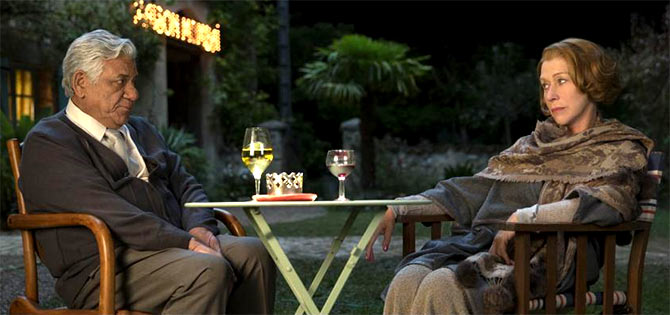
Om Puri and Helen Mirren

Om Puri and Helen Mirren

“THE HUNDRED-FOOT JOURNEY” My rating: B  (Opening wide on Aug. 8)

122 minutes | MPAA rating: PG

Moviegoers are forgiven for approaching “The Hundred-Foot Journey” with foreboding. From the ads one might reasonably conclude that this is yet another middlebrow movie tailor-made to soothe (but never challenge) the sensibilities of the art house blue-hair brigade.

Well, Lasse Hallstrom’s film is definitely middlebrow, and it is certainly soothing — but it’s also very well acted and emotionally potent. It  introduces two newcomers (quite possibly the handsomest couple I’ve seen on screen in ages) who will, if there is any justice, become overnight stars. And they are perfectly complemented by two cinema veterans at the top of their game.

Plus, “The Hundred-Foot Journey” is, God help me, life-affirming, albeit without feeling manipulative. (I don’t mind when a movie makes me cry…only when it twists my arm to achieve that effect.)

The widower  Kadam (Om Puri) has fled political upheaval in his native India and with his five children has opened a restaurant outside London. But the weather sucks and now they are driving around Europe, trying to find a place to settle down. (Granted, this doesn’t sound like a terribly smart business plan, but since Kadam still converses regularly with his dead wife, you’ve got to assume cosmic forces are in play.)

The family’s van breaks down in a postcard-perfect French burg (it’s got a river, rolling hills and a view of the mountains) and Kadam gloms onto an abandoned building that he believes could become the home for his new Indian restaurant.

Problem is, it sits just across the road (100 feet away, to be precise) from a Michelin-starred French restaurant operated for decades by the widow Madame Mallory (Helen Mirren). Mallory is a shrewish lady who lives and breathes haute cuisine, and she is appalled by the Kadam family’s blaring Bollywood music, the garish colors of their restaurant’s decor, and the heavily-spiced odors that drift across the road and into her stuffy establishment. (“If your food is anything like your music, I suggest you tone it down.”)

Continue Reading »

Andrew

Andrew

“RICH HILL” My rating: A- (Opening Aug. 8 at the Screenland Crown Center)

91 minutes | No MPAA rating

Get out your hanky.  After watching “Rich Hill” you’ll need it.

This Sundance Grand Jury Prize-winning documentary from cousins Tracy Droz Tragos and Andrew Droz Palermo — centering on three adolescent boys coming of age in Rich Hill, MO (southeast of Kanas City in Bates County) — is a heartfelt and sobering study of poverty in America.

It’s about the sort of people the rest of the world looks upon with amusement and disdain, something that is acknowledged in the opening minute by 14-year-old Andrew, who declares “We’re not trash. We’re good people.”

And Andrew really is good people, a young man overflowing with hope and benign intentions despite a family situation — a mother this close to being institutionalized and a handyman father whose endless (and apparently hopeless) quest for employment means moving his clan several times every year — that would leave a lesser individual angry and impotent.

Instead Andrew is smart, well-spoken, and maintains a charitable disposition that is little short of miraculous. You feel that he might have a real chance at making something of himself.

The same cannot be said of the film’s other two subjects.

Continue Reading »

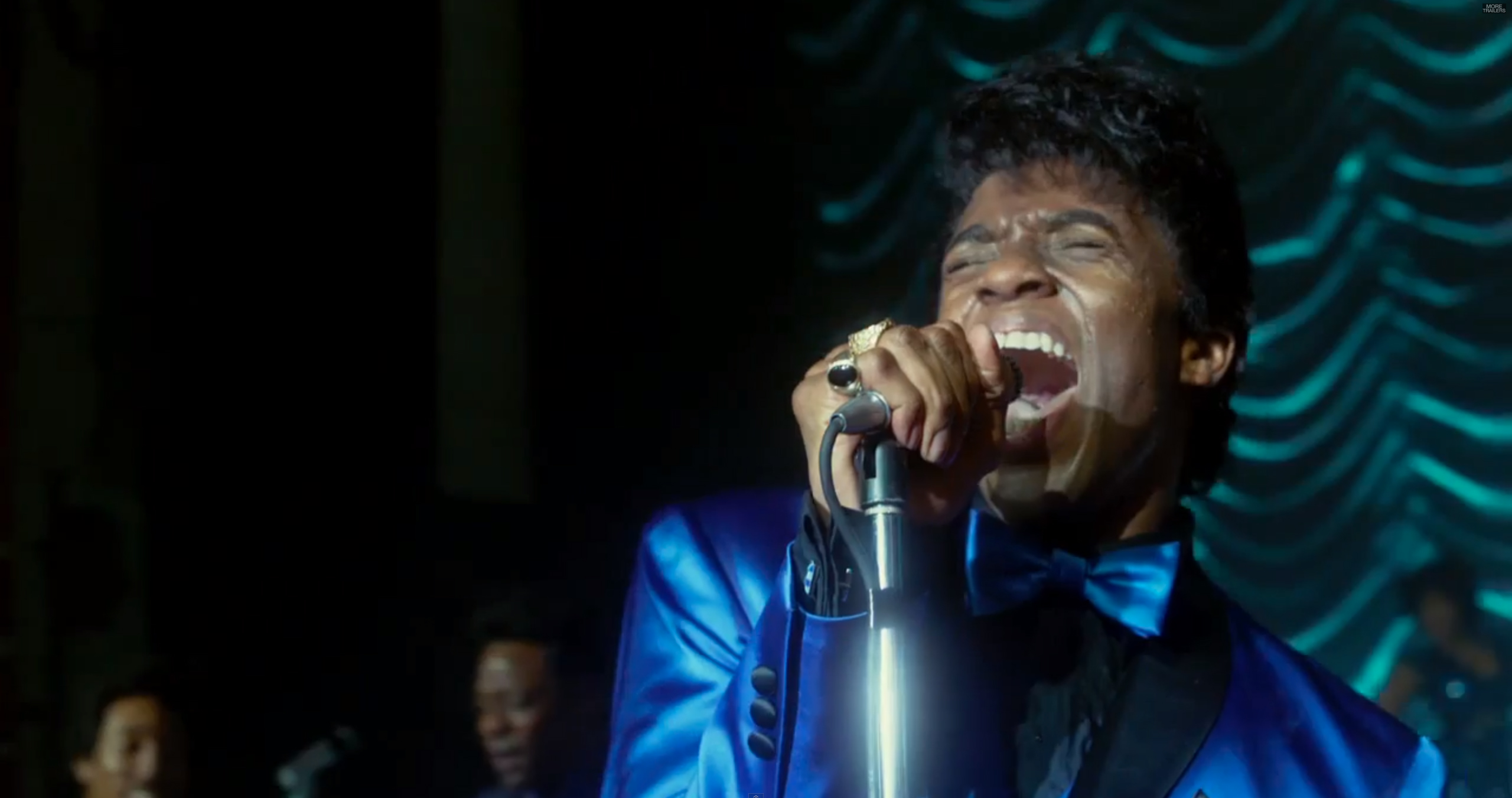
Chadwick Boseman as James Brown

Chadwick Boseman as James Brown

“GET ON UP”  My rating: C+ (Opening wide on August 1)

138 minutes | MPAA rating: PG-13

Actor Chadwick Boseman doesn’t look much like James Brown.

They’re both African Americans, yeah, but that’s about as far as the resemblance goes.

But Boseman, who a couple of years back wowed us with his performance as baseball great Jackie Robinson in “42,” pulls off an impressive transformation in “Get On Up.”

He gets some help from a closet full of wigs and funky period clothing, but mostly he acts his way into Brown’s shoes, capturing the movements, the physical attitude, the facial expressions of the late great Godfather of Soul. Viewed from the right angle, illuminated with dramatic stage lighting, Boseman convinces us that he’s the real deal.

Too bad the film of which he is the centerpiece can’t decide what deal it’s talking about.

James Brown was a musical genius, an exacting boss, a wandering and frequently violent husband. He was a bundle of contradictions — compelling and caustic, inspiring and irritating — and the makers of “Get On Up” clearly don’t know what to make of him.

Should they idolize him? Should they knock him off his pedestal?

Perhaps screenwriters Jez and John-Henry Butterworth were limited by the dictates of Brown’s estate and heirs.  Or perhaps they simply were unable to find a coherent take on a guy whose rags-to-riches life is the stuff of American legend and whose personal failings were damn near Sophoclean.

They try to mask their wishywashy approach by employing a time-bending narrative that is forever zigging and zagging between Brown’s impoverished (emotionally and financially) childhood and his adult triumphs and misadventures. But without a clear point of view running throughout the picture, “Get On Up” runs out of dramatic steam long before the final credits.

Thank heavens for that superb James Brown songbook, which allows Boseman to perform such killer hits as “It’s a Man’s World,” “Please Please Please,” “Cold Sweat” and “Papa’s Got a Brand New Bag.”  I can’t tell if Boseman is doing his own singing here or lip-syncing to original Brown tracks, but the results are mesmerizing. At the very least you’ll come away from the film marveling at Brown’s musical contributions and continuing influence.

Continue Reading »

Ellar Coltrane...growing up before our eyes

Ellar Coltrane…growing up before our eyes

“BOYHOOD”  My rating: A (Opening Aug. 1 at the Tivoli, Rio, Glenwood Arts and AMC Town Center)

165 minutes | MPAA rating: R

True originality is rare in the cinema, perhaps the most self-referential and cannibalistic of all the art forms.

But with “Boyhood” Texas auteur Richard Linklater has given us something so fresh and new it boggles the mind.

The gimmick is that Linklater filmed the picture over 12 years, each year shooting a few new scenes featuring the same actors.

His central character, Mason,  is portrayed from age 6 to 18 by Ellar Coltrane, who is as natural in his scenes as a college freshman as he was as a first grader when the movie began almost three hours earlier.

It isn’t just Mason who grows up before our eyes.  Everyone in the cast undergoes the transformation dictated by the passage of time — Lorelei Linklater (the filmmaker’s daughter), who plays Mason’s sassy older sister Samantha, and Ethan Hawke and Patricia Arquette, who portray their divorced parents. (Hawke, of course, is with Julie Delpy the star of Linklater’s “Before…” series, which to date has produced three movies examining a romantic relationship over two decades.)

Early in this review I called “Boyhood’s” setup a gimmick. Well, if this is a gimmick it is a singularly profound gimmick, one that packs an overwhelming emotional punch. By using the same actors at various stages in their lives Linklater is able to meld the specific with the universal in a way I’ve never before experienced in a fiction film.

Continue Reading »

GoneTara“Gone With the Wind” screens at 1:30 p.m. Saturday, August 2, 2014 in the Durwood Film Vault of the Kansas City Central Library, 14W. 10th St.  Admission is free. It’s part of the year-long film series Hollywood’s Greatest Year, featuring movies released in 1939.


In the wake of “12 Years a Slave,” is it still possible to enjoy “Gone With the Wind” with the same enthusiasm with which it traditionally has been received?

That’s the question I asked myself as I sat down to watch the film for the umpteenth time…but the first time since seeing “12 Years a Slave.”

Steve McQueen’s 2013 historic drama – based on the true story of a free black man from New York who in the years before the Civil War was shanghaied by slave traders and sold to a Southern plantation owner  – was a grueling experience.

Making it particularly effective was the movie’s emphasis not only on the agonies slaves endured, but on the corrosive effect of the “peculiar institution” on the attitudes and personalities of wealthy whites who owned other human beings.

Overnight, “12 Years…” became the definitive cinematic statement about American slavery.

Not that “Gone With the Wind” – either in the form of Margaret Mitchell’s novel or the 1939 Oscar-winning film – was about slavery.  In fact, to the extent to which it was possible, the issue of slavery was avoided, glossed over, and trivialized.

The film isn’t history or sociology. It’s a melodramatic page-turner about spoiled rich hellcat Scarlett O’Hara (Vivien Leigh) and her love/hate affair with courtly scoundrel Rhett Butler (Clark Gable).

Watching the film with an eye to how slavery is handled, I’ve concluded that Mitchell and especially the makers of the film had it both ways.

Continue Reading »

I-origins-2“I ORIGINS” My rating: C (Opening July 25 at the Tivoli and Glenwood Arts)

113 minutes | MPAA rating: R

The temptation is to dismiss “I Origins” as an inscrutable mess. Except that it has been made with enough care and intelligence to make a reasonable viewer wonder if he/she hasn’t somehow missed the point.

At least  I certainly missed the point.

The latest from Mike Cahill — who in 2011 gave us a small classic of thinking-person’s sci-fi in “Another Earth” — is a sort of metaphysical science story. It seems initially like one of those yarns in which an atheistic scientist finds his beliefs (or lack thereof) rocked by his discoveries. But the film is so emotionally remote that the payoff never materializes.

Michael Pitt (HBO’s “Boardwalk Empire”) is Ian, a molecular biologist  doing research on the origins of the human eye.  Ian has little use for religion and is irritated by the argument offered by some Christian apologists that evolution cannot account for the complexity of the human eye, that this can only be explained by a creator.

To that end Ian and his nerdy/hot research assistant, Karen (regular Cahill collaborator Brit Marling), are trying to identify some species of blind animal — probably a worm or other primitive — which they can subject to gene therapy.  The idea is to grow functioning eyes where there were none.

As mad scientist plots go, this is pretty low keyed…and it doesn’t help that Cahill’s dialogue is crammed with long, scientific ruminations.

Happily, there is more going on in Ian’s life than just research.  Not only are eyes the focus of his work, they’re a longtime personal passion. For years he has been photographing close-ups of people’s eyes. He has books full of these snapshots.

One night at a Halloween party he falls for a masked woman. She won’t reveal her face, but does allow Ian to photograph her eyes.

*** and Michael Pitt

*** and Michael Pitt

And then he’s thrown for a loop when he spots those very same eyes on a huge billboard — this discovery takes place in a single complex zoom/tracking shot right out of Hitchcock or Spielberg. The eyes belong to a gamine-ish young model, Sofi (Astrid Berges-Frisbey) and, by happy coincidence (or divine intervention), Ian spots her on the subway.  Despite Sofi’s loopy metaphysical pronouncements — hey, did you know that white peacocks embody the universal soul? — they become lovers. They plan to wed.

And then…let’s just say it doesn’t work out.

Years pass.  Now Ian is married to his former assistant Karen. They have an infant son, and when the kid is put through eye recognition registration, it is revealed that his eyes are virtually identical to the late operator of  cattle ranch Out West as well as to a homeless child in India.

Brit Marling

Brit Marling

Are we talking reincarnation?  Damned if I know. The movie is so muddled that it’s impossible to draw a straight line from A to B.

In any case, Ian goes to India to search out the child, a little girl (Kashish) with eyes as deep and old as the ocean. Haven’t you heard? The eyes are the window to the soul.

Along the way we’re treated to appearances by Archie Panjabi (of TV’s “The Good Wife”) as an Indian welfare worker and William Mapother (the co-star of “Another Earth”) as a vaguely sinister Christian business man Ian encounters in his hotel.

Cahill does some very interesting stuff with reflections — in windows, in eyes, on the surfaces of cars. And he even drops a reference to the famous National Geographic cover photo of beautiful blue-eyed Afghan girl that is echoed in Ian’s discovery of the Indian child..

But in the end “I Origins”  (think “Eye Origins”) is a kitchen sink movie, with so many ideas being furiously thrown at us that nothing is able to stick.

| Robert W. Butler


Continue Reading »

Scarlett Johansson is Lucy

Scarlett Johansson is Lucy

“LUCY”  My rating: B- (Opening wide on July 25)

90 minutes | MPAA rating: R

We’ve been repeatedly told that  human beings coast by using only 10 percent of our brainpower.

What happens when we kick that statistic up to 20 percent, 50 percent — even 100 percent — is illustrated in “Lucy,”  director Luc Besson’s giddy, goofy and slickly made sci-fi thriller.

Our titular heroine (Scarlett Johansson) is a young woman studying in Taiwan — though she apparently spends more time partying than cracking books. In the film’s opening moments she is coerced by a former boyfriend into delivering a

Min-sik Choi

Min-sik Choi

briefcase to a high-rise office building. There she finds herself in the clutches of a venal gangster, Jang (Min-sik Choi, the scary/compelling star of “Old Boy” and “I Saw the Devil”), who has a plan to use Lucy and three other kidnapped individuals to smuggle a new superdrug into Europe and the U.S.

The ghastly plan calls for large plastic pouches of the drug CPH-4 to be sewn into the  abdomens of the unwilling mules.  Failure to complete the mission will mean reprisals against the couriers’ families.

Before she can board a plane, though, the bag in Lucy’s tummy ruptures, flooding her system with the potent pharmaceutical and kicking her brain into overdrive.  Not only are her thinking processes given a jump start, but she gains superhuman hand-eye coordination, X-ray vision (a tree comes alive with flowing, glowing dots of energy) and, eventually, control of time and space.

“I feel everything.” she says. “Space, air, vibrations, people…I can feel gravity, the rotation of the Earth.”

All this is presented in a breathless visual style that feels not unlike the mind-blowing head journey that concluded Kubrick’s “2001: A Space Odyssey” — although Besson delivers his trip at Mach speed.  Creative visual effects depict the changes in Lucy’s body at the cellular level — and in a couple of gloriously oddball sequences we meet a hairy man-ape in the Pleistocene.  Besson also likes to drop in snippets of cheetahs hunting gazelles to suggest that Lucy is now the top predator in her world.


Continue Reading »