Feeds:
Posts
Comments
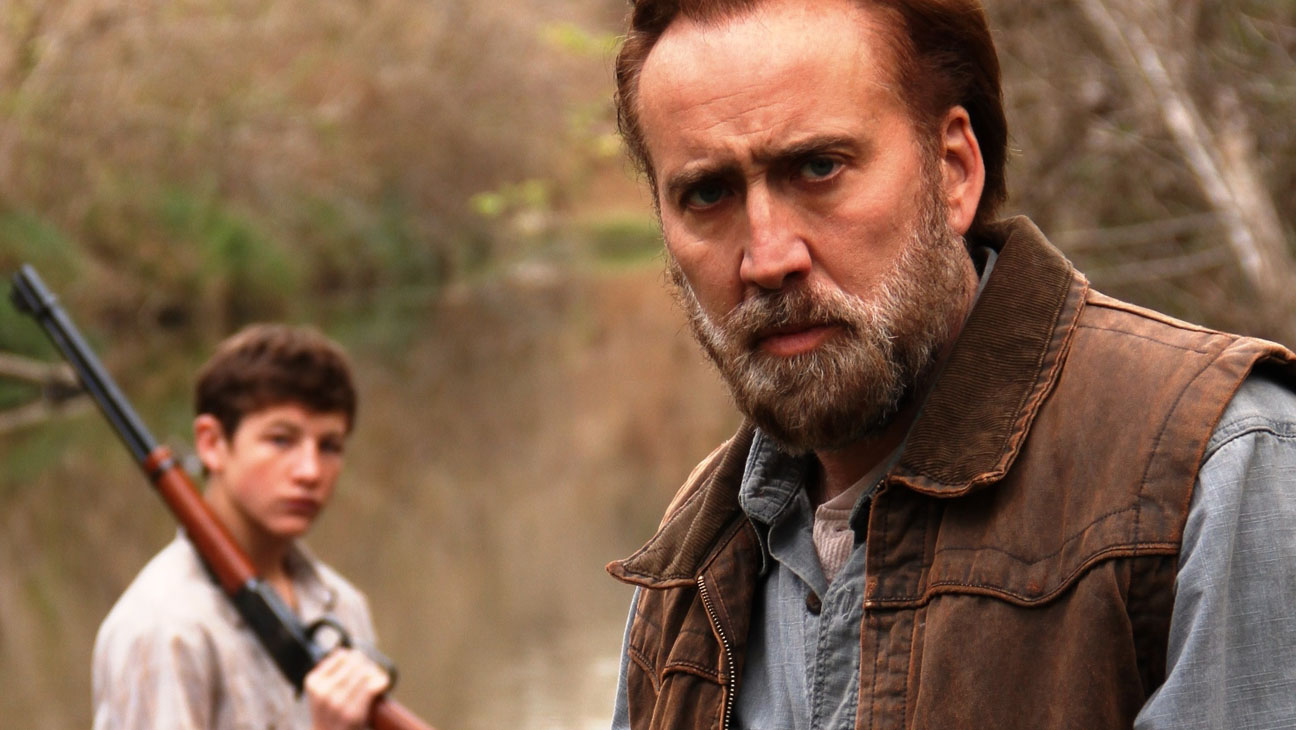
Tye Sullivan, Nicolas Cage in "Joe"

Tye Sullivan, Nicolas Cage in “Joe”

“JOE” My rating: B (Now showing at the Leawood)

118 minutes | MPAA rating: R

Nicolas Cage has for so long seemed a parody of himself that it’s a minor shock to realize that an Oscar-winning actor still lurks beneath the scenery chewing.

As the title character of the rural-Texas drama “Joe,” Cage shows he’s still got it, delivering an indelible portrait of a small-town ex-con trying to get through life without falling back into the violence that almost ruined his life.

The bearded, laconic Joe contracts with a big lumber concern to scour company forest land, poisoning trees that are of no commercial value to make way for new seedlings. He has a crew of workers – unsophisticated, rural black men, mostly – with whom he does a neat balancing act, being both the man who writes the paychecks and just one of the guys.

Gary Hawkins’ screenplay (adapting Larry Brown’s novel) isn’t densely plotted. It’s more of an extended character study.

Joe lives outside town in a nondescript farmhouse. A pit bull on a chain lives beneath the porch. He tends to drink alone at the local bar. He’s hasn’t got a regular girl – although halfway through he allows a local gal to stay with him until her trouble at home blows over. He’s known by his first name at the seedy whorehouse outside town.

At the same time, Joe appears always ready to do a good deed for someone even more hapless at negotiating life than he is. He’s no Chamber of Commerce poster boy, but he tries to keep his nose clean and do right by others.

Continue Reading »

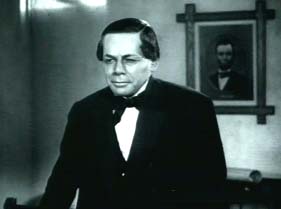
young-mr-lincoln

“Young Mr. Lincoln” screens at 1:30 p.m. Saturday, May 3, 2014 in the Durwood Film Vault of the Kansas City Central Library, 14W. 10th St.  Admission is free. It’s part of the year-long film series Hollywood’s Greatest Year, featuring movies released in 1939.

In the essay “Mr. Lincoln by Mr. Ford,” the great Soviet movie maker Sergei Eisenstein – whose 1925 silent film Battleship Potemkin remains embedded in most critics’ short lists of the best movies ever made – speculated on the one American movie he wished he had made.

He chose John Ford’s “Young Mr. Lincoln.”

Ford had made films that were richer and more effective, Eisenstein wrote. But “Young Mr. Lincoln” “has a quality, a wonderful quality, a quality that every work of art must have – an astonishing harmony of all its component parts, a really amazing harmony as a whole.”

Seventy five years after its creation, the film still retains an astonishing ability to tap into our shared mythology. Much of Ford’s artistic output can be summed up in one question – What does it mean to be an American? – and “Young Mr. Lincoln” provides some essential answers.

As the title suggests, Lamar Trotti’s screenplay is about Lincoln before he became a famous icon. It covers the early months of his law practice in Springfield, Illinois in the 1840s, and centers on Lincoln’s first big case, a murder trial. (Actually, it is a highly fictionalized version of a murder case that Lincoln handled in 1858, shortly before he got into national politics).

Watching the film today one is struck by how much actor Henry Fonda looks like photos of the young Lincoln (Fonda donned a prosthetic nose and wart for the role, and at one point rides a miniature mule that makes his legs look ridiculously long). It’s an astounding performance, one that gives us a rough-hewn, unpretentious Abe but which is packed with intimations of the greatness that is to come.

Continue Reading »

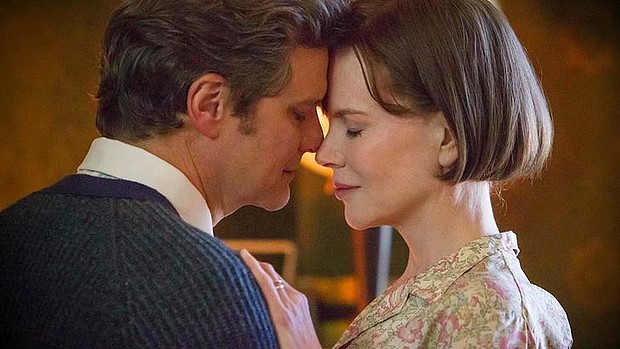
Colin Firth, Nicole Kidman

Colin Firth, Nicole Kidman

“THE RAILWAY MAN”  My rating: B- (Now showing at the Glenwood Arts)

116 minutes | MPAA rating: R

Knowing that the story told in “The Railway Man” is more or less true is essential to appreciating Jonathan Teplitzky’s film.

For there are moments here – lots of them – when I felt I’d been conned into a clumsily structured, overly earnest “lesson” film.

The story begins with a bit of deceptive  romance.  Sixtyish Eric Lomax (Colin Firth) is a British bachelor who loves trains.  He’s not a trainspotter, he emphasizes, but a “train enthusiast.”  This being 1980 in jolly olde England, there are plenty of trains to take pleasure in.

On one such train he runs into Patti (Nicole Kidman), a recently divorced woman whom he helps plana trip to Scotland.  Eric may not be terribly adept socially, but he apparently has the schedule of every train in Britain committed to memory.

As they cruise through the countryside, Eric regales her with bits of local history.  One town, he notes, was where the film “Brief Encounter” was shot…a nice observation since Eric and Patti seem to be living their own version of that classic movie.

So…”The Railway Man” is a sweet,  late-in-life love story?

Continue Reading »

under-the-skin-scarjo-3“UNDER THE SKIN” My rating: B (Opens April 18 at the Cinemark Palace, AMC Town Center 20, and Leawood)

108 minutes | MPAA rating: R

Jonathan Glazer’s “Under the Skin” moves like molasses and is astonishingly stingy when it comes to explaining itself…yet there’s something compelling about this challenging, maddening experience you can’t quite shake.

One big thing it has going for it is Scarlett Johansson, weirdly fascinating as a young woman who drives around Glasgow, Scotland, trying to initiate conversations with young men. It’s not that the actress has to show a lot of range here…but she is Lady Scarlett, one of the most watchable movie stars we’ve got.

Johansson’s character hasn’t a name. She seems utterly without emotion…although when confronted with a specimen of thick Scottish manhood she seems to know just what buttons to push — quiet and circumspect with some fellas, more aggressive with others.

When one of these young oafs gets into her vehicle with a bit of action on his mind, she drives him to an abandoned building where both disrobe and she leads him into a pool of black, viscous stuff that sucks him up.

Clearly, our girl is not of this world. Is she killing these lunks?  Storing them for a food supply?

Expect no answers.

She drives around in a white panel van (apparently the vehicle of choice of serial killers throughout the galaxy) and frequently interacts with a silent man in cycle leathers who rides a bike and abets our heroine, though what exactly he’s doing is never explained.

Continue Reading »

Jude Law as Dom Hemingway

Jude Law as Dom Hemingway

“DOM HEMINGWAY” My rating: B- (Opening April 18 at the Glenwood Arts, AMC Studio 30, and Cinemark Palace)

93 minutes | MPAA rating: R

Every now and then an actor needs to get outside his comfort zone.

In “Dom Hemingway,”  Jude Law leaves his usual suave screen persona wimpering in the dust.

That it’s going to be a bumpy ride is evident from the first shot of the film, a long take of Dom’s face and naked shoulders as he screams about the power of his penis.

It’s a mighty organ, to hear Dom tell it, capable of upending empires and slaying women who merely get a glimpse of it, and his spittle-spewing rant goes on for two, three, maybe even four minutes of uninterrupted profane poetry.

Oh, did I mention that Dom’s in prison and being pleasured by a young inmate while he lets rip with his phallic analysis?

Dom has spent the last 12 years in a British prison for refusing to give up the crime boss for whom he worked.  Now he’s getting out, and he fully expects to be repaid for his time behind bars.

He’s met at the prison gates by his old pal Dickie (Richard Grant, marvelously greasy), who over the years has lost one hand on a job and now wears an inflexible prosthetic in a black leather glove.

Dom has two things immediately on his mind.  First, sex.  Dickie has provided a couple of eager birds for just that purpose.  Second, he beats the living crap out of the nondescript guy who married Dom’s ex-wife (she has since died of cancer) and raised Dom’s daughter (Evelyn).

Continue Reading »

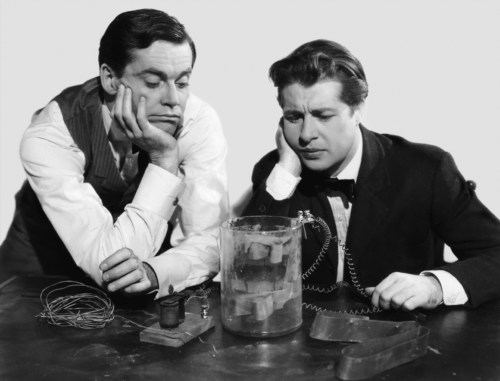
Bette Davis, George Brent, Miriam Hopkins

Bette Davis, George Brent, Miriam Hopkins

“The Old Maid” screens at 1:30 p.m. Saturday, April 26, 2014 in the Durwood Film Vault of the Kansas City Central Library, 14W. 10th St.  Admission is free. It’s part of the year-long film series Hollywood’s Greatest Year, featuring movies released in 1939.


The acting duel you see on screen in The Old Maid isn’t all acting.  It reflects the genuine animosity between its two stars, Bette Davis and Miriam Hopkins.

The 1939 film version of The Old Maid had quite a pedigree. It began as a novella by the great writer Edith Wharton, and became a Pulitzer Prize-winning stage play by Zoe Akins.

The story is pure, unadulterated melodrama.

In the 1860s New York, debutante Delia Lovell (Hopkins) learns on her wedding day that the man to whom she promised herself years before has finally returned, having been out of contact for several years while he made his fortune.  Determined to forge ahead with her marriage into a high society banking family, Delia sends her cousin Charlotte Lovell (Davis) to deal with this old beau, Clem (George Brent).

Charlotte comforts Clem. Apparently she really comforts him, because after a long visit to the country for her “health,” she returns to NYC with a baby girl.  Little Clementine, Charlotte explains, is an orphan she picked up on her trip. In fact, Charlotte begins operating an orphanage for children left parentless by the Civil War.

Clem, little Clementine’s papa, died fighting for the Union.  Anyway, Clementine’s heritage is Charlotte’s most closely guarded secret. The only other person who knows the truth is Delia, now a rich widow.  Delia has Charlotte and Clementine come live with her, and Clementine grows up thinking that Delia is her adopted mother and that Charlotte, a bitter old maid, is her aunt.

Motherhood! Jealousy! Rejection!

Bring on the violins! (No, seriously…Max Steiner’s musical score keeps the string section madly sawing away. You never have to guess what you’re supposed to be feeling in any scene because the overwrought music does that job for you.)

Continue Reading »

Bette Davis, George Brent

Bette Davis, George Brent

“Dark Victory” screens at 1:30 p.m. Saturday, April 19, 2014 in the Durwood Film Vault of the Kansas City Central Library, 14W. 10th St.  Admission is free. It’s part of the year-long film series Hollywood’s Greatest Year, featuring movies released in 1939.

“Dark Victory” is one of those old-fashioned weepies that sophisticated film goers hate to love.

But then, ever since its release in 1939 this Bette Davis classic has left audiences torn between helpless sobbing and a slow-burning resentment over the picture’s emotional manipulation.

Davis, who was nominated for a best actress Oscar (she lost to Vivien Leigh in “Gone With the Wind”), plays spoiled, vivacious heiress Judith Traherne, who is diagnosed with a brain tumor and falls in love with the surgeon who goes poking around in her noggin.

Problem is, after the surgery the M.D. realizes the tumor will come back with fatal results.  But he doesn’t tell his patient of the grim diagnosis (a choice that today would get his license yanked), allowing her to go along with her flighty life. Judith will feel perfectly fine until the day ten months hence when she goes suddenly blind and drops dead.

Continue Reading »

220px-The_Unknown_Known_poster“THE UNKNOWN KNOWN” My rating: B (Opening April 11 at the Screenland Crown Center)

103 minutes | MPAA rating: PG-13

Who the hell is Donald Rumsfeld, anyway?

I mean, I know he has been a career public servant since the Nixon administration, a bureaucrat with unmatchable survival instincts. I know he’s served as Secretary of Defense under two presidents, that he was one of the major creators of the War on Terror.

I remember being in awe of Rummy for his passive/aggressive handling of journalists during the Iraq war – he could engage in a seemingly affable conversation while giving the unmistakable impression that he considered all reporters to be idiots bent on wasting his time.

Was I amused at his disdain for a free press? Outraged? Both, actually.

But, inside, who is this guy?

I had hoped for answers from “The Unknown Known,” the latest documentary from Errol Morris. A few years back in “The Fog of War” Morris turned his camera on Vietnam war architect Robert McNamara, and the result was an Oscar-winning study of a once-powerful man haunted by his mistakes.

So perhaps Morris would work the same sort of magic on Donald Rumsfeld?

Dream on. For starters, the word “mistake” may not even exist in Rumsfeld’s vocabulary. His admitting to one would be a sure sign of the End of Days.

Continue Reading »

Joan Crawford, Norma Shearer, Rosalind Russell

Joan Crawford, Norma Shearer, Rosalind Russell

“The Women” screens at 1:30 p.m. Saturday, April 12, 2014 in the Durwood Film Vault of the Kansas City Central Library, 14W. 10th St.  Admission is free. It’s part of the year-long film series Hollywood’s Greatest Year, featuring movies released in 1939.

No good parts for women?

Not in 1939. That was the year director George Cukor gave us “The Women,” an alternately satiric and heartstring-tugging  comedy featuring an all-female cast. (No man is seen on screen…not even depicted in a photo hanging on the wall.)

Our heroine is well-to-do Mary Haines (Norma Shearer), who learns from a gossiping beautician that her husband has been gallivanting with a slutty perfume counter girl (Joan Crawford). As if that wasn’t upsetting enough, the catty rumor monger Sylvia Fowler (Rosalind Russell) is having a field day spreading the news of Mary’s dilemma through the Park Avenue grapevine.

That’s the basic setup, but the film has an endless supply of subplots and supporting characters. Among the actresses you’ll see here are Mary Boland, Paulette Goddard, Joan Fontaine, Marjorie Main, Virginia Grey, Ruth Hussey and Hedda Hopper (who was an actress before becoming one of Hollywood’s most power gossip columnists).

The film was based on the hit Broadway play by Clare Booth Luce, who in addition to being an accomplished woman of letters was the wife of the powerful Henry Luce, publisher of Time, Life and Fortune magazines. Later she would be elected to the U.S. House of Representatives from Connecticut and would become a U.S. ambassador.

Luce was a notorious wit whose axioms have entered our common language: “Widowhood is a fringe benefit of marriage.” “A hospital is not the place to be sick.” “No good deed goes unpunished.”

Continue Reading »

cap 3“CAPTAIN AMERICA: THE WINTER SOLDIER” My rating: C+ (Opening wide)

136 minutes | MPAA rating: PG-13

There are few moments early in “Captain America: The Winter Soldier” that suggest what the film might have been.

Fans of the Marvel Universe will recall that at the end of 2011’s “Captain America: The First Avenger,” the Cap (Chris Evans) was thawed out after a half-century of suspended animation and was recruited by Nick Fury (Samuel L. Jackson) and his super-secret spy organization S.H.I.E.L.D.

Put yourself in the Captain’s shoes. You grew up in the 1930s a 98-pound weakling. You were transformed into a muscled hunk of extraordinary power by some government-brewed elixir. You fought the Nazis in World War II.

And now you’re in 2014. Overnight you went from a world where “high tech” meant an AM radio to one of cell phones and the worldwide web. Of course, you must contend with more than just technical advancements. You’re bombarded by modern morals and sensibilities that run counter to your squeaky-clean upbringing.

When you were frozen the word “teenager” didn’t exist. Now you’re in a civilization that caters to teens as the most desirable demographic (this movie being Exhibit A).

Credit Christopher Markus and Stephen McFeely’s screenplay for this much at least: It tries to say something about the dislocation that good-guy Cap – aka Steve Rogers – feels, to explore the angst of a man from a genteel past trapped in a crass present.

That’s a movie I would have enjoyed.

Continue Reading »