Feeds:
Posts
Comments
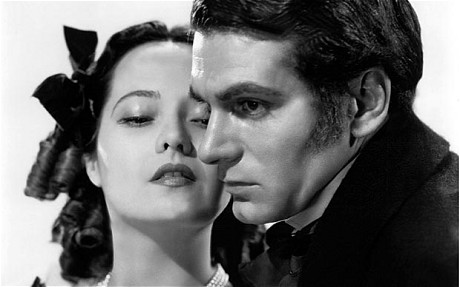
The amazing Charles Laughton in the title role of "The Hunchback of Notre Dame"

The amazing Charles Laughton in the title role of “The Hunchback of Notre Dame”

“The Hunchbck of Notre Dame” screens at 1:30 p.m. Saturday, Feb. 8, 2014 in the Durwood Film Vault of the Kansas City Central Library, 14W. 10th St.  Admission is free. It’s part of the year-long film sereies Hollywood’s Greatest Year, which offers movies released in 1939.

During the 1930s RKO wasn’t known as a prestige movie studio.

It wasn’t a poverty row operation, but neither did it have the sort of big budgets and lavish productions that were the pride of outfits like M-G-M, Fox, and Paramount.

But for 1939’s “The Hunchback of Notre Dame,” RKO pulled out all the stops.

A replica of Medieval Paris was built on the RKO ranch in the San Fernando Valley, with a life-size recreation of the façade of Notre Dame Cathedral. It was so tall that local officials insisted on a blinking red light being placed atop it as a warning to aircraft.

An RKO sound team was dispatched to France to record the cathedral’s bells – those recordings were later incorporated into the film’s soundtrack.

The man many viewed as the greatest actor of the day – Britain’s Charles Laughton – was hired to play the deformed title character of Victor Hugo’s story. William Dieterle — revered for such films as “A Midsummer Night’s Dream,” “The Story of Louis Pasteur,” “The Prince and the Pauper,” ” The Life of Emile Zola” and “Juarez” – was given directing duties.

True, the studio tried to save some money by casting a couple of key roles with relatively inexpensive newcomers. But as we’ll see, even those players were on the cusp of greatness.

Before it was over RKO spent nearly $2 million on the production, making it the studio’s most expensive to date. But the results were hard to argue with.

For this “Hunchback” is not only the best version of the tale ever committed to celluloid, it is a remarkable artistic achievement – hugely emotional and entertaining, packed with political/social subtext, and marked by a fantastically detailed sense of time and place…not to mention great performances.

Just how good the film is going to be is obvious from the first scene, a huge celebration unfolding in the shadow of Notre Dame.  Thousands of Parisians are celebrating a feast day with drinking, carousing, jugglers, and dancers. Dieterle, who cut his cinema teeth on German expressionism, captures the chaos with rapid editing and tilted camera angles that give the proceedings an almost drunken feel.

Laughton’s Quasimodo, the cathedral’s deaf, deformed bell ringer, is introduced in an amazing closeup as his head is thrust through a curtain. He’s been nominated as the king of fools, an honor given the ugliest person in Paris.  He more than earns it.

Continue Reading »

"Possessions"

“Possessions”

This year’s program of Oscar-nominated animated shorts opens Jan. 31 at the Tivoli.

“POSSESSION” (directed by Shuhei Morita; Japan;  14 minutes) My rating: A

In this visual tour-de-force – presented in a cell-animation form that often resembles classic Japanese prints – a traveler seeks shelter from a storm in an abandoned hut deep in the woods.

But thought it’s tiny on the outside, this building seems huge on the inside. The man discovers hundreds of torn and broken parasols which he painstakingly repairs. Little by little he explores this haunted environment, and has an encounter with the ghostly woman who lives there.

Clearly inspired by samurai movies (especially “Ugetsu”), Shuhei Morita’s film defies waking logic – it’s a dream (or a nightmare) adhering to its own rules.

But – good lord! – is it ever beautiful, a masterpiece of design, an opera of light and shadow, a seamless synthesis of classic Disney-style animation and Japanese anime.  I could watch it again…and again… and again.

"Get A Horse"

“Get A Horse”

“GET A HORSE” (directed by Lauren MacMullan; USA; 6 minutes) My rating: B

Taking her cue from Buster Keaton’s silent masterpiece “Sherlock Junior” (a dimension-bending comedy in which a movie projectionist dreams that he enters the world depicted on the screen), Disney animator Lauren MacMullan has come up with a witty – even metaphysical – idea.

Her short begins with an old (or is it?) black-and-white Mickey Mouse cartoon and then breaks down the barriers between screen and theater auditorium.

In the “old” movie, Minnie Mouse is kidnapped by perennial villain Pegleg Pete. Mickey tries to save her. But at a certain point the action spills off of the screen and into the theater in which we are sitting. Once they are in our reality, the characters are presented in full color and the rounded surfaces of sophisticated computer animation.

Audiences for Disney’s Christmas release “Frozen” saw “Get a Horse” in 3-D, which further highlighted the difference between the flat “old” movie and the depth of the action unfolding in front of the screen in the “real”  theater.

This is less an animated comedy than it is a meditation on real and unreal, 2-D and 3-D, on animation’s roots and  its current state of anything-is-possible.

By the way, Mickey’s voice is provided by the late Walt Disney (he did the vocal honors for the first couple of years of sound cartoons). Nice touch. Continue Reading »

Tom Hollander, Martin Freeman in "The Voorman Project"

Tom Hollander, Martin Freeman in “The Voorman Project”

This program of the 2013 Oscar-nominated live-action shorts opens Jan. 30 at the Tivoli.

“THE VOORMAN PROBLEM” (Directed by Mark Gill; UK; 13 minutes) My rating: B-

It features a couple of recognizable faces and some impressive ultra-widescreen cinematography, but basically Mark Gill’s “The Voorman Problem” plays like a truncated “Twilight Zone” episode.

Martin Freeman (“The Hobbit,” PBS’s “Sherlock”) is Doctor Williams, a psychiatrist summoned to a prison to examine an inmate who claims to be God.  Williams interviews Voorman (Tom Hollander) — who is trussed up in a straightjacket — and finds that his patient is smart, cocky, droll, and absolutely committed to his, er, delusion.

Voorman announces that the universe is only nine days old — that he created it only a week earlier. When the doctor protests that he has years worth of memories stretching back to early childhood, Voorman says that’s because he gave the doc those memories.

“I know you’re skeptical, Doctor,” Voorman says. “I made you that way.”

As proof of his powers, the prisoner announces that he’s going to do away with Belgium. Crazy, right? Except that when Williams goes home that night and opens his trusty world atlas,  he discovers that the space formerly occupied by Belgium is now a large inland sea.

“The Voorman Problem” is technically accomplished (but why wide-screen treatment for so claustrophobic a topic?), well acted and quite amusing. But it’s a lot of effort devoted to a jokey idea.

** and ** in "Helium"

Pelle Falk Krusbaek and Casper Crump in “Helium”

“HELIUM” (directed by Anders Walter; Denmark; 22 minutes) My rating: A

A quiet little heartbreaker of extraordinary power, the Danish “Helium” unfolds in a children’s hospital where a newly-hired janitor, Enzo  (Casper Crump), befriends the terminally ill Alfred (Pelle Falk Krusbaek).

Alfred has no illusions about his future — “They say I’m going to heaven…looks like a boring place to me” – and Enzo responds by creating for him a world called Helium, “where sick kids go to get their health back.”  Alfred – who is a big aviation fan – will be transported to this alternate universe aboard the Helium Express, a huge Jules Verne-ish airship.

As Alfred’s health fails and Enzo tries to wrap up his story while there’s still time, “Helium” raises all sorts of moral conundrums.  Does Enzo – not a parent or a doctor but a mere janitor — have any right to fill the boy’s head with nonsense? Is Helium any more ludicrous a concept than a cloudy afterlife filled with harp-strumming angels? And where do you stand on lies when those lies provide hope?

Director Anders Walter dishes some lovely fantasy sequences set in the ethereal Helium, but the film’s greatest triumphs take place in a hospital room where two souls struggle to find meaning in tragedy.

Leah Drucker, ** in "Just Before Losing Everything"

Leah Drucker, Miljan Chatelain in “Just Before Losing Everything”

“JUST BEFORE LOSING EVERYTHING” (directed by Xavier LeGrand; France; 30 minutes) My rating: B+

Small, seemingly insignificant details add up to a gut-knotting nail biter in “Just Before Losing Everything,” a French production that keeps us on the edge of our seats.

Director Xavier LeGrand builds his story slowly.  A little boy (Miljan Chatelain) ditches school and hides under a brdige. His mother (Lea Drucker) picks him up in her car. Then they get his teenage sister (Anne Benoit), who bids a tearful farewell to her boyfriend.

They drive to the mother’s workplace, a big box store where her coworkers – everyone from sales clerks to the manager – bends over backwards to facilitate what we finally realize is an escape from an abusive husband and father.

And then Daddy (Denis Menochet) shows up at the store looking for the Missus.

With a lived-in feel and almost documentary performances, “Just Before Losing Everything” brings us face to face with a story repeated hundreds of times a day. Frankly, it’s scarier than any horror movie I’ve seen in a long time. Continue Reading »

"Prison Terminal"

“Prison Terminal”

This program of the 2013 Oscar-nominated documentary shorts opens Jan. 30 at the Tivoli.

“PRISON TERMINAL: THE LAST DAYS OF PRIVATE JACK HALL”  (directed by Edgar Barens; USA: 40 minutes) My rating: A-

Nearly three decades ago Jack Hall – a decorated veteran of World War II who spent time in a German POW camp – murdered the drug dealer who had hooked Jack’s teenage son, leading to the boy’s suicide.

Jack has spent the last 12 years of his life sentence in the infirmary of  the Iowa State Penitentiary in Fort Madison. But his chronic heart and lung ailments now have reached the point that he’s moved to the prison’s hospice facility.

There other inmates – many of them serving life terms for murder – will bathe Jack, massage him, lift him, and pray with him. It’s volunteer work – the state has no money to staff the hospice. None of these men has much chance of dying outside the prison walls – the best they can hope for is to reclaim some of their humanity by caring for each other.

“Prison Terminal” follows the 82-year-old Jack through his last days. The cinema verite style adopted by director Edgar Barens certainly captures the grimy reality of life behind prison walls.

The down side is that without a narrator, the film seems a bit stingy with facts. I wanted to know more about Jack’s crime and his earlier life. He seems harmless now, but there are hints of multiple marriages, post traumatic stress disorder, alcoholism, and regular run-ins with the law.

But as a purely emotional experience, “Prison Terminal” is powerful, gut-wrenching stuff. Dare you not to shed a tear over the death of this killer.

FYI: “Prison Terminal” debuts on Jan. 13 on HBO.

Ra Paulette in one of his creations

Ra Paulette in one of his creations

“CAVE DIGGER” (directed by Jeffrey Karoff ; USA; 37 minutes) My rating: B

Art and artists come in many forms. But Ra Paulette and his work are one of a kind.

Paulette, 65, digs caves in the sandstone near his New Mexico home. He’s been doing it for 30 years, creating astonishing underground spaces – they’ve been called cathedrals – of soaring columns, winding corridors and intricately carved friezes. He does it working alone with just hand tools and a wheelbarrow. No blasting. No power tools.

He calls his work “a celebration…I want to create a space that is transformative.”  Well, mission accomplished.

But as Jeffrey Karoff’s documentary shows,  it’s not an easy vocation. Though obviously smart and well spoken, Paulette is driven to “uncover something that’s already there.” He doesn’t work from plans, but feels his way through his growing subterranean spaces. He knows when it’s time to stop, but more often than not his projects end when their sponsors – folks who think it would be cool to have a shrine-like cave on their property – grow short of cash and patience.

“I am not the paintbrush,” he says, “and my client is not the painter.” In other words, Ra Paulette is always in charge.

Unlike the artist Andy Goldwsworthy – famous for installations using materials from nature – Paulette has never figured out how to earn a living from his art. He survives largely through the good graces of his oft-exasperated wife.

And yet like all good artists, he does it because he must. His purpose in life, he says, is “digging a hole in the ground and finding God in that hole.”

Amen.

"Karama Has No Walls"...the charge against the barricade

“Karama Has No Walls”…the charge against the barricade

“Karama Has No Walls” (directed by Sara Ishaq; Yemen; 27 minutes) My rating: B+

In March 2011 thousands of protestors gathered in Change Square in the center of Yemen’s capitol city. Inspired by the Arab Spring that was fomenting revolutionary movements  all over the Islamic world, the protestors demanded the retirement of the president who had ruled for 33 years.

Sara Ishaq’s documentary – drawing heavily from footage shot by two young cameramen – follows the growing peaceful protest and expanding tent city. Watching the dancing, singing, and drum playing, you can’t help but be reminded of Occupy Wall Street movement in NYC and elsewhere.

But the president’s security forces weren’t giving up easily. They built a wall blocking one street into the square, and from behind this barricade launched a wave of burning gasoline while snipers fired into the crowd from rooftops.

It’s at this point that “Karama Has No Walls “ (“Karama” is the Arabic word for “dignity”) kicks into high gear. The two cameramen were targeted by the snipers, and they captured extraordinary footage of unarmed protestors charging and toppling the barricade, even as people around them were mowed down by bullets meant for the journalists.

Ishaq peppers her film with talking-head interviews with the fathers of two of the incident’s young fatalities, and with the testimony of the cameramen.  It’s touching, but nothing can match the hair-raising footage of the confrontation itself. Continue Reading »


iron“The Man in the Iron Mask” screens at 1:30 p.m. Saturday, Feb. 1, 2014 in the Durwood Film Vault of the Kansas City Central Library, 14W. 10th St.  Admission is free. It’s part of the year-long film sereies Hollywood’s Greatest Year, which offers movies released in 1939.

“he Man in the Iron Mask” (1939) is the sort of rousing historical swashbuckler that Hollywood turned out with regularity during its so-called Golden Era.

In this adaptation of Alexander Dumas’ novel, Louis Hayward stars as both the foppish, corrupt King of France and as his twin brother, an honest and charming young swordsman. The royal twins were separated at birth (to avoid competing claims for the throne that might destroy the kingdom) and grew up unaware of each other’s existence.

Louis XIV is a very bad ruler who amuses himself by hanging peasants. His brother Philippe is raised in rural Gascony by D’Artagnan (Warren Williams) and the other swashbucklers introduced in Dumas’ earlier novel The Three Musketeers.

The setup allows Hayward to play two very different characters.  The film’s title springs from a late-breaking development: learning of his twin’s existence, the evil Louis has Philippe imprisoned in the Bastille, his head encased in a metal mask that, with time, will choke the prisoner on his own growing beard and hair.

Not to worry. D’Artagnan and the other musketeers will come to his rescue and ensure that Philippe is reunited with his true love, Maria Theresa of Spain (Joan Bennett).

“The Man in the Iron Mask” is the last great gasp in the career of director James Whale, who rose to prominence with Universal’s horror pictures and then found himself more-or-less blacklisted because he was openly gay.

Whale grew up an artistically inclined youth in a factory town in the English West Midlands. Even before he recognized his own homosexuality, simply by wanting a career in the arts the working-class Whale marked himself as an outsider. In fact outsiders – alcoholics, prostitutes, mad scientists, monsters – were to be the primary subject of his movies.

Continue Reading »

Cary Grant and Jean Arthur

Cary Grant and Jean Arthur

“Only Angels Have Wings” screens at 1:30 p.m. Saturday, January 25, 2014 in the Durwood Film Vault of the Kansas City Central Library, 14W. 10th St.  Admission is free. It’s part of the year-long film sereies Hollywood’s Greatest Year, which offers movies released in 1939.

Before the 1950s, movie companies rarely filmed in exotic locations. If a script called for a Welsh mining village, a Medieval castle, or a steamy jungle, it was all created on a soundstage or the back lot of a Hollywood studio.

Howard Hawks’ Only Angels Have Wings is set in a South American coastal town from which daredevil pilots take off to fly the mail over mountains and into the continent’s interior. It wasn’t shot in South America but on a sound stage in North Hollywood, California.

Creating an entire world on a studio soundstage was all in a day’s work for the designers, artists, and craftsmen on the payroll of every studio in the 1930s.  How good were they?

Watch the first 10 minutes of Only Angels.  The film begins with a nighttime shot of a ship approaching the dock through the fog. (I’m pretty sure a model boat was employed.) Then the camera begins wandering along the pier alongside the ship, following a couple of flyers who are looking for a little after-hours action. There’s a cacophony of voices and sounds, a swirl of busy movement.

Continue Reading »

Chris Pine as the new Jack Ryan

Chris Pine as the new Jack Ryan

“JACK RYAN: SHADOW RECRUIT” My rating: C (Opens wide on January 17)

105 minutes | MPAA rating: PG-13

Tom Clancy’s Jack Ryan has always been the anti-Bond, a CIA agent who balances a normal family life with adventures that carry a torn-from-the-headlines aroma.

No luscious babes. No super villain with a high-tech lair disguised as a volcano.

Actually, “Jack Ryan: Shadow Recruit” might have benefitted from a super villain or a luscious babe or two. This latest attempt to reboot the franchise (previous

Keira Knightley

Keira Knightley

Jack Ryans include Alec Baldwin, Ben Affleck and, most notably, Harrison Ford) is a competent but fairly sedate affair. Whether it will jump-start the series is up to the ticket buyers…I’m not terribly hopeful.

Chris Pine, fresh from his other gig as a young James T. Kirk in the “Star Trek” universe, is our new Jack Ryan. We meet him studying economics in London in 2001. After 9-11 he enlists in the Marines, is shot down in Afghanistan, paralyzed with a spinal injury, and undergoes a long rehab which not only gets him back on his feet but into the bed of his med-student therapist, Cathy (Keira Knightley).

This all happens in the first 10 minutes.

While still recuperating at Walter Reed he’s recruited by CIA spookmaster Thomas Harper (Kevin Costner), who gets Jack a job in a big Wall Street firm from

Kevin Costner

Kevin Costner

which he can covertly look for funding channels for terrorist groups. If he were married to Cathy, Jack could tell her of his real job, but since they’re only living together, he can’t. This puts a strain on their relationship.

Jack’s study of international financing raises alarms of a plot from within Russia to destroy the U.S. economy with a combined terrorist attack and world-wide sell-off of American securities that would make the dollar worthless.

So Jack is off to Moscow to confront one of those newly-minted Russian billionaires, Viktor Cherevin (a thin-lipped Kenneth Branagh), who carries an old Cold War grudge against the Yanks and wants to elevate Mother Russia to her rightful place at the top of the international food chain.

Continue Reading »

bettie“BETTIE PAGE REVEALS ALL”  My rating: B (Opens Jan. 17 at the Tivoli)

101 minutes | MPAA rating: R

Even those who don’t know her name will recognize the look — the black bangs, the gorgeous body (not skinny, not plump, just right), and especially the attitude she wore like other women wore clothing —  a heady blend of healthy sexuality and girl-next-door good humor.

Bettie Page was the pinup girl of the 1950s. Then she vanished, only to return in recent years as an iconic image, the stuff of advertisements, book covers and tattoos.

Her face and form are so universally recognized and accepted that she’s become a brand, and as is  the case with Walt Disney, many young people don’t even realize that Bettie Page was a real person.

Mark Mori and Doug Miller’s documentary, “Bettie Page Reveals All,” means to set the record straight. And they have an unexpected ally: Bettie herself, who a few years before her death at age 85 in 2005 sat down to tape a long audio interview about her life and career.

She’s not the only voice here — the film is packed with talking-head sexperts ranging from Hugh Hefner and Dita Von Teese to pop culture academics and, poignantly, one of Bettie’s former husbands. But Bettie’s is the voice you remember, a grandmotherly voice with a Southern drawl and a tendency to make even horrific memories somehow less ghastly.

Continue Reading »

Clark Gable, Norma Shearer in "Idiot's Delight"

Clark Gable, Norma Shearer in “Idiot’s Delight”

“Idiot’s Delight” screens at 1:30 p.m. Saturday, January 18, 2014 in the Durwood Film Vault of the Kansas City Central Library, 14W. 10th St.  Admission is free. It’s part of the year-long film sereies Hollywood’s Greatest Year, which offers movies released in 1939.

“Idiot’s Delight” is a movie whose time has come.

And gone.

Sorry to damn with faint praise a film based on a Pulitzer Prize-winning play, a movie that features Clark Gable’s only on-screen singing/dancing performance. But this is a classic case of a once-celebrated flick that no longer works for modern audiences.

Still, it came out in 1939 and as one of that year’s hits it’s part of our year-long film series Hollywood’s Greatest Year.

“Idiot’s Delight” is about a bunch of travelers representing different countries and political persuasions who are stranded in a posh mountaintop hotel in the Alps. War has broken out (clearly World War II, though it’s not identified as such) and the borders have been closed.

Continue Reading »

Julianne Nicholson, Meryl Streep, Julia Roberts

Julianne Nicholson, Meryl Streep, Julia Roberts

“AUGUST:  OSAGE COUNTY”  My rating: C+ (Opens wide on Jan. 10)

121 minutes | MPAA rating R

Some stories were meant to be performed on a stage.

For instance, the plays of Sam Shepard, which deliver moments of violence and affrontery you almost never see in live theater. A Shepard character might be required to beat a typewriter to death with a golf club, smash dozens of glass bottles just feet from the folks in the front row, or urinate on his little sister’s science project in full view of the paying customers.

If those things happened in a movie, you’d shrug. No big deal.  In a movie you can do anything.

But seeing those moments play out live, in the flesh, while you brace yourself to dodge flying glass shards or broken typewriter keys…well, that has a way of focusing your mind most wonderfully.

I thought of Shepard’s plays while watching John Wells’ screen version of “August: Osage County,” Tracy Letts’ Pulitzer-winning black comedy about an Oklahoma clan assembled to bury its patriarch (played, ironically enough, by  Sam Shepard).  In the same way that Shepard’s  plays almost never make satisfying movies, “August: Osage County” makes an uncomfortable transition to the screen.

First, don’t buy into the TV ads that make it look like a rollicking comedy.  There are laughs here, yeah, but they’re the sort of laughs you can choke on. Dourness is the order of the day.

In adapting his play Letts has boiled a 3 1/2 hour production down to 2 hours. Stuff’s been left out — character development, carefully calibrated pauses — and while the essence of the play remains, it feels curiously underwhelming.

Continue Reading »