Feeds:
Posts
Comments

Jimmy_P_Movie_Wallpaper_10_qlaon“JIMMY P.”My rating: B (Opening March 7 at the Screenland Armour)

117 minutes | No MPAA rating

Mental health movies tend to run in well-established ruts.

The theraputic breakthrough. The hellish hospital. Indifferent doctors and sadistic aides/nurses.

“Jimmy P.” isn’t having any of that. This drama from French director Arnaud Desplechin (his last movie was 2008’s “A Christmas Tale,”  a fondly remembered family drama with Catherine Daneuve as the head of a troubled but still tight family) is fiercely, stubbornly realistic.  As well it should be, since  Desplechin adapted it from a memoir by psychiatrist George Devereux, who worked for years at the famous Menninger Clinic in Topeka.

Jimmy Picard (Oscar winner Benicico del Toro) is a Blackfoot Indian from Montana, recently returned from World War II. While in France he suffered a severe head injury in a fall from a moving truck.  Now he’s suffering from what today we’d call PTSD, which manifests itself in crippling headaches, blindness, and visual and auditory hallucinations.

The Veterans Administration sends him to Topeka, Kansas (it was shot in Michigan and Montana), where the doctors conclude there’s nothing wrong with him physically.  Conventional psychiatric therapy seems the best option.

But Jimmy won’t talk. Though he can be perfectly lucid and even eloquent, something in his Native American background gets in the way of the probing that is part of therapy.

As a last resort, clinic head Karl Menninger (Larry Pine) calls an old friend, Romanian anthropologist and psychiatrist Devereux (Mathieu Almaric), who might be described as an Indian groupie.  He’s fascinated with all things Native America and just spent two years living with a tribe in the Mojave Desert.

Continue Reading »

Emma Roberts, John Cusack

Emma Roberts, John Cusack

“ADULT WORLD” My rating: D (Opening March 7 at the Screenland Armour)

 97 minutes | MPAA rating: R

In the skin-crawling indie comedy “Adult World,” former tweener star Emma Roberts (TV’s “Nancy Drew”) dulls up the screen as a college coed whose lack of self awareness and sense of entitlement  is so total as to be crippling.

Her Amy, a student at Syracuse University, has convinced herself that she’s a great poet. In fact, she is a ghastly poet (“…shattered wings catapult the vulva to vast oblivion…”), but nothing like a reality check gets in the way of her quest for literary greatness.

In short order she has dropped out of school and been kicked out of her parents’ home.  She gets a job clerking at Adult World, a mom & pop adult book/video store owned by a mom and pop (Cloris Leachman and John Collum, who make an early appearance and then bail) and managed by the sweet/cute/ironic  Alex (Evan Peters, Jesse Eisenberg now being too old for these parts.).

Given the setting, you might expect some “Clerks”-style satire of the whole porn thing, but  we get only a few half-hearted stabs at the store’s loser clientele (“Do you have the anti-microbial anal beads?”). Outrageous? Hardly. It it all feels very 1980s made-for-television. (Still can’t figure out what earned the movie an R rating.)

Continue Reading »

Henry Fonda and Claudette Colbert

Henry Fonda and Claudette Colbert

“Drums Along the Mohawk” screens at 1:30 p.m. Saturday, March 8, 2014 in the Durwood Film Vault of the Kansas City Central Library, 14W. 10th St.  Admission is free. It’s part of the year-long film series Hollywood’s Greatest Year, featuring movies released in 1939.

Director John Ford had a terrific year in 1939.

One of his films from that year, Stagecoach, was instantly recognized as a classic and was nominated for the Academy Award for best picture. Plus, it turned around the career of a middling cowboy actor named John Wayne, who thereafter was one of Hollywood’s greatest stars.

Another Ford effort from ’39, Young Mr. Lincoln (with Henry Fonda excelling as the future president), is recognized as one of the finest pieces of Americana ever captured on celluloid.

Given the stratospheric acclaim directed at those two landmarks, it’s not unusual that Ford’s third film from ’39, Drums Along the Mohawk, often gets overlooked.

Which is a real shame, since it’s a strong effort that dovetails seamlessly with Ford’s recurring theme of what it means to be an American.

In addition, it was Ford’s first Technicolor film, and right out of the gate he excelled at capturing brilliant, vibrant images.  In fact, he dismissed color as ridiculously easy to work with when compared to black-and-white.

Based on Walter Edmunds’ bestselling novel (it’s still a great read), Drums centers on the Revolutionary War as it was fought on the frontier, with Yankee settlers battling Indian tribes. The Indians have been convinced by the British that as an independent nation, Americans would waste no time in sweeping westward and seizing tribal land, and that their best interests are to be found by siding with the redcoats.

That’s the story’s background.  But the real meat of the yarn lies in the relationship of and Gil and Lana Martin, newlyweds carving a life out of the wilderness.

Continue Reading »

Olivia DeHavilland, Errol Flynn

Olivia DeHavilland, Errol Flynn

“Dodge City” screens at 1:30 p.m. Saturday, March 1, 2014 in the Durwood Film Vault of the Kansas City Central Library, 14W. 10th St.  Admission is free. It’s part of the year-long film sereies Hollywood’s Greatest Year, featuring movies released in 1939.

Depending upon how you choose to view it, “Dodge City” is either a quintessential Western or a shameless collection of cowboy cliches.

It’s got a cattle drive, a stampede, fetching dance hall girls (the main one is played by Ann Sheridan), a wicked gambler (Bruce Cabot) who runs the town like a private fiefdom, a temperance meeting, a running gun battle on a steam-driven train, and a world-class barroom brawl … all of it captured in glorious early Technicolor.

Most of all it features the cinematic three-way of director Michael Curtiz and stars Errol Flynn and Olivia DeHavilland.

Flynn and DeHavilland had been successfully paired in “Captain Blood” (1935), “The Charge of the Light Brigade” (’36), and “The Adventures of Robin Hood” (’38). They would go on to share the screen in a total of eight features, including “Dodge City” (’39) and “They Died with Their Boots On” (’41).

It was widely assumed that the actor and actress were an item.  But that was all publicity. DeHavilland was a fairly genteel sort, while the Australian Flynn was a notorious womanizer and drinker whose career barely survived a 1942 trial for statutory rape. His memoir was entitled My Wicked, Wicked Ways.

Still, DeHavilland was not immune to her co-star’s bad-boy charisma. “He was a charming and magnetic man,” she wrote years later, “but so tormented. I had a crush on him, and later I found he did for me.”

In the films they made together Flynn and DeHavilland invariably were directed by Curtiz, an Austrian immigrant who just a couple of years later would achieve screen immortality by giving us Bogie and Bergman in “Casablanca.”

Continue Reading »

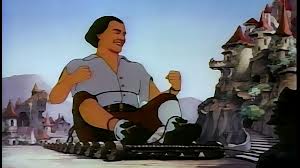
gulliver

“Gulliver’s Travels” screens at 1:30 p.m. Saturday, Feb. 22, 2014 in the Durwood Film Vault of the Kansas City Central Library, 14W. 10th St.  Admission is free. It’s part of the year-long film sereies Hollywood’s Greatest Year, featuring movies released in 1939.

Nobody remembers who came in second.

Perhaps that explains why just about everyone but animation historians have forgotten Gulliver’s Travels. Released by the Fleischer Animation Studio in 1939, it was only the world’s second feature-length animated film.

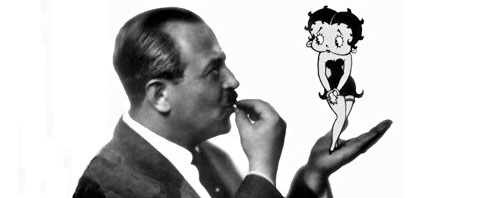
The Fleischer brothers – Dave and Max – got their start in animation in the 1920s. From their New York studio they launched two fantastically popular series.

Max Fleischer and Betty Boop

Max Fleischer and Betty Boop

Betty Boop was a prototypical flapper of the era, a big-headed beauty with a svelt body who was subversively aware of her sex symbol status.

Popeye, on the other hand, was a brawling, mumbling sailor who found superhuman strength in chugging canned spinach.

Both series were solid moneymakers.

But the financial and artistic success of Walt Disney’s Snow White and the Seven Dwarfs  in 1937 convinced the brass at Paramount – which financed the Fleischers – that they needed their own feature animated film.

Prodded into action, the brothers announced that they would adapt Jonathan Swift’s Gulliver’s Travels. It was Max Fleischer’s favorite book from boyhood.

What with its story of the shipwrecked Gulliver being held captive by a society of combative tiny people, there were all sorts of visual possibilities. (The novel’s second half finds Gulliver in a land of giants – but that part of the yarn was dropped.)

Continue Reading »

Paulina Garcia in "Gloria"

Paulina Garcia in “Gloria”

“GLORIA” My rating: B  (Opens Feb. 14 at the Tivoli and Glenwood Arts)

110 minutes |MPAA rating: R

Funny thing about growing older.

Our desires and curiosities can become muted.  Having learned from our youthful mistakes, we’re now more cautious.

Some of us, anyway. There are others who in middle age (or even old age) resume the exploring they gave up long ago…or never experienced in the first place.

Gloria (Paulina Garcia), the title character of Chilean filmmaker Sebastian Lelio’s naturalistic drama, belongs in the second camp.

She’s got two grown kids who don’t get along, a failed marriage in her past, and a full-time job. Which leaves her evenings free to pursue … what?

Romance? Sex? Companionship? Perhaps just the satisfaction of knowing she’s still alive and kicking?

“Gloria” begins in a Santiago club where the over-50 crowd go dancing. Our heroine is no bombshell (she’s got a goofy pair of glasses and a retro ‘do), but she’s got a sly self confidence that is definitely intriguing. Especially to Roldofo (Sergio Hernandez), a retired naval officer several years her senior.

The film is a chronicle of Gloria and Rodolfo’s affair, complete with nude bedroom encounters (brace yourself for less-than-perfect bodies), and it takes us from giddy “this could be the start of something big” territory to hard-nosed lessons in disappointment.

Initially we’re swept off our feet along with Gloria. Rodolfo is charming, sauve, apparently sincere, and he’s something of a self-made man who operates a paintball field where weekend warriors stalk each other with big guns that shoot only pigment.

And the sex is terrific!

Continue Reading »

Merle Oberon, Laurence Olivier

Merle Oberon, Laurence Olivier

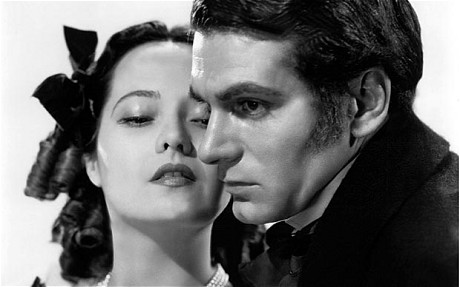
“Wuthering Heights” screens at 1:30 p.m. Saturday, Feb. 15, 2014 in the Durwood Film Vault of the Kansas City Central Library, 14W. 10th St.  Admission is free. It’s part of the year-long film sereies Hollywood’s Greatest Year, which features movies released in 1939.

Happy sets do not always result in happy movies.

Nor do miserable sets invariably produce cinematic dreck.

For proof of that one need look no further than the career of William Wyler, one of the most prolific and honored filmmakers ever.

Films made by Wyler (1902-1981) have won more awards – acting, writing, technical achievement — than those of any other director in Hollywood history. Moreover, Wyler himself was 12 times nominated for an Oscar for best director, winning three times. That’s a record that holds today.

But Wyler had a reputation for crankiness, imperiousness and, some would say, borderline sadism in his handling of actors.

He was a perfectionist who would drive his cast and crews crazy with reshoots, earning him the nickname “90-take Wyler.”  While filming “Jezebel,” he had Henry Fonda do the same scene 40 times in a row. His only comment to the actor was “Again.”

When an exasperated Fonda asked what was wrong with the take they’d just completed, Wyler replied: “It stinks.” And kept on shooting.

In 1938 producer Samuel Goldwyn contracted with Wyler to direct an adaptation of Emily Bronte’s Gothic classic, “Wuthering Heights.”

By this time Wyler – who was born in Alsace, a French-speaking district of Germany – had been shooting Hollywood features for a decade.

His earliest efforts were mostly Westerns (a French-speaking German shooting cowboy pictures … go figure) but he’d also done a good mix of comedy (“Her First Mate,” “The Good Fairy,” “The Gay Deception”) and drama (“Counselor at Law,” “These Three,” “Dodsworth,” “Dead End”).

Moreover, he’d gotten terrific performances from a wide range of actors: John Barrymore, Paul Lukas, Constance Cummings, Margaret Sullavan, Herbert Marshall, Joel McCrea, Miriam Hopkins, John Huston, Frances Farmer, Humphrey Bogart, Sylvia Sidney.

Continue Reading »

monuments_men“THE MONUMENTS MEN” My rating: C+ (Opening wide on Feb. 7)

118 minutes | MPAA rating: PG-13

Most of  the films George Clooney has directed  — “Confessions of a Dangerous Mind,” “Good Night, and Good Luck” and “The Ides of March” — have found him stretching himself, developing a style that was part indie edgy and part Hollywood classic, with a choice in topics that skewed liberal and humanistic.

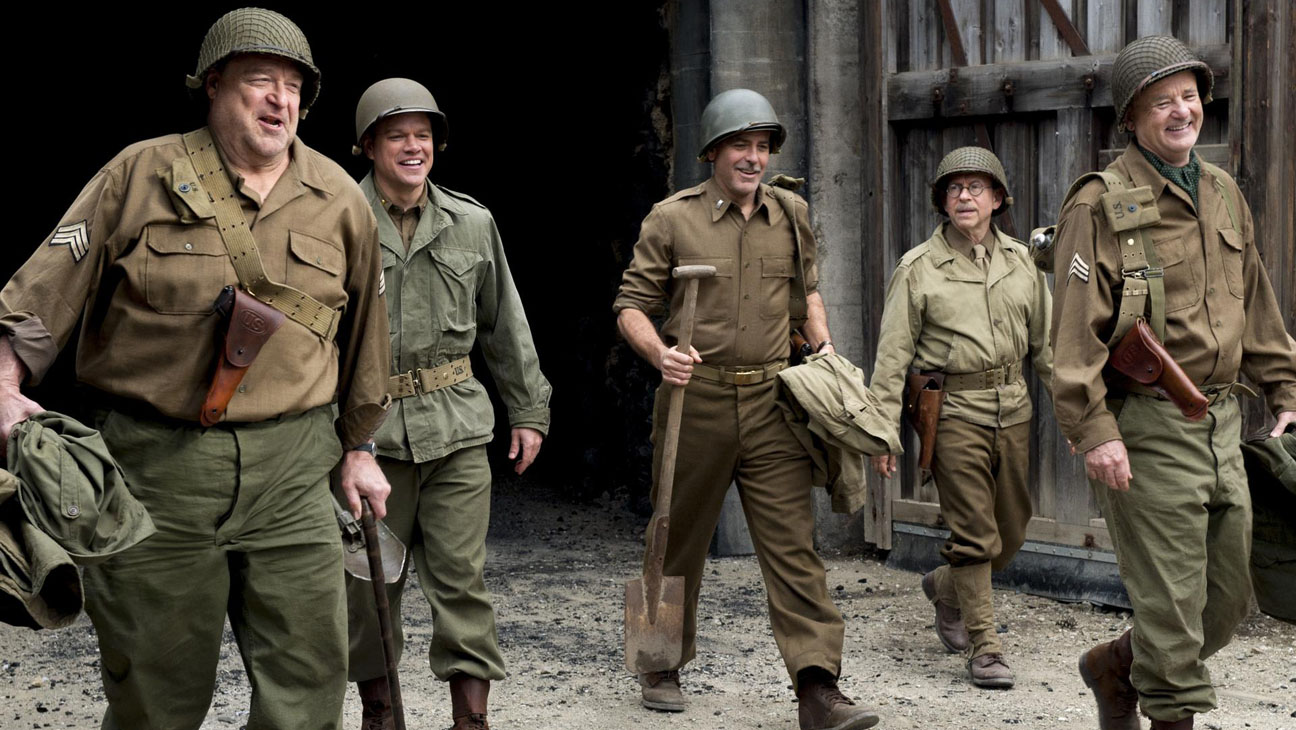
His latest, “Monuments Men,” based on the real-life exploits of art experts who recovered masterpieces stolen by the Nazis, hits the Hollywood classic part perfectly. In fact it feels exactly as if it could have been made by a big studio in the early 1960s.

It’s been lushly produced, carefully scripted, tastefully shot. But edgy it isn’t…there’s hardly a moment here that doesn’t seem to have been painstakingly  weighed and thought out in advance.

Clooney — with a trim ‘stache and graying temples that make him look remarkably like a mature Clark Gable — portrays Frank Stokes, an art expert who creates a unit within the U.S. Army with the sole purpose of tracking down and saving art masterpieces looted by  the Germans.

He recruits a decidedly un-military bunch of art specialists, most of them pushing 60, who must undergo the rigors of basic training before they can be deployed to recently-liberated Normandy to begin their search.

Continue Reading »

The amazing Charles Laughton in the title role of "The Hunchback of Notre Dame"

The amazing Charles Laughton in the title role of “The Hunchback of Notre Dame”

“The Hunchbck of Notre Dame” screens at 1:30 p.m. Saturday, Feb. 8, 2014 in the Durwood Film Vault of the Kansas City Central Library, 14W. 10th St.  Admission is free. It’s part of the year-long film sereies Hollywood’s Greatest Year, which offers movies released in 1939.

During the 1930s RKO wasn’t known as a prestige movie studio.

It wasn’t a poverty row operation, but neither did it have the sort of big budgets and lavish productions that were the pride of outfits like M-G-M, Fox, and Paramount.

But for 1939’s “The Hunchback of Notre Dame,” RKO pulled out all the stops.

A replica of Medieval Paris was built on the RKO ranch in the San Fernando Valley, with a life-size recreation of the façade of Notre Dame Cathedral. It was so tall that local officials insisted on a blinking red light being placed atop it as a warning to aircraft.

An RKO sound team was dispatched to France to record the cathedral’s bells – those recordings were later incorporated into the film’s soundtrack.

The man many viewed as the greatest actor of the day – Britain’s Charles Laughton – was hired to play the deformed title character of Victor Hugo’s story. William Dieterle — revered for such films as “A Midsummer Night’s Dream,” “The Story of Louis Pasteur,” “The Prince and the Pauper,” ” The Life of Emile Zola” and “Juarez” – was given directing duties.

True, the studio tried to save some money by casting a couple of key roles with relatively inexpensive newcomers. But as we’ll see, even those players were on the cusp of greatness.

Before it was over RKO spent nearly $2 million on the production, making it the studio’s most expensive to date. But the results were hard to argue with.

For this “Hunchback” is not only the best version of the tale ever committed to celluloid, it is a remarkable artistic achievement – hugely emotional and entertaining, packed with political/social subtext, and marked by a fantastically detailed sense of time and place…not to mention great performances.

Just how good the film is going to be is obvious from the first scene, a huge celebration unfolding in the shadow of Notre Dame.  Thousands of Parisians are celebrating a feast day with drinking, carousing, jugglers, and dancers. Dieterle, who cut his cinema teeth on German expressionism, captures the chaos with rapid editing and tilted camera angles that give the proceedings an almost drunken feel.

Laughton’s Quasimodo, the cathedral’s deaf, deformed bell ringer, is introduced in an amazing closeup as his head is thrust through a curtain. He’s been nominated as the king of fools, an honor given the ugliest person in Paris.  He more than earns it.

Continue Reading »

"Possessions"

“Possessions”

This year’s program of Oscar-nominated animated shorts opens Jan. 31 at the Tivoli.

“POSSESSION” (directed by Shuhei Morita; Japan;  14 minutes) My rating: A

In this visual tour-de-force – presented in a cell-animation form that often resembles classic Japanese prints – a traveler seeks shelter from a storm in an abandoned hut deep in the woods.

But thought it’s tiny on the outside, this building seems huge on the inside. The man discovers hundreds of torn and broken parasols which he painstakingly repairs. Little by little he explores this haunted environment, and has an encounter with the ghostly woman who lives there.

Clearly inspired by samurai movies (especially “Ugetsu”), Shuhei Morita’s film defies waking logic – it’s a dream (or a nightmare) adhering to its own rules.

But – good lord! – is it ever beautiful, a masterpiece of design, an opera of light and shadow, a seamless synthesis of classic Disney-style animation and Japanese anime.  I could watch it again…and again… and again.

"Get A Horse"

“Get A Horse”

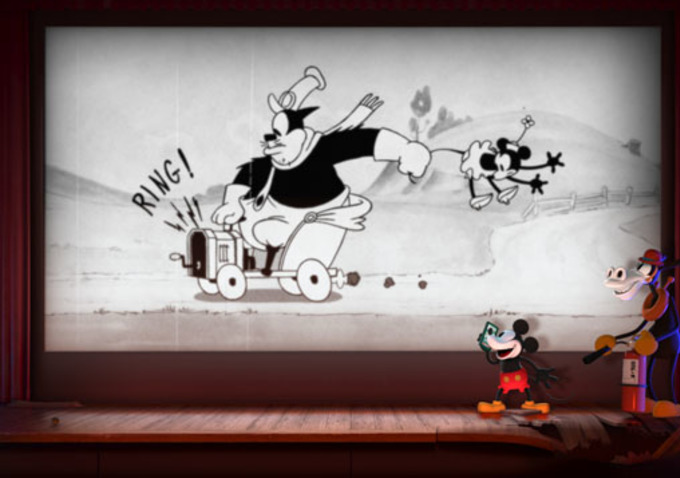
“GET A HORSE” (directed by Lauren MacMullan; USA; 6 minutes) My rating: B

Taking her cue from Buster Keaton’s silent masterpiece “Sherlock Junior” (a dimension-bending comedy in which a movie projectionist dreams that he enters the world depicted on the screen), Disney animator Lauren MacMullan has come up with a witty – even metaphysical – idea.

Her short begins with an old (or is it?) black-and-white Mickey Mouse cartoon and then breaks down the barriers between screen and theater auditorium.

In the “old” movie, Minnie Mouse is kidnapped by perennial villain Pegleg Pete. Mickey tries to save her. But at a certain point the action spills off of the screen and into the theater in which we are sitting. Once they are in our reality, the characters are presented in full color and the rounded surfaces of sophisticated computer animation.

Audiences for Disney’s Christmas release “Frozen” saw “Get a Horse” in 3-D, which further highlighted the difference between the flat “old” movie and the depth of the action unfolding in front of the screen in the “real”  theater.

This is less an animated comedy than it is a meditation on real and unreal, 2-D and 3-D, on animation’s roots and  its current state of anything-is-possible.

By the way, Mickey’s voice is provided by the late Walt Disney (he did the vocal honors for the first couple of years of sound cartoons). Nice touch. Continue Reading »