Feeds:
Posts
Comments

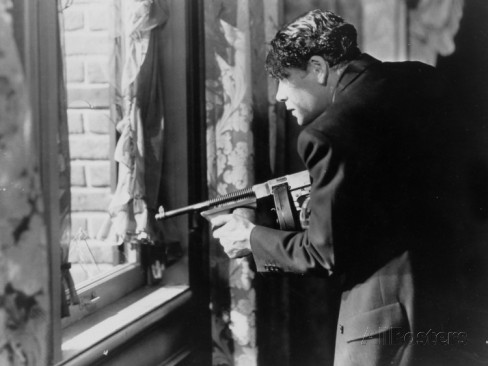
scarface“SCARFACE” screens at 1:30 p.m. Saturday, Dec. 7, at the Kansas City Central Library, 14 W. 10th St., as part of the film series Muni the Magnificent.

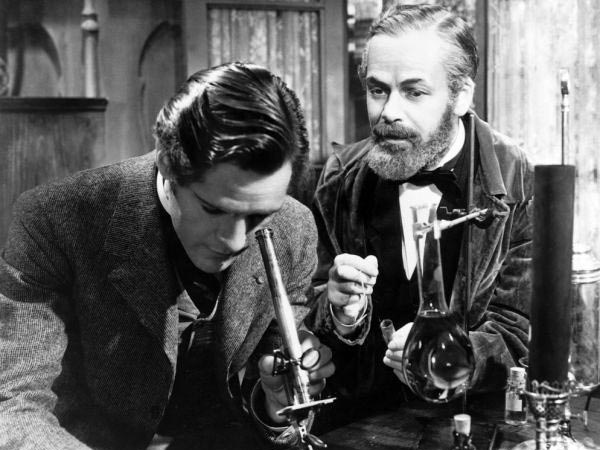
Actor Paul Muni (1895-1967) was a human chameleon obsessed with transforming himself for his roles. Throughout the 1930s and into the ‘40s he was considered America’s premier dramatic actor, landing six Oscar nominations and one win.

But along with his genius came some world-class eccentricities.

Muni was painfully shy and became completely unnerved when fans recognized him in public.

He did extensive research to prepare for his roles and once he’d settled on an interpretation no one – not his director, not his fellow actors – could get him to vary from it. He allowed his wife to be the final judge of his work… if she didn’t approve of a scene, it had to be reshot.

Between takes on the movie set he calmed himself by playing a violin. He was thrown into a panic if he saw someone wearing red clothing.

And Muni gave up a lucrative Warner Bros. contract while still in his acting prime.

Born in Austria, Muni came to America as a child. His parents were actors in the Yiddish Theatre and Muni made his stage debut at age 12 playing an 80-year-old man. A master of stage makeup, Muni was so transformed that theater goers didn’t realize he was just a child.

Yiddish was his first language. He didn’t act in English until he was nearly 30 years old.

Continue Reading »

Bruce Dern, Will Forte

Bruce Dern, Will Forte

“NEBRASKA” My rating: A (Opening Nov. 27 at the Glenwood Arts)

115 minutes | MPAA rating: R

Delightfully funny and surprisingly soulful, “Nebraska” is filmmaker Alexander Payne’s comic valentine to small-town America.

Fuelled by terrific perfs from veteran Bruce Dern and “SNL” alumn Will Forte as a father and son  on a raggedy road trip — and shot in black-and-white so gorgeous you wonder why Hollywood ever let it go – “Nebraska” skewers small minds while celebrating big hearts.

Having it both ways has long been Payne’s trademark (“Sideways,” “About Schmidt,” “The Descendants”), but this time he’s refined his approach to near perfection. “Nebraska” is more than a plot and a collection of performances – it’s a feeling, a state of mind.

It is pretty freakin’ sublime.

Woody Grant (Dern) is an unshaven old coot who may be drifting off into dementia. Repeatedly he’s been found walking the highway near his home in Billings, Montana;  his destination, he tells the cops, is Lincoln, Nebraska, where a fortune awaits him.

In the mail Woody has received one of those publishing sweepstakes prize packets informing him that he may have won $1 million. Now he’s determined to present the dog-eared letter in person and claim his prize.

Continue Reading »

Judi Dench, Steve Coogan

Judi Dench, Steve Coogan

“PHILOMENA” My rating: B+ (Opening wide on Nov. 27)

98 minutes | MPAA Rating: PG-13

It may be a buddy/road movie, but “Philomena” is a buddy/road movie of a singularly high order.

For starters, it’s got Judi Dench in the title role, giving one of her best performances.

The excellence continues with the screenplay by co-star Steve Coogan (with Jeff Pope) that won the top writing award at the Venice Film Fest this year.

And it jells with the direction of Stephen Frears, who approaches potentially controversial and/or maudlin material with just the right deft touch.

Inspired by a non-fiction book by Martin Sixsmith, “Philomena” describes how Sixsmith (Coogan), a former BBC newsman fired from his high-profile government job, goes looking for a story with which to reignite his journalism career.

The perfect yarn falls into his lap when he’s hooked up with Philomena Lee (Dench) , a woman who 50 years earlier gave birth to an illegitimate son in one of Ireland’s notorious Magdalene laundries run by the Catholic Church.

Against her wishes, Philomena’s son was given up for adoption by the nuns. Now she wants to track him down.

“Philomena” pulls off an high-wire balancing act. On the one hand it’s a comedy of class differences.  The rather snooty Sixsmith (nobody can match Coogan when it comes to playing aloof ass-hats) is intially bemused and a bit contemptuous of the working-class Philomena, a woman addicted to bad romance novels whose idea of a big night is sitting in a hotel room watching a Martin Lawrence/”Big Momma” movie.

Coogan and Dench clearly are having a ball playing such dissimilar traveling companions.

Continue Reading »

***, Emily Watson and Stephen Rea in "The Book Thief"

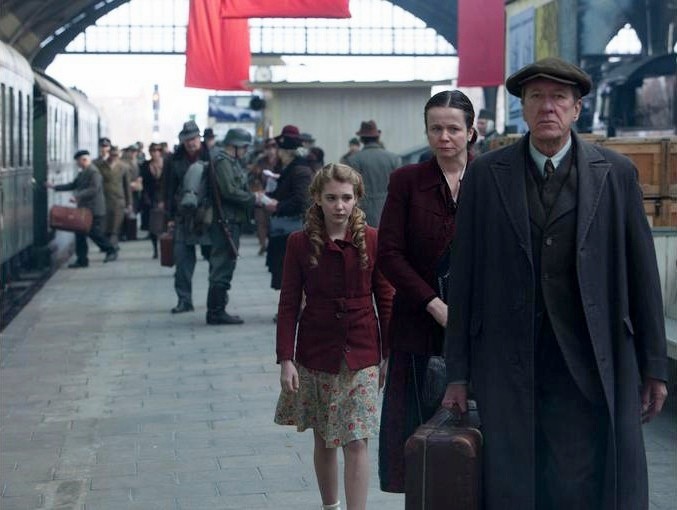
Sophie Nelisse, Emily Watson and Geoffrey Rush in “The Book Thief”

“THE BOOK THIEF”  My rating: B- (Opening wide on Nov. 22)

131 minutes | MPAA rating: PG-13

There is much to admire in the new film “The Book Thief.” But something’s missing.

Fans of the novel will tell you that quite a bit is missing, but they’re talking about plot points jettisoned on the way to the screen. I’m referring to the film’s curious emotional neutrality…this should be a Class A tear-wringer, but it failed to evoke in me even a whimper.

Still,   “The Book Thief” offers an interesting lesson on the difference between literature and movies.

Markus Zusak’s novel — categorized as lit for young people but drawing a far wider audience — is a variation on Anne of Green Gables set in Nazi Germany.

A young girl is adopted by a kindly man and his severe wife. She becomes so obsessed with reading that she risks much to “borrow” books from the local mayor’s private library. Thus the title.

She witnesses Nazi madness:  book burnings, torch-lit rallies, Hitler Youth songfests. The family harbors a fugitive Jew. Her new papa, though far too old for action, is conscripted into the army.

The most amazing thing about the novel, though, is its narrator: Death.  Yep, the Grim Reaper himself, who observes human life from a distance and comments – often sardonically – on his limited (though final) interactions with homo sapiens. Death is the novel’s most interesting character.

He’s hardly in the movie at all.

Continue Reading »

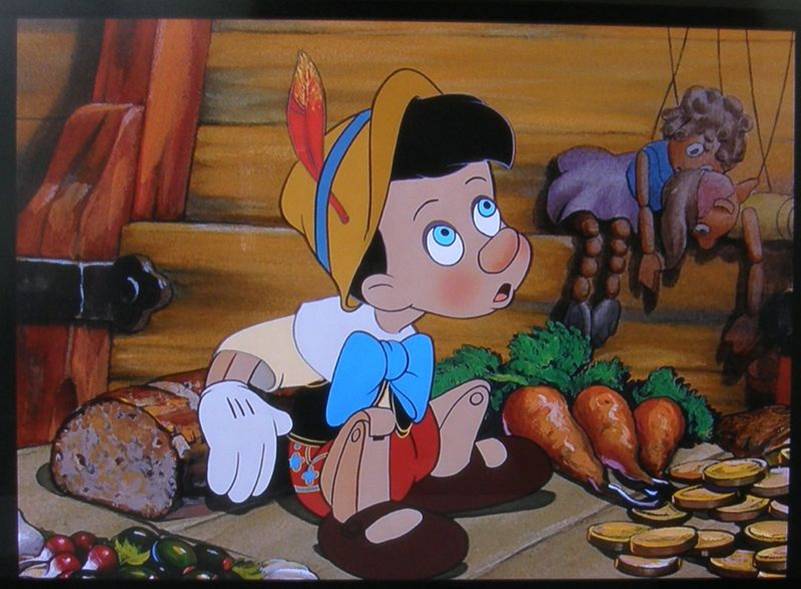
Pinocchio oneMost of us saw Walt Disney’s Pinocchio when we were children.

It was exciting, funny, tuneful, and a bit scary.

In other words, great entertainment for the small fry.

But have you seen Pinocchio since becoming an adult?

It’s a whole other thing.

Pinocchio (1941) screens at 1:30 p.m. Sunday, December 1, 2013,  at the Plaza Branch, 4801 Main St., as part of the Movies That Matter film series. I’ll be showing the film and giving a brief talk before and after the movie. Admission is free.

After the huge success in 1937 of Snow White and the Seven Dwarfs, Walt Disney had planned for Bambi to be his next full-length animated film. But finding an appropriate animation style for that movie’s various forest creatures was proving a problem.

So when one of his animators gave Disney a copy of Carlo Collodi’s 1938 novel The Adventures of Pinocchio, he jumped on the chance to make his next movie about the puppet who yearns to become a real boy.

But it wasn’t as easy a project as Disney had imagined. The Pinocchio of the book is selfish and mean. Nasty, in fact. And while his misbehavior was tolerable on the printed page, in a film it could be alienating.

So the Disney bunch went to work giving the puppet an overhaul. He was redesigned to look less like a severe marionette and more like a cute little boy (hinges were added to his knees and elbows). Pinocchio’s personality got an overhaul, too.  Now he’s an innocent newborn whose lapses are the result not of selfishness or meanness but of his wide-eyed naivete.

In the book Pinocchio squashes a cricket who tries to teach him right from wrong. For the movie the animators elevated the cricket to co-star status. Named Jiminy and voiced by recording sensation Cliff Edwards, this cricket provided a refreshing modern sensibility in the midst of a 19th-century fairy tale. Jiminy offered comic relief.

Continue Reading »

where“WHERE DO WE GO NOW?” screens at 1:30 p.m. Saturday, Nov. 30, at the Kansas City Central Library, 14 W. 10th St., as part of the film series Middle Eastern Voices.

The only thing men love more than fighting is sex.

That ancient truth, recognized in 411 BC in Aristophanes’ “Lysistrata” (a comedy in which the women of a Greek city withhold sex until their husbands stop making war), gets an updating in “Where Doi We Go Now?” from Lebanese filmmaker Nadine Labaki.

Labaki wastes no time in letting us know that her film, set in an isolated village, should be viewed as a fable.

It begins with the town’s women walking to the local cemetery to clean the graves of their dead menfolk. They’re evenly divided between Christian and Muslim. But they are united by grief.

Slowly their footsteps become synchronized to a percussive beat. The women begin moving their arms and gesturing in unison.

It’s a lot like one of choreographer Pina Bausch’s curious rhythmic marches, and it tells us up front not to expect too much realism over the next 110 minutes.

Continue Reading »

Jennifer Lawrence, Josh Hutcherson

Jennifer Lawrence, Josh Hutcherson

“THE HUNGER GAMES: CATCHING FIRE”  My rating: A- (Now showing)

146 minutes | MPAA rating: PG-13

Most fans of Suzanne Collins’ Hunger Games trilogy agree that the series peaked with the first book.

Nobody seems to have told the makers of “Hunger Games: Catching Fire.” Here’s a sequel that is not only a match for the original, but in many ways superior.

I was so wowed by the first film’s canny blend of crowd-pleasing elements and incisive political allegory – the series basically presents a world in which the one-percent have life-and-death power over everyone else – that I forgave some missteps. In retrospect, Gary Ross’s direction was a bit tentative and few moments (like the computer generated dog-beasts) rang false.

But under the direction of Francis Lawrence, “Catching Fire” is a tremendously accomplished work, one that remains slickly entertaining while reinforcing Collins’ potent socio/political agenda.

Picking up just a few months after the conclusion of the first film, “Fire” finds Hunger Games winners Katniss (Jennifer Lawrence) and Peeta (Josh Hutchinson) on a victory tour of the impoverished districts, where some rebellious souls insist on viewing them as revolutionary icons.

As you’ll recall, the two triumphed in the games by pretending to fall in love, thus engaging public support and allowing the operators of the game to declare both of them winners (normally only one combatant survives).  Having to pretend she’s in love with Peeta only makes Katniss more surly than usual. As for Peeta, he’s genuinely smitten by his woman warrior.

And then there’s the hunky Gale (Liam Hemsworth), for whom Katnis has genuine feelings. It’s a very touchy three-way relationship. Continue Reading »

Delivery-Man-2013-Movie-Image“DELIVERY MAN” My rating: C- (Opens wide on Nov. 22)

103 minutes | MPAA rating: PG-13

In his latest film Vince Vaughn plays an irresponsible, ambitionless slacker for whom real work is an afterthought.

Wait a minute…that’s the character Vince Vaughn plays in most of his movies.

The twist in the squishy-soft comedy “Delivery Man” is that Vaughn’s character  finds that thanks to his regular donations to a sperm bank more than two decades ago, he is now the biological father of 533 children. What’s more, 142 of his offspring have filed a lawsuit against the fertility clinic, hoping to discover Daddy’s identity.

So that they can, like, bond with him or something.

Vaughn’s David Wozniak drives a delivery truck for his family’s Manhattan meat wholesaling biz. He’s inept at even this simple job…he’s always late making his rounds, has a world-class collection of parking citations, and frequently sees his truck towed by the cops.

He’s got a girlfriend whom he ignores for days on end (Cobie Smulders of TV’s “How I Met Your Mother”); plus, she’s pregnant and isn’t sure she wants a loser like David on her team.

He’s growing hydroponic pot in his apartment.

Oh, yeah, David also has a gambling problem. He owes $100,000 to loan sharks who periodically send thugs to rough him up and, when that produces no results, they take to assaulting David’s elderly father.

In a word, David is worthless. So of course writer/director Ken Scott devotes this film to proving he’s really a great, cuddly, nice guy.

Continue Reading »

dallas“THE DALLAS BUYERS CLUB”  My rating: B (Opening wide on Nov. 22 )

117 minutes | MPAA rating: R

The critical resurrection of Matthew McConaughey’s career forges ahead with “The Dallas Buyers Club,” which finds him dropping a fifth of his body weight to portray an HIV-infected cowboy/con man.

But McConaughey isn’t the only actor undergoing a big transformation here. Equally impressive is erstwhile studmuffin Jared Leto, who not only does the crash diet thing but reinvents himself as a transvestite hooker.

Talk about trolling for Oscars, fellas.

When we first meet Ron Woodruff (McConaughey) he’s doing a cowgirl in one of the bronco chutes at a rodeo. Director Jean-Marc Vallee (“The Young Victoria”) wastes no time in establishing Ron’s bona fides as a ladies’ man.

Early on we learn that the gaunt rodeo rider is also a hustler who’ll set up a betting pool – his horsey buddies wager on how long a fellow rider can stay atop a bull – and then try to flee with the money without paying off the winners.

Ron lives in a mobile home that has seen better days. He drinks. He does drugs. He stages orgies.

He’s contemptuous of anyone who doesn’t share his homophobic, racist, good ol’ boy Texas view of things.

Ron is about to get his comeuppance. Injured on the job (he’s an electrician), he’s taken to a hospital. When the doctors come to talk to him they’re wearing surgical masks. They inform him that he has tested positive for the HIV virus. Continue Reading »

Mohsen Ramezani

Mohsen Ramezani

“THE COLOR OF PARADISE” screens at 1:30 p.m. Saturday, Nov. 23, at the Kansas City Central Library, 14 W. 10th St., as part of the film series Middle Eastern Voices.

“The Color of Paradise” can reduce even the most jaded filmgoer to open-mouthed astonishment.

Iranian writer/director Majid Majidi has taken a tale that would have made Dickens proud and presented it in such a way that it seems both utterly realistic and achingly poetic.

Simultaneously a religious parable and a socially conscious drama, “The Color of Paradise” is unforgettable.

Mohammad (Mohsen Ramezani) is an 8-year-old boy who spends most of each year in a Tehran school for the blind. Now, at the end of term, he’s left twiddling his thumbs while all the other children are picked up by their parents.

Left alone in a park-like setting, Mohammad’s attention is focused on nearby chirping. A tiny bird has fallen from a tree and is being threatened by a hungry cat; on hands and knees Mohammad searches for the distressed creature, retrieves it and then risks his neck by climbing up the tree, feeling his way along the branches, and replacing the hatchling in its nest.

Continue Reading »