“WHERE DO WE GO NOW?” screens at 1:30 p.m. Saturday, Nov. 30, at theKansas City Central Library, 14 W. 10th St., as part of the film series Middle Eastern Voices.
The only thing men love more than fighting is sex.
That ancient truth, recognized in 411 BC in Aristophanes’ “Lysistrata” (a comedy in which the women of a Greek city withhold sex until their husbands stop making war), gets an updating in “Where Doi We Go Now?” from Lebanese filmmaker Nadine Labaki.
Labaki wastes no time in letting us know that her film, set in an isolated village, should be viewed as a fable.
It begins with the town’s women walking to the local cemetery to clean the graves of their dead menfolk. They’re evenly divided between Christian and Muslim. But they are united by grief.
Slowly their footsteps become synchronized to a percussive beat. The women begin moving their arms and gesturing in unison.
It’s a lot like one of choreographer Pina Bausch’s curious rhythmic marches, and it tells us up front not to expect too much realism over the next 110 minutes.
“THE HUNGER GAMES: CATCHING FIRE” My rating: A- (Now showing)
146 minutes | MPAA rating: PG-13
Most fans of Suzanne Collins’ Hunger Games trilogy agree that the series peaked with the first book.
Nobody seems to have told the makers of “Hunger Games: Catching Fire.” Here’s a sequel that is not only a match for the original, but in many ways superior.
I was so wowed by the first film’s canny blend of crowd-pleasing elements and incisive political allegory – the series basically presents a world in which the one-percent have life-and-death power over everyone else – that I forgave some missteps. In retrospect, Gary Ross’s direction was a bit tentative and few moments (like the computer generated dog-beasts) rang false.
But under the direction of Francis Lawrence, “Catching Fire” is a tremendously accomplished work, one that remains slickly entertaining while reinforcing Collins’ potent socio/political agenda.
Picking up just a few months after the conclusion of the first film, “Fire” finds Hunger Games winners Katniss (Jennifer Lawrence) and Peeta (Josh Hutchinson) on a victory tour of the impoverished districts, where some rebellious souls insist on viewing them as revolutionary icons.
As you’ll recall, the two triumphed in the games by pretending to fall in love, thus engaging public support and allowing the operators of the game to declare both of them winners (normally only one combatant survives). Having to pretend she’s in love with Peeta only makes Katniss more surly than usual. As for Peeta, he’s genuinely smitten by his woman warrior.
And then there’s the hunky Gale (Liam Hemsworth), for whom Katnis has genuine feelings. It’s a very touchy three-way relationship. Continue Reading »
“DELIVERY MAN” My rating: C-(Opens wide on Nov. 22)
103 minutes | MPAA rating: PG-13
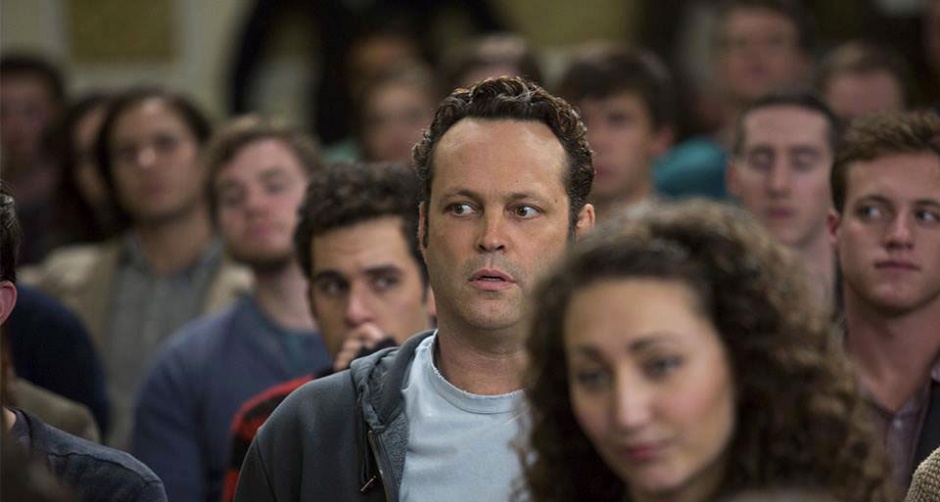
In his latest film Vince Vaughn plays an irresponsible, ambitionless slacker for whom real work is an afterthought.
Wait a minute…that’s the character Vince Vaughn plays in most of his movies.
The twist in the squishy-soft comedy “Delivery Man” is that Vaughn’s character finds that thanks to his regular donations to a sperm bank more than two decades ago, he is now the biological father of 533 children. What’s more, 142 of his offspring have filed a lawsuit against the fertility clinic, hoping to discover Daddy’s identity.
So that they can, like, bond with him or something.
Vaughn’s David Wozniak drives a delivery truck for his family’s Manhattan meat wholesaling biz. He’s inept at even this simple job…he’s always late making his rounds, has a world-class collection of parking citations, and frequently sees his truck towed by the cops.
He’s got a girlfriend whom he ignores for days on end (Cobie Smulders of TV’s “How I Met Your Mother”); plus, she’s pregnant and isn’t sure she wants a loser like David on her team.
He’s growing hydroponic pot in his apartment.
Oh, yeah, David also has a gambling problem. He owes $100,000 to loan sharks who periodically send thugs to rough him up and, when that produces no results, they take to assaulting David’s elderly father.
In a word, David is worthless. So of course writer/director Ken Scott devotes this film to proving he’s really a great, cuddly, nice guy.
“THE DALLAS BUYERS CLUB” My rating: B (Opening wide on Nov. 22 )
117 minutes | MPAA rating: R
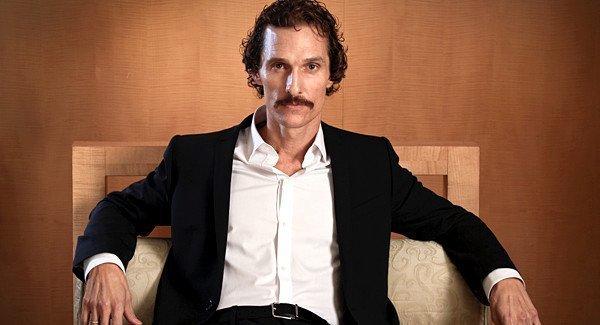
The critical resurrection of Matthew McConaughey’s career forges ahead with “The Dallas Buyers Club,” which finds him dropping a fifth of his body weight to portray an HIV-infected cowboy/con man.
But McConaughey isn’t the only actor undergoing a big transformation here. Equally impressive is erstwhile studmuffin Jared Leto, who not only does the crash diet thing but reinvents himself as a transvestite hooker.
Talk about trolling for Oscars, fellas.
When we first meet Ron Woodruff (McConaughey) he’s doing a cowgirl in one of the bronco chutes at a rodeo. Director Jean-Marc Vallee (“The Young Victoria”) wastes no time in establishing Ron’s bona fides as a ladies’ man.
Early on we learn that the gaunt rodeo rider is also a hustler who’ll set up a betting pool – his horsey buddies wager on how long a fellow rider can stay atop a bull – and then try to flee with the money without paying off the winners.
Ron lives in a mobile home that has seen better days. He drinks. He does drugs. He stages orgies.
He’s contemptuous of anyone who doesn’t share his homophobic, racist, good ol’ boy Texas view of things.
Ron is about to get his comeuppance. Injured on the job (he’s an electrician), he’s taken to a hospital. When the doctors come to talk to him they’re wearing surgical masks. They inform him that he has tested positive for the HIV virus. Continue Reading »
“THE COLOR OF PARADISE” screens at 1:30 p.m. Saturday, Nov. 23, at theKansas City Central Library, 14 W. 10th St., as part of the film series Middle Eastern Voices.
“The Color of Paradise” can reduce even the most jaded filmgoer to open-mouthed astonishment.
Iranian writer/director Majid Majidi has taken a tale that would have made Dickens proud and presented it in such a way that it seems both utterly realistic and achingly poetic.
Simultaneously a religious parable and a socially conscious drama, “The Color of Paradise” is unforgettable.
Mohammad (Mohsen Ramezani) is an 8-year-old boy who spends most of each year in a Tehran school for the blind. Now, at the end of term, he’s left twiddling his thumbs while all the other children are picked up by their parents.
Left alone in a park-like setting, Mohammad’s attention is focused on nearby chirping. A tiny bird has fallen from a tree and is being threatened by a hungry cat; on hands and knees Mohammad searches for the distressed creature, retrieves it and then risks his neck by climbing up the tree, feeling his way along the branches, and replacing the hatchling in its nest.
“BLUE IS THE WARMEST COLOR” My rating: A(Opening Nov. 15 at the Tivoli and the Rio)
179 minutes | MPAA Rating: NC-17
What is the greatest film performance you’ve ever seen?
For me the answer changes every few years. But for the foreseeable future my greatest film performance is given by Adele Exarchopoulos in “Blue Is the Warmest Color.”
“Blue…” arrives on these shores riding a wave of acclaim and notoriety. Writer/director Abdellatif Kechiche and its two lead actresses – Exarchopoulos and Lea Seydoux – jointly were awarded the Palm d’Or at last May’s Cannes Film Festival.
The film has generated controversy for extended scenes of lesbian lovemaking that earned an NC-17 rating from the MPAA. And then there are the recent accusations of sexual coercion hurled by the actresses at Kechiche.
Well, heavy breathing girl-on-girl action may be titillating, and rumors of on-set sexual politics can be diverting.
But let’s look at what “Blue Is the Warmest Color” really is: a monumental (three hours) study of a young woman’s life over several years that delves into her psyche with the sort of detail usually only afforded by a great novel. Continue Reading »
“GOD LOVES UGANDA” My rating: B(Opens Nov. 15 at the Tivoli)
83 minutes | No MPAA rating
At first glance, Roger Ross Williams’ documentary “God Loves Uganda” seems to be a study of a group of young people from the Kansas City area who go to Uganda as missionaries.
They are obviously sincere and highly motivated Christians, full of youthful enthusiasm and convinced that in their faith they have found the answer to…well, everything.
But little by little “God Loves Uganda” tells a dramatically different story, one about conservative Christians who have gained so much influence in a foreign country that their anti-gay bias is being institutionalized in laws that would make homosexuality a crime – even a capital crime.
It takes a while for the film to make its case. Early on we meet the Rev. Kapya Kaoma, a Zambian priest now living in Boston. We see him making breakfast for his family.
Why are we spending time with this guy? Well, it is gradually revealed that Kaoma was a gay-rights researcher who fled Uganda in fear of his life. He believes that American Christian missionaries, no matter how sincere, are responsible for a culture of hate and fear in that country.
Most of the Christians featured in the film are members of the International House of Prayer, which has headquarters in Grandview, Mo., on Kansas City’s south side.
Williams – an Oscar winner for his documentary short “Music by Prudence “– seems to have been given unlimited access , filming worship services and training sessions as the fresh-scrubbed young proselytizers get ready. He then follows them on their mission abroad.
Less likeable are several fire-and-brimstone conservative American preachers who are hugely influential in Uganda. The most objectionable of this bunch may be Scott Lively, an anti-gay activist credited by many with using outright falsehoods (homosexuals were behind the Nazi movement) to whip up an anti-homosexual feeding frenzy.
The resulting documentary is depressing and scary. These fundamentalist Americans see Africa as fertile ground for anti-gay pogroms, without having to deal with the civil rights issues their approach would raise in the U.S.
“God Loves Uganda” has been criticized as being anti-Christian. Actually, it’s anti-Christian bigot. There’s a difference, isn’t there?
There was before “Breathless,” and there was after “Breathless.”
Few movies have done so much to change film culture.
Jean-Luc Godard’s 1960 film screens at 1:30 p.m. Sunday, November 17, at the Plaza Branch, 4801 Main St. It’s part of the ongoing Movies That Matter free film series. I’ll be showing the film and giving a brief talk before and after the movie.
How big a game-changer can one movie be?
Pretty damn big.
More than any other movie, “Breathless” drew the world’s attention to the French New Wave, a movement of movies created by young critics-turned-directors. These filmmakers – among them Claude Chabrol, Francois Truffaut, Alain Resnais, and many others – were united not by style or subject matter but by their defiance of the status quo.
The New Wave was a rebellion against the complacency of the French film industry. Instead of aiming for polished, well-made productions, the New Wavers often worked in the streets with skeleton crews, exploring subject matter and attitudes at odds with the official cinema culture.
“PERSEPOLIS” screens at 1:30 a.m. Saturday, Nov. 16 at the Kansas City Central Library, 14 W. 10th St., as part of the film series Middle Eastern Voices.
Animation has for so long been the domain of fairy-tale heroines and wise-guy bunnies that it’s a shock to discover that the form can tell human stories with the depth of great literature.
That’s what we have in “Persepolis,” the animated French-made feature based on Marjane Satrapi’s graphic novels about her youth in revolutionary Iran.
There’s nothing remotely cute here, thematically or visually. Told in black-and-white line drawings occasionally relieved by splashes of color or subtle shading, this film by Satrapi and Vincent Paronnaud could have been shot as live action.
But animation adds another dimension; the movie’s minimalist style allows us to zero in on the emotions unfolding on the screen without distractions that might pull the eye away from what really matters. It’s a heightened reality.
Among the many virtues of J.C. Chandor’s “All Is Lost” is this: It may be one of the purest examples of cinema I’ve encountered in ages.
You could turn off the soundtrack and still understand exactly what is going on here. Movies are about movement, after all, and “All Is Lost” is a near-perfect example of visual storytelling.
Robert Redford, now 77, stars as our unnamed protagonist, the sole traveler on a well-equipped modern sailboat on the Indian Ocean.
We first see him awakening to the slosh of water in his cabin; he quickly discovers that his boat has been rammed by a floating container bin — one of those railway car-sized steel shoeboxes that evidently has fallen from the deck of a freighter. It has knocked a whole in the side of the sailor’s boat…and in a bit of ironic commentary, has left the sea littered with thousands of colorful running shoes that it held.
“All Is Lost” is the near-wordless story of what our man does to survive in a hostile environment. As such it bears no small resemblance to another much-ballyhooed current film on the same theme: “Gravity.”
But the fact is that “All Is Lost” is the superior film — less gimmicky, more believable, unbearably suspenseful and heartbreakingly sad.
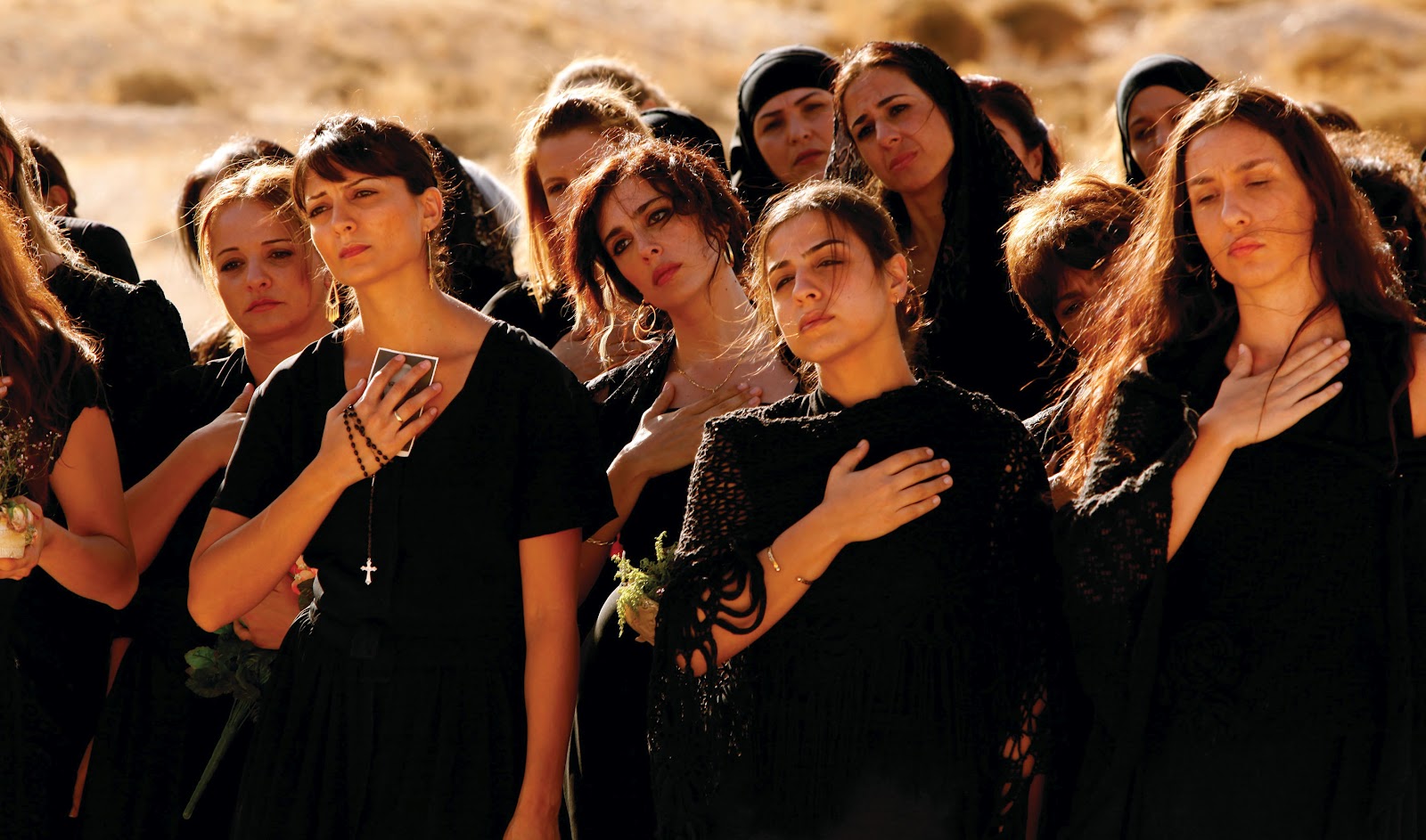 “WHERE DO WE GO NOW?” screens at 1:30 p.m. Saturday, Nov. 30, at the Kansas City Central Library, 14 W. 10th St., as part of the film series Middle Eastern Voices.






 Butler's Cinema Scene