“INCENDIES” screens at 1:30 p.m. Saturday, Nov. 9 at the Kansas City Central Library, 14 W. 10th St., as part of the film series Middle Eastern Voices.
Denis Villeneuve’s Oscar-nominated (for foreign language film) “Incendies” (French for “fires”) is about war and peace, about family and forgiveness.
It overflows with horror and emotional beauty, yet it delivers its potent payload with a minimum of sentimentality and filmic melodrama.
It’s the story of one life, but also about how the ripples from that life have spread to engulf many other lives.
Writer/director Villeneuve (whose first American film, “Prisoners” with Jake Gyllenhaal and Hugh Jackman, opened a few weeks back) has given us an intimate epic.
In modern-day Quebec twins Jeanne and Simon Marwan (Melissa Desormeaux-Poulin, Maxim Gaudette) learn that their late mother, Nawal, a native of Lebanon who lived in Canada for more than two decades, has left behind a will packed with bombshells.
Through a notary the dead woman instructs Jeanne to find the twins’ father and deliver a letter to him. Simon is told to locate their older brother and hand over a similar epistle. Continue Reading »
“MUSCLE SHOALS” My rating: B(Opening Nov. 1 at the Tivoli)
111 minutes | MPAA rating: PG
Like “Standing in the Shadows of Motown,” “AKA Doc Pomus” and “Tom Dowd & the Language of Music,” the new documentary “Muscle Shoals” leaves you stunned at the realization of the great music created by just one individual, record label or – in this case – town.
Muscle Shoals, Alabama, population 8,000, is a redneck burg of no particular distinction. Yet it became the birthplace of some of our greatest R&B and rock. Why should a rural town in one of the most racially-charged states have become a happy melting pot of black and white music-makers?
Greg Camalier’s film tries to answer that. Maybe it has something to do with the landscape – Native Americans called the nearby Tennessee River “the river that sings.” Opines U2’s Bono: “It’s like the songs came out of the mud.”
Whatever. Here’s what we can say for certain.
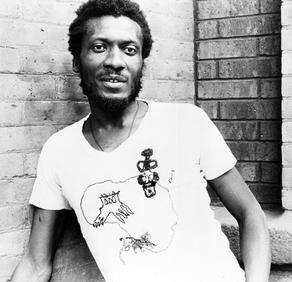
Jimmy Cliff
In the early ‘60s a local guy named Rick Hall created a recording studio in Muscle Shoals and hired a bunch of local white kids as a house band. As individual musicians they weren’t all that great – not at first, anyway — but together they had a synergy, a creativity that allowed them to take any performer, any song, and find just the right approach and arrangement. They became known as The Swampers.
Hall’s Fame Studio in Muscle Shoals got a big shot in the arm when a local nursing home worker named Percy Sledge recorded “When A Man Loves a Woman” there. Attracted by that huge hit, as well as tunes recorded in Muscle Shoals by Arthur Alexander, big-time record producer Jerry Wexler began bringing artists like Wilson Pickett and Aretha Franklin to work with Hall and the Swampers.
The combination of black artists and a white producer and studio band resulted in spectacular music like “Respect” and “Land of 1,000 Dances.”
Michael Fassbender, Lupita Nyong’o, Chiwetel Ejiofor
“12 YEARS A SLAVE” My rating: A (Opens wide on Nov. 1)
133 minutes | MPAA rating: R
“12 Years a Slave” is gruelling.
Exhausting.
Horrifying.
It is, one can say without fear of contradiction, the best, most complex and fully-realized fictional film ever about American slavery.
Here the full panoply of institutional evil is on display, not just the physical abuse (whippings, chains, drudgery) but the emotional toll.
There have been other movies on the subject, but most have either been a whitewash (“Gone with the Wind,” which feels unwatchable in the wake of the gut-punch that is “12 Years…”) or the stuff of lurid exploitation (“Mandigo” and, yes, Quentin Tarantino’s “Django Unchained”).
Steve McQueen’s film – based on the 1853 memoir of a free black man who was kidnapped and sold into slavery – manages to reference slavery’s many evils without feeling exploitative.
Moreover, it does something I’ve never before seen. In addition to telling its story from a slave’s point of view, it is a devastating study of the corrosive influence of the “peculiar institution” on the lives of slaveholders themselves.
In 1841 Solomon Northup (Chiwetel Ejiofor) lived in upstate New York with his wife and family. A free Negro, he enjoyed the rights and privileges of any citizen. He was well liked and admired and made a good living as a musician.
Lured away with the promise of work on the road, he was drugged and awoke to find himself in chains in a dank cellar somewhere in Washington D.C. (The still-unfinished Capitol building towers over the town, providing a silent but eloquently ironic commentary on Solomon’s situation.)
Like any free man, he indignantly protests his treatment — and is beaten for it. He learns to keep quiet.
Soon, with other kidnapped blacks, he finds himself with a new name – Platt – and on a steamboat headed south to Louisiana, where he will pass through the hands of two masters.
Ford (Benedict Cumberbach) is what you might call a Jeffersonian slaveholder. An essentially decent man, he knows slavery is wrong but is too invested economically in his plantation to repudiate the practice.
Still, the slave and the master develop something approaching mutual respect – it’s pretty clear that Solomon/Platt is the only person for miles around with whom Ford can hold an intelligent dialogue.
But in a world where a black man can be hanged for reading and writing, Solomon knows to keep his light well hidden. Continue Reading »
“THE SUMMIT” My rating: C+(Opens Oct. 25 at the Tivoli)
96 minutes | MPAA rating: R
When did narration in documentaries become a dirty word?
Ever since the rise of cinema verite back in the ‘60s, narration has been fading. Maybe by eliminating conventional narration, documentarists hoped to separate themselves from TV journalism, which relied heavily on a narrator’s voice.
Thing is, some movies need a narrator. Like “The Summit,” an examination of the events of Aug. 1, 2008, when 11 climbers died on the slopes of K2, our planet’s second-highest peak.
Writer Mark Monroe and director Nick Ryan tell a complicated story from several perspectives (even people who were there can’t quite agree on what happened or who – if anyone – is to blame). Furthermore, the story drifts back and forth in time.
The film is screaming for a narrative voice to put things into perspective, to guide us, to explain the lay of the land. Without that “The Summit” becomes a frustrating example of inside baseball, with climbers talking in their own language and those of us on the outside scrambling to figure out what they’re saying.
“THE COUNSELOR” My rating: C(Opens wide on Oct. 25)
117 minutes | MPAA rating: R
Having apparently concluded that his work to date is unrealistically optimistic, Pulitzer-winning (for The Road) novelist Cormack McCarthy has at age 80 written his first original screenplay.
The resulting movie – directed by Ridley Scott — seems to have been concieved for those who found “No Country for Old Men” implausibly upbeat.
“The Counselor” begins with a long opening scene in which a lawyer known only as Counselor (Michael Fassbender) and his paramour Laura (Penelope Cruz) make love in the bedroom of his uber-modern El Paso home. Enjoy it…it’s the only moment of tenderness in the whole two hours.
Next we see the Counselor in Europe buying a big diamond from a chatty dealer (Bruno Ganz). He’s going to propose to his gal.
So far, so normal.
But it slowly dawns on us (slowly because in his dialogue McCarthy has declared war on simple declarative sentences) that the Counselor is having money problems and in an attempt to turn things around has invested in a very shady deal. Drug smuggling.
In Mexico we see barrels of the stuff being placed inside the tank of a rust bucket septic service truck and covered with human waste – because what border guard wants to delve too deeply into such a repellant mess? (I’m not kidding…this movie must have employed a turd wrangler.)
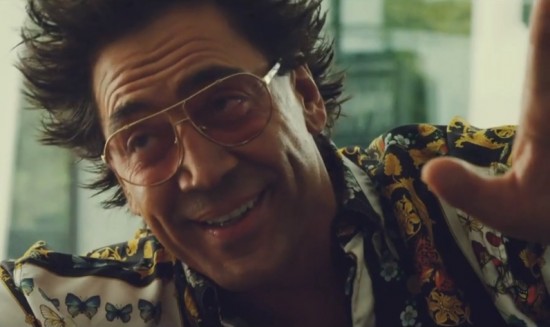
Javier Bardem
The Counselor has a couple of partners in this nefarious venture. Westray (Brad Pitt) is a savvy facilitator in Stetson and cowboy-chic suit who conducts business in restaurants and talks matter-of-factly about all the things that can go wrong with this sort of enterprise. Think of his dialogue as foreshadowing.
Reiner (Javier Bardem, with a ‘do that looks like an exploding outhouse) runs local nightclubs and lives lavishly, but also needs to make a lot of money fast. He’s living with the predatory Malkina (Cameron Diaz), who not only keeps two pet cheetahs but has had her body tattooed with cat-like spots. I suppose you could call her sexy, but in a very creepy way.
There’s also the Counselor’s client, a female drug kingpin (Rosie Perez) serving time in a Texas prison. She requests that our hero intervene on behalf of her son, who’s been arrested for speeding. That seemingly inconsequential act has grave repercussions.
Blink and you’ll miss cameos by John Leguizamo, Dean Norris (the late Hank of “Breaking Bad”), Natalie Dormer (Anne Bolyn in “The Tudors”), Goran Visnjic (“E.R.”) and Ruben Blades.
Cameron Diaz, Penelope Cruz
None of these individuals – save for Cruz’s deer-in-the-headlights innocent – has any redeeming qualities. Notwithstanding his love for Laura, the Counselor is pretty much a cold fish, which makes him a less than compelling protagonist.
The moral of McCarthy’s tale is that once you get involved in the Dark Side there’s no turning back. The bad guys here – interchangeable drug cartel killers — are faceless and implacable. They just keep coming at you until there’s no escape. Talk — something the Counselor must be good at — has no power here.
“The Counselor” looks good – Scott always makes good-looking films – and takes full advantage of the ugly/beautiful Southwestern landscape. A couple of action scenes have been well staged.
But McCarthy’s super-literary dialogue is off putting. I think he’s aiming for a Mamet-esque tone, but he doesn’t have Mamet’s sense of humor. Or any sense of humor at all.
The film is frustrating because nobody here actually says what they mean. They all talk in code, in metaphor, and this tangential approach will leave some audience members wondering what the hell they just saw.
Anyway, “The Counselor” is so unrelentingly bleak that showers should be installed at theater exits.
It’s part of the ongoing Movies that Matter free film series. I’ll be showing the film and giving a brief talk before and after the movie.
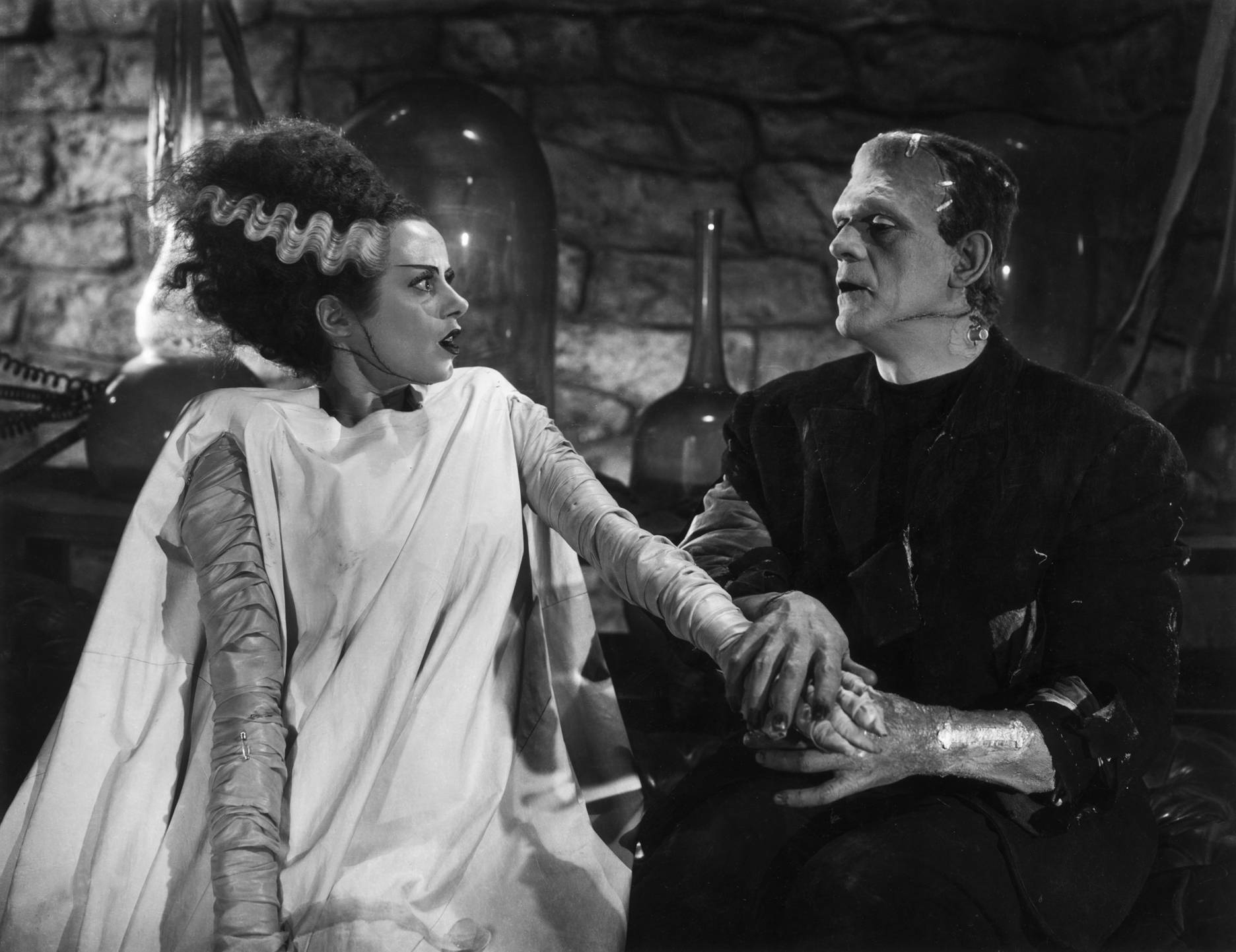
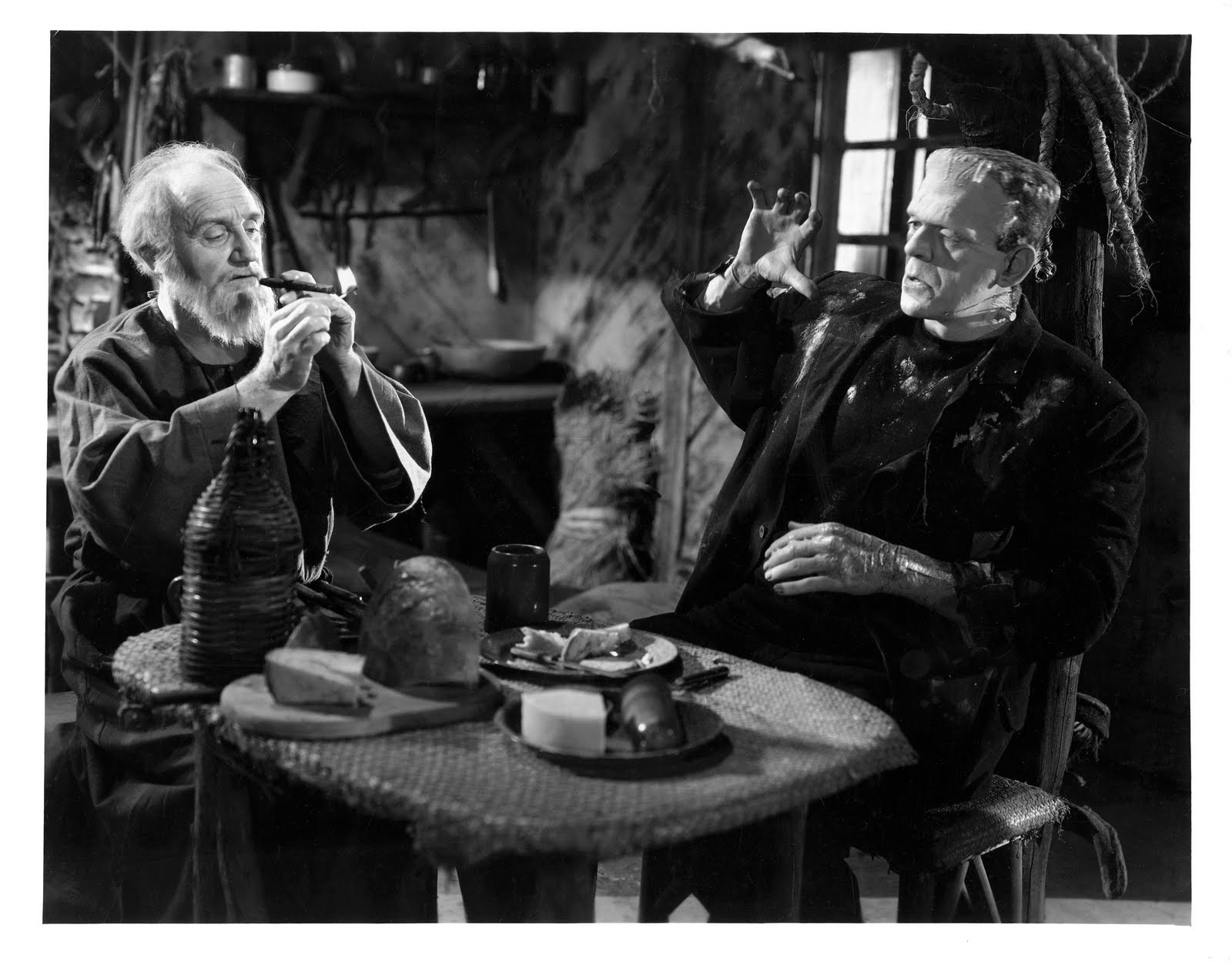
Just to put you in the mood, here are 10 little-known facts about the film, which is widely regarded as one of the greatest horror films of all time…although it is also terrifically funny. Some, in fact, have called it the first great camp classic.
The Frankenstein legend is one of the most popular movie subjects. To date more than 100 feature films have been released with “Frankenstein” in the title.
The Bride of Frankenstein surprises many first-time viewers who are shocked to discover that it treats Boris Karloff’s “creature” with sympathy. This time around the monster learns to talk (Karloff resisted the idea, but later embraced it), and in many scenes is depicted as a Christ-like figure suffering at the hands of cruel mankind.
Director James Whale (he made both Frankenstein in 1931 and the sequel four years later) was openly gay at a time when most creative individuals in Hollywood hid that fact. Many have speculated that The Bride of Frankenstein’s curious blend of horror and outlandish humor was the result of Whale indulging his camp sensibilities.
Elsa Lanchester, who plays both author Mary Shelley (in the opening prologue) and the female “monster,” was the wife of actor Charles Laughton. She based her portrayal of the newly-animated Bride on the movements of birds.
The Bride’s towering hairdo was inspired by an ancient bust of the Egyptian princess Nefertiti wearing a similarly-shaped headdress.
Director Whale so wanted actor O.P. Heggie to play the blind hermit who takes in the Monster that he delayed shooting those scenes until the end of production, when Heggie would be finished with another film. Heggie never saw The Bride of Frankenstein…he died only a few months later.
Colin Clive, the English actor who portrayed Victor Frankenstein in both Frankenstein and The Bride of Frankenstein, died only two years later of tuberculosis and chronic alcoholism. For 40 years his ashes sat unclaimed in the basement of a Los Angeles funeral parlor; in 1978 they were scattered at sea.
Valerie Hobson, who portrayed Baroness Frankenstein (taking over the role originated by Mae Clarke), later played the adult Estella in David Lean’s 1946 Great Expectations. In 1954 she married future British Prime Minister John Profumo, whose career ended in scandal in 1963 after he lied to the House of Commons about his affair with call girl Christine Keeler.
Boris Karloff on the Monster: “He was the best friend I ever had.”
“THE FIFTH ESTATE” My rating: C(Opens wide on Oct. 18)
128 minutes | MPAA rating: R
The meteoric rise and fall of Julian Assange and Wikileaks sounds like the stuff of great topical moviemaking.
If only.
The usually reliable Bill Condon (“Kinsey,” “Gods and Monsters,” “Dreamgirls” … oh, OK, and two “Twilight” movies) struggles mightily to make a story about people sitting at computers seem dynamic.
He fills the movie with flashing strobes and throbbing techno. His camera dances and swirls around the geeks bent over their terminals. There are ”Matrix”-type special effects with cataracts of glowing green numbers flooding across the screen.
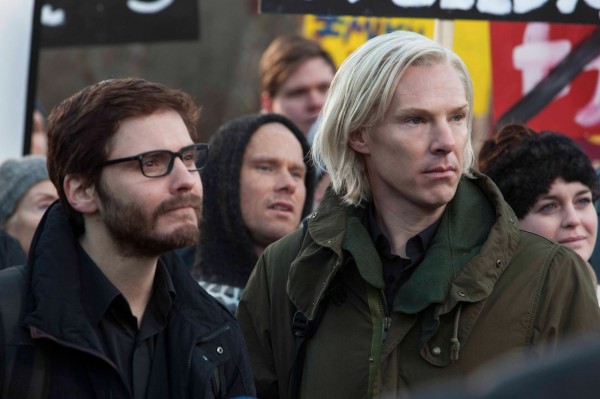
But despite the presence of two of today’s best young actors — Benedict Cumberbatch and Daniel Bruhl — “The Fifth Estate” is dramatically stillborn.
Part of the problem is that the story is told from the perspective of a rather boring individual. Another drawback is that Assange himself keeps slipping in and out of focus.
While that slipperiness seems to be an essential part of the man’s character – leaving many of us with a love/hate relationship – it makes for frustrating movie going.
Our protagonist is Berlin computer geek Daniel Berg (Bruhl), who meets the then-unknown Aussie Assange (Cumberbatch) at a conclave of anarchistic cybertypes. Almost immediately Berg falls for the white-haired dynamo’s spiel about the need for a place on line where whistleblowers from around the world can submit their purloined and/or secret data in complete anonymity.
“CONCUSSION” My rating: C+(Opens Oct. 18 at the Tivoli)
96 minutes | MPAA rating: R
Feeling smothered by her suburban marriage, a woman begins spending her days in the big city as a high-priced call girl.
This is not exactly an original idea. The best and most famous example of the genre is Louis Bunuel’s 1967 “Belle de Jour” with Catherine Deneuve.
But in “Concussion” writer/director Stacie Passon pulls a major switcheroo – our leading lady is half of a lesbian marriage and her “johns” all are women.
We first meet Abby (Robin Weigert) in the aftermath of being bonked on the head by a baseball thrown by her son. She’s on the way to the E.R. for stitches and is less than sanguine about the whole thing, angrily condemning the kid as a “little shit.”
But the concussion she has suffered has done more than bloody her face and sour her mood. In its aftermath Abby realizes she’s no longer satisfied with her lot as the stay-at-home wife of successful divorce lawyer Kate (Julie Fain Lawrence). There must be more to life than shopping, chauffeuring kids, and hanging out after spin class with the other moms in suburban New Jersey.
“Concussion” makes no big deal of the fact that Abby and Kate are gay. It’s a non issue. The other (straight) couples they hang out with are totally accepting. Their children – a boy and a girl – seem to be well adjusted.
“CAPTAIN PHILLIPS” My rating: B(Opens wide on Oct. 11)
134 minutes | MPAA rating: PG-13
Tom Hanks’ near-uncanny ability to build a compelling Every Man character out of minimal substance is put to good use in “Captain Phillips,” director Paul Greengrass’s tension-charged recreation of a real-life 2009 hijacking of an American freighter in the Indian Ocean.
Capt. Richard Phillips, the main player in the incident and in this film, is a somewhat controversial character. He was hailed as a hero after Navy Seals rescued him from the lifeboat on which he was being held by four Somali pirates.
But since then members of his crew have sued Phillips for what they say was a reckless disregard for their safety by insisting on navigating close to the Somali coast – thus saving time and money – rather than plotting a course further out to sea.
Hanks and Greengrass have it both ways. We see early on that Phillips can be something of a tough captain – not a Queeg-ish martinet, exactly, but forceful enough to irritate some of his crewmen. But he’s also a resourceful fellow looking out for his men in a crisis.
It’s hard to say precisely what sort of a guy he is. “Captain Phillips” lives mostly in the moment, and we don’t learn a whole lot about our protagonist except when he’s under the gun.
Early on we see him driving to the airport with his wife (Catherine Keener, filmed so obliquely she’s hardly recognizable) and we learn that he’s married with a couple of college-age kids. And that’s about it.
Under most circumstances this would result in a movie with a hole where its center should be. But Tom Hanks fills the void with his own star presence. And it pretty much works.
“ESCAPE FROM TOMORROW” My rating: B-(Opens Oct. 11 at the Tivoli)
90 minutes | No MPAA rating:
“Escape from Tomorrow” is about as subversive as movies get.
For starters, first-time writer/director Randy Moore shot most of it surreptitiously—and without permission – at Disneyland and Walt Disney World.
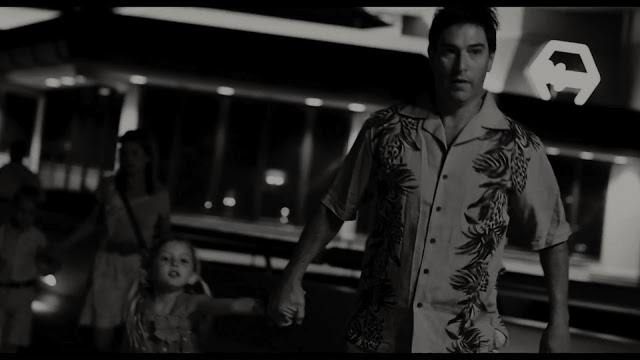
The cast members entered the parks like any other guests, and performed their scenes while surrounded by real tourists. Cinematographer Lucas Lee Graham employed small digital cameras that wouldn’t draw the attention of theme park authorities.
But equally as subversive is the movie’s satiric view of “The Happiest Place on Earth” as a shiny façade concealing a nightmare landscape of swirling, supernatural evil, and its depiction of the average American family as the joyless union of steady backbiting and sexual frustration.
While his wife Emily (Elena Schuber) and kids Sara and Elliot (Katelynn Rodriguez, Jack Dalton) sleep late in their Orlando-area hotel room, Jim (Roy Abramsohn) paces on the balcony in his skivvies as his boss informs him by telephone that he’s been canned.
Jim is in no mood to play the happy husband and father at Disney World, but what the hell…he’s already there, right?
Katelynn Rodriguez, Roy Abramsohn
Except that his day just keeps getting weirder and weirder.
First there are warnings posted about something called “cat flu.” (We later learn that among the alarming symptoms are hair balls.)
Jim is plagued by disturbing hallucinations in which animatronic dolls on the “It’s A Small World” ride briefly mutate into fanged, blazing-eyed demons.
And he’s so smitten with a couple of cute French teenagers (Annet Mahendru, Danielle Safady) that he spends hours stalking them, frequently forgetting that he’s supposed to be watching his kids.
 “INCENDIES” screens at 1:30 p.m. Saturday, Nov. 9 at the Kansas City Central Library, 14 W. 10th St., as part of the film series Middle Eastern Voices.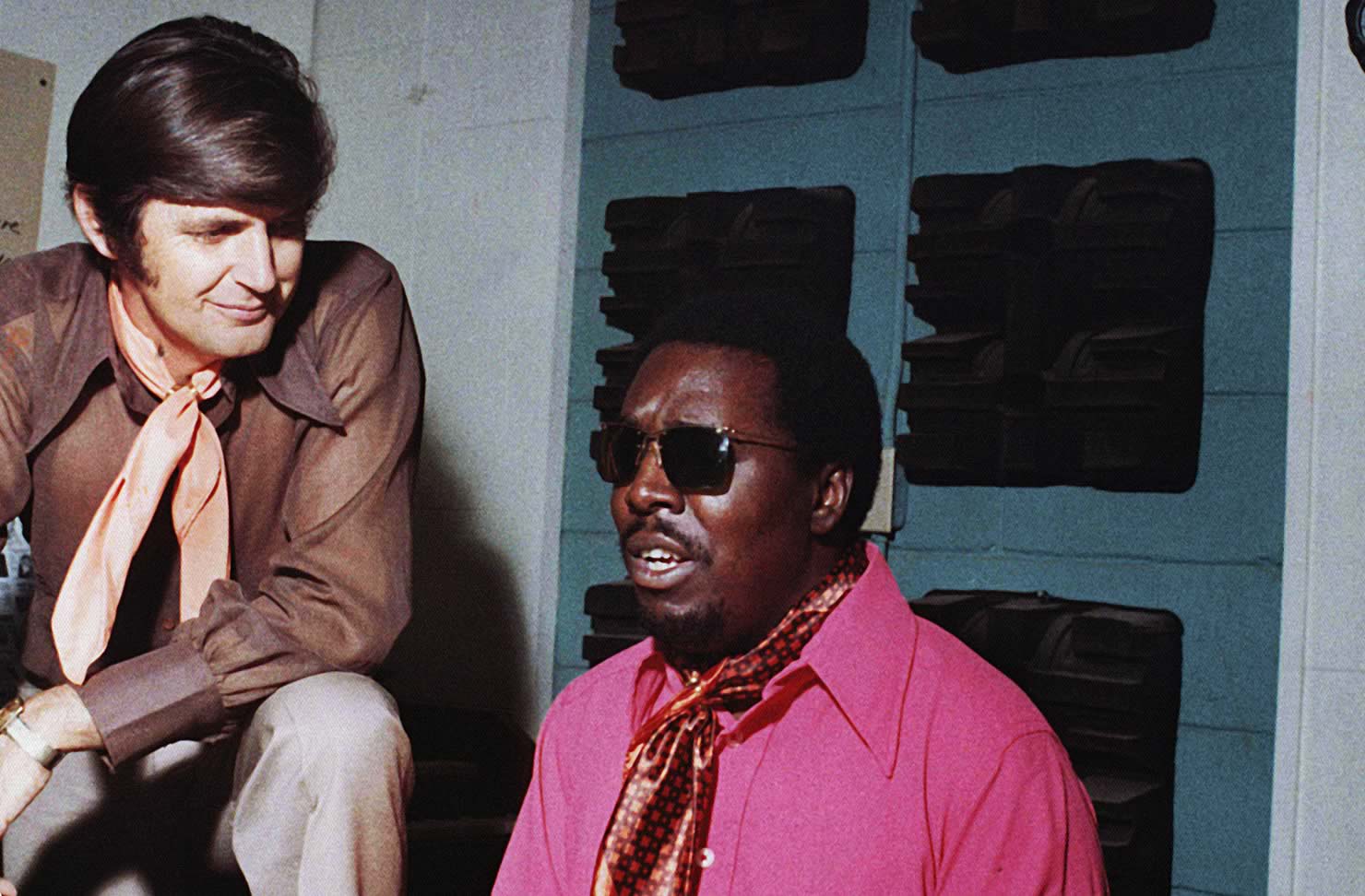








 Butler's Cinema Scene