Feeds:
Posts
Comments

blue blanchett“BLUE JASMINE” My rating: B (Now showing wide)

98 minutes | MPAA rating: PG-13

Tragedies require great performances. Otherwise they’d be unbearable.

Lucky for Woody Allen, then, that “Blue Jasmine” stars Cate Blanchett giving a performance with Oscar written all over it.

“Blue Jasmine” is one of Allen’s “straight” movies, though it does have a few moments of bleak humor.  Theater dweebs will immediately recognize it as a modern updating of Tennessee Williams’ “A Streetcar Named Desire.”  Our Blanche Dubois stand-in is Jasmine (Blanchett), the former pampered wife of a Wall Street mover-and-shaker who has gone to prison as part of a Bernie Madoff-ish scandal.

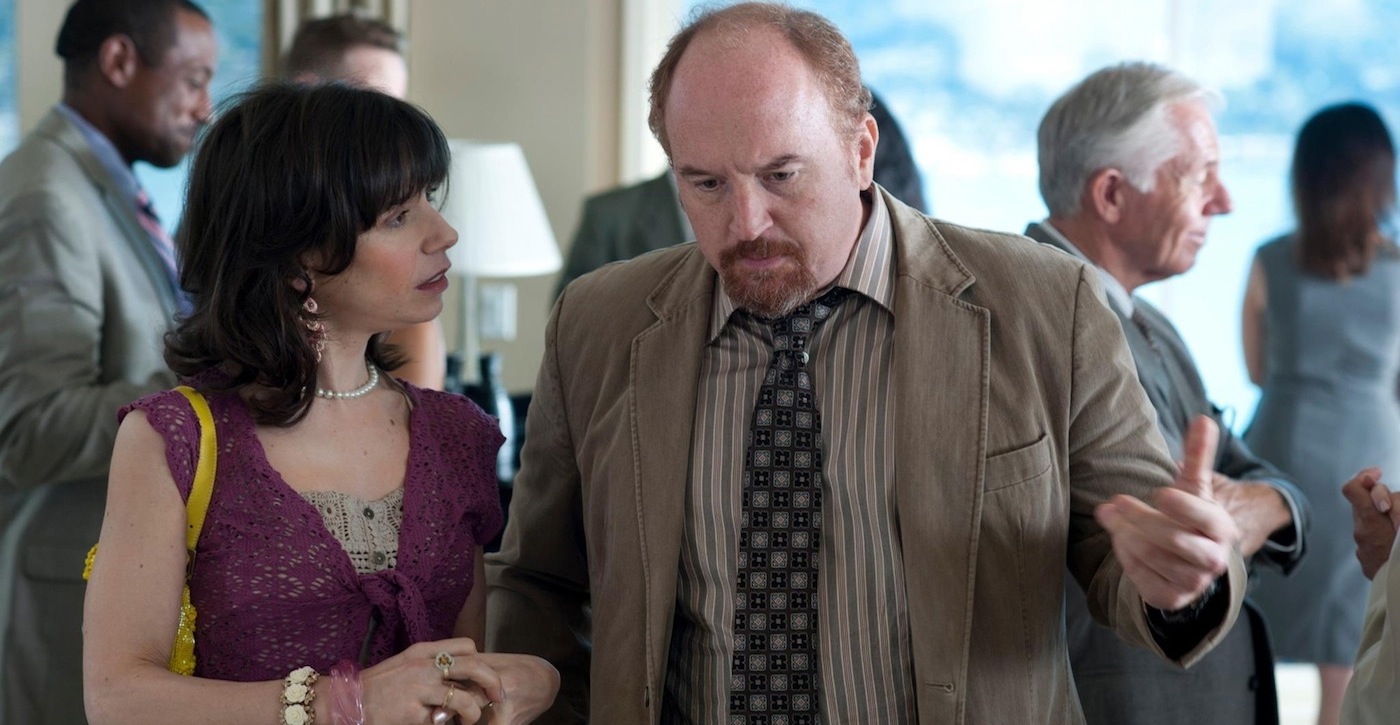
Sally Hawkins, Louis C.K.

Sally Hawkins, Louis C.K.

Now the brittle, babbling but still weirdly glamorous Jasmine (real name, Jeanette) has washed up penniless in the San Francisco apartment of her adopted sister Ginger (Sally Hawkins).  She’s dependent on the kindness of strangers (Ginger is kind almost to the point of being a punching bag), and should be groveling with gratitude. But, no, Jasmine puts on airs, complains about having had to sell her furs and jewels, sneers at her now-proletarian living conditions, and winces painfully at the racket generated by her two young nephews.

“Blue Jasmine” is a curious piece. We start out utterly contemptuous of  this fallen trophy wife whose husband’s crooked dealings left hundreds of thousands of investors (among them sister Ginger) high and dry. So now she has to get a job as a dentist’s receptionist and sleep on a couch? Serves her right, right?

But so powerful is Blanchett’s peformance that by the end we are (against our own good moral judgment) practically rooting for her to hook up with a rich, unsuspecting guy who can maintain her in the style to which she has become accustomed.

Which is to say that this is some great acting. Continue Reading »

spectacular-now-tickets“THE SPECTACULAR NOW” My rating: B+ (Opens Aug. 23 at the Cinemark Palace)

95 minutes | MPAA rating: R

Movie teenagers bear about as much resemblance to real kids as movie cops do to real police work.

Which makes “The Spectacular Now” a wonderful aberration, a film that feels fresh and authentic and injects new life into a worn-out genre.

Director James Ponsoldt’s Sundance hit is a love story but it’s also an insightful personality study of two young people who find in each other something each desperately needs.

Sutter Keely (a terrific Miles Teller) is a popular guy at his high school, a funny, friendly senior whose self-effacing humor and deadpan wit suggest he’s far smarter than his terrible grades would indicate. (Imagine the love child of Vince Vaughn and a “Say Anything”-era John Cusack.) He’s popular with both his fellow students and his exasperated teachers.

Unfortunately, his charm masks the fact that he’s an alcoholic-in-training, getting blotto with alarming regularity.

Sutter has a steady squeeze (Brie Larson) who appreciates him for his warmth and fun-loving ways but recognizes that there’s no future with such an unmotivated slacker. With graduation looming (it looks like he won’t be getting a diploma), she tells Sutter that it’s over, though he’ll always be her favorite ex-boyfriend.

Then he’s thrown together with wallflower Aimee Finicky (Shailene Woodley), who on her morning paper delivery route finds Sutter sleeping off a bender on someone’s front lawn. Having misplaced his car, he asks for a ride.

Continue Reading »

butler lede“THE BUTLER” My rating: B- (Opening wide on Aug. 16)

132 minutes | MPAA rating: PG-13

I’m not a huge fan of Lee Daniels (“Precious,” “The Paperboy”) or of his new film “The Butler.”

But I think I understand what he’s trying to do with this multi-decade story about a poor black man from the South who becomes a member of the White House staff, serving presidents and eavesdropping on America’s movers and shakers.

And I think he got the job done.

One of the drawbacks of better race relations in this country (which is not to say that everything’s fine…check out the Missouri State Fair rodeo clown controversy) is that we now have a generation of young black people who want nothing to do with America’s troubled racial past.

They are embarrassed by the very mention of slavery and tend to take for granted the civil rights they enjoy, with little appreciation of the generation of activists whose sacrifices made those advancements possible.

“The Butler,” I think, is aimed directly at this indifferent audience and seems to have been fashioned specifically to bring them up to speed, to force them to confront  the bad old days of their grandparents.

It’s not a particularly artful film (despite a couple of fine performances) and is frequently downright clumsy. But it succeeds in bringing to life the arc of 20th century African American history in an accessible and dramatic manner.

Inspired by the life of Eugene Allen (1919-2010)– who worked for 34 years in the White House, rising through the ranks to become maître d’hotel (top butler) —  Danny Strong’s screenplay is the fictional story of Cecil Gaines (Forest Whitaker).
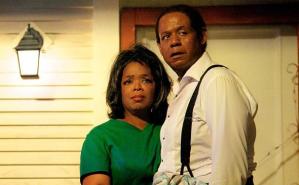
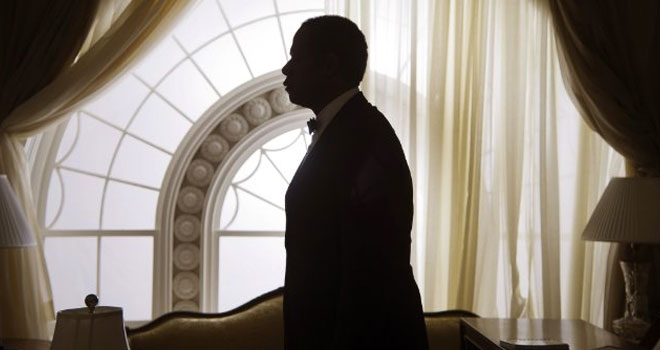
Oprah Winfrey, Forrest Whitaker

Oprah Winfrey, Forest Whitaker

Early on Strong and Daniels lay things on with a trowel. One of the film’s first images is of two black men dangling from nooses. Then we’re back in the 1920s in a Southern cotton field where young Cecil witnesses  his mother (Mariah Carey) being sexually abused by the landowner’s swaggering son. When her husband  objects to this outrage, he is shot dead.

Shades of  “Mandingo.”

The lady of the plantation (Vanessa Redgrave, the first of an endless stream of big-name actors making cameo appearances) takes pity on young Cecil and declares she’ll make him a “house nigger.” Under her training he becomes an ideal servant, finally taking off on his own to launch a career first at a Southern hotel, then at one in Washington D.C.  That’s where he’s spotted and invited to work at the White House.

“The Butler” attempts to balance Cecil’s private life against the era’s burning social issues. Much of the tension comes from his belief, drilled into him, that a good butler should never make his presence known unless directly addressed by those he is serving. Cecil believes in hard work and personal advancement. He is decidedly uncomfortable with questions of politics or public policy, which leads to decades of tension with his activist son Louis (David Oyelowo) and charges of Uncle Tom-ism. 

Continue Reading »

jobs-movie“JOBS” My rating: C+ (Opening wide on Aug. 16)

122 minutes | MPAA rating: PG-13

“You’re good. Damn good,” a colleague tells young computer visionary Steve Jobs early in the new bio-pic “Jobs.”

“But you’re an asshole.”

Yup.

“Jobs” isn’t a bad movie. And if you’re looking for an affectionate recreation of the early days of the personal computer industry – when things we now take for granted (like a writing program with changeable fonts) were hailed as major breakthroughs – it’s geekily engaging.

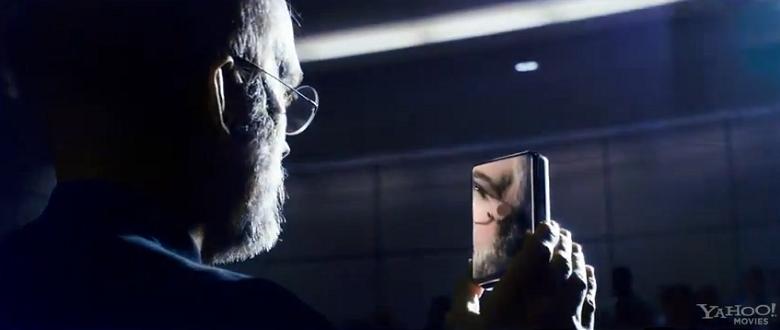
Jobs ashtonBut Joshua Michael Stern’s film is painted in broad strokes and rarely gets behind the mysterious and mercurial surface of its central character. The late Apple Computer founder Steve Jobs comes off as an arrogant, self-centered visionary who touched millions of lives through his products but alienated many of his nearest and dearest.

That the movie never really connects on an emotional level is not the fault of Ashton Kutcher, who gives a perfectly acceptable performance and who eerily recreates Jobs’ skinny, turtlenecked frame and loosey-goosey slouch walk. The problem is that Matt Whiteley’s screenplay never quite decides what it thinks of this polarizing figure.

“Jobs” begins in the mid-70s with our protagonist a barefoot dropout hanging around the Reed College campus, follows him through the creation and rise of Apple, through his being fired by the board of directors in 1985, and his eventual return to the failing company in 1996 to retake the reins and spearhead Apple’s resurgence,  one of the greatest turnarounds in business history.

Actually, the movie ends in the late ‘90s…there’s no mention of iconic products like the iPhone or the iPad or of the long fight with cancer that left Jobs dead in 2010 at age 56.

But, then, “Jobs” leaves out so much. It’s almost as if it were written with the assumption that we already know most of the important details of Jobs’ life and work.  The results feel superficial, unformed.

Continue Reading »

blackfish“BLACKFISH” My rating: B+ (Opening Aug. 16 at the Tivoli )

83 minutes | MPAA rating: PG-13

Let’s assume that the documentary “Blackfish” – about killer whales in captivity – is an honest effort, that it doesn’t manipulate the facts for propaganda purposes.

Granted, that’s a big assumption. We all got burned a couple of years back by “The Cove,” a doc that blamed marine theme parks for the annual mass slaughter of dolphins in Japan.

Later, after “The Cove” had won the Oscar for best feature documentary, we learned that Japanese fishermen have been rounding up and killing dolphins for at least a century because the mammals compete with them for fish. Moreover, marine theme parks no longer capture wild dolphins, relying instead on breeding programs. Which meant that the film’s entire premise was pretty much bogus.

“Blackfish” also condemns the marine theme park industry, but by focusing exclusively on the biggest animals in these menageries – the magnificent black-and-white orcas  – Gabriela Cowperthwaite’s film stands on much firmer journalistic ground.

But at the same time it’s a hugely emotional experience. Don’t be surprised if you find yourself bawling. I’ m talking about a full-bore, nose-blowing rush of pathos.

The main subject here is a whale named Tilikum who made headlines in 2010 when he killed his trainer, Dawn Brancheau.  SeaWorld-Orlando claimed that Brancheau, an experienced whale handler, was targeted by Tillicum because she wore her hair in a ponytail.

But as “Blackfish” shows, Tillicum was a killer long before that. In fact, this one whale was already responsible for two other human deaths. Continue Reading »

kick-ass Chloe“KICK-ASS 2”  My rating: C (Opening wide on Aug. 16)

103 minutes | MPAA rating: R

“Kick-Ass 2” is a letdown, a mean-spirited and puerile sequel that leaves you stranded between giggling and gagging.

But I’m not sorry to have seen it for one reason: Chloe Grace Moretz.

Moretz was only 12 in 2009 when she appeared in the first “Kick-Ass” as Mindy Macready, a little girl trained by her vigilante father to suit up in purple Spandex and fight crime under the name of Hit-Girl. The novelty of seeing this petite child stomping the hell out of viscious adults (and lobbing ear-stinging profanities) was memorable, to say the least.

In the intervening four years — during which she turned in a brilliant performance as a child vampire in “Let Me In” and had a big role in Martin Scorsese’s “Hugo” — Moretz has grown up considerably.  She’s becoming a beautiful young woman (small wonder that this film often features looming closeups emphasizing her hazel eyes and full lips) and this lends a whole new aspect to her Hit-Girl persona.

To put it bluntly, she’s now a dirty old man’s dream teen.

Not that she’ll be making a career of that. She’s too talented. But her presence in “K-A 2” announces that as she matures she’s going to be a major star. Bet on it.

Despite Moretz, this new film has two strikes against it. First, even fans of the “Kick-Ass” comic books acknowledge that while the initial series was terrific, the followup was awful.

And, second, the first movie benefitted from the direction of Matthew Vaughn, the guy behind the nifty Brit crime film “Layer Cake” and, later, “X-Men: First Class.”  For “K-A 2” he’s been replaced by Jeff Wadlow, who with his third feature doesn’t yet demonstrate the tonal control needed to keep the yarn’s amusing and appalling elements in balance.

Continue Reading »

Murder as a musical number

Murder as a musical number

“THE ACT OF KILLING” My rating: A- (Now at the Alamo Drafthouse Cinema)

116 minutes | No MPAA rating

Mind boggling.

Horrifying.

Astonishing.

Joshua Oppenheminer’s “The Act of Killing” is unlike any other documentary you’ve  seen.

Other films have explored the “banality of evil.” Other films have looked at war crimes. But I can recall no other film that so effectively rubs our faces in brutality and the human capacity for violence.

In outline “The Act of Killing “ sounds like some sort of twisted comedy skit.

Congo

Anwar Congo

Oppenheimer’s subjects are the old men who nearly 50 years were members of the death squads that turned Indonesia into a bloodbath. In the wake of a 1965 military coup more than 1 million people were murdered for being communists…though there’s no way of knowing if these were real communists or simply folk unfortunate enough to run afoul of the ruling junta.

The filmmakers offer these graying killers – they describe themselves as “gangsters” and have spent most of their lives operating outside the law — a chance to make short movies re-enacting their glory days of murder and torture. Now in their 60s, these death squad veterans jump at the opportunity with the eagerness of children playing dress-up.

Told they can make any sort of film, some emulate an American crime melodramas, complete with double-breasted suits and fedoras. Some create a cowboy picture. There’s even a big Hollywood musical with pink-gowned dancing girls emerging from the mouth of a gigantic carp (a building in the shape of a fish) to the strains of “Born Free.”

The killers play both the executioners – demonstrating the preferred methods for taking a life without ruining your clothes – and the victims. They take great delight in being doused with stage blood and re-enacting the death throes of their victims.

The central figure here is Anwar Congo, a thin, white-haired grandfather who looks a bit like Nelson Mandela. He personally was responsible for killing 1,000 people, usually with a strangulation method of his own devising: “At first we beat them to death but there was too much blood…it smelled awful. To avoid the blood I used this system.”

Congo is proud of his violent past and happy to recreate it for the camera: “This is who we are. This is history. Step by step we tell the story of what we did when we were young.”

Continue Reading »

elysium“ELYSIUM” My rating: C (Opening wide on Aug. 9)

109 minutes | MPAA rating: R

One classic definition of science fiction is a story that takes a contemporary social or scientific situation and extrapolates how it might play out in the future.

Neil Blomkamp’s “Elysium” should be great sci-fi. Instead it’s a great idea that quickly bogs down in the same sort of slam-bam chaos we’ve been enduring all summer.  (Hell, for as long as I can remember).

As such it’s a distinct step down from Bloomkamp’s debut feture, 2009’s “District Nine,” a savvy futuristic satire of Apartheid involving aliens instead of black people.

We all know about the 1 percent, right? Well, 150 years from now the wealthiest among us have given up on the dying planet Earth and relocated to Elysium, a big, sleek space station rotating in orbit.

There the lawns are all manicured, the foliage is lush, the people are rich and beautiful, and the technology so advanced that every home has a machine that diagnoses illnesses or physical damage and cures the patient in a matter of minutes.

Back on terra firma the vast mass of humanity lives in conditions that suggest a South American favela that has spread to cover the entire planet. Everyone dreams of going to Elysium; a few actually make it thanks to smugglers who make illegal shuttle runs.

Max (Matt Damon, head shaved, heavily tattooed) is an ex-con working in an L.A. factory making ‘droids. Thanks to his criminal past he’s always being hassled by the cops (actually robots) and spends a lot of time talking to his parole officer (a robotic mannequin so primitive it looks like one of those fortune tellers in a turn-of-the-last-century penny arcade).

Continue Reading »

James Cromwell, Genevieve Bujold

James Cromwell, Genevieve Bujold

“STILL MINE” My rating: C+ (Opening Aug. 9 at the Rio)

102 minutes | MPAA rating: PG-13

There is much to admire in “Still Mine”: Fine acting, some gorgeous cinematography, lovely New Brunswick landscapes.

None of which can dispel the sensation that the movie is bitter medicine that we should swallow because it will be good for us.

“When I was young I looked at old people and thought if you live long enough, you probably have time enough to figure out dying,” says 80-something Irene Morrison (Genevieve Bujold). “But I’m no closer now to the great mystery than when I was 10.”

Craig (James Cromwell), her husband of some 60 years, shrugs. A crusty old farmer, he hasn’t time for meditations on mortality. He’s got stuff to do.

“Still Mine,” written and directed by Michael McGowan, is a Canadian geezer drama (based on a real incident) that chronicles Craig’s long legal wrestling match with the local authorities over his plan to build a new house on his farmland.

With his beloved Irene slipping into dementia and their century-old farmhouse now unsuitable for folks their age (the place is impossible to heat and the only bathroom is on the second floor), Craig decides to build a nice cozy new one-story home. He’ll do it himself, the way his father taught him.

And he sees no reason why he should have to file building permits, or draw up architectural specs, or buy lumber that has been officially inspected and stamped (after all, he mills his own boards from his own trees and knows that the quality exceeds anything he’d find at a building supply store).

“When did we become a country of bureaucrats?” Craig fumes.

Continue Reading »

I’m happy to report that once again this year I’ll be hosting Movies That Matter, the KC Public Library’s  series devoted to some of the greatest titles in cinema history.

Last year for our kickoff  we offered such classics as Buster Keaton’s “The General,” Orson Welle’s “Citizen Kane,” Martin Scorsese’s “Raging Bull,” Carl Theodore Dryer’s “The Passion of Joan of Arc,” the screwball comedy “Bringing Up Baby,” Disney’s animated “Snow White,” the musical “Singin’ in the Rain” and Wim Wenders’ haunting “Wings of Desire.”

Movies That Matter: The Sequel  consists of 10 titles from both the silent and sound eras. We’ll be showing comedies, musicals, adventures, searing drama, horror – even an animated classic.

All screenings are at 1:30 p.m. Sundays in the Truman Forum of the Plaza Branch, 4801 Main St. Admission is free.

The schedule:

THE GRAND ILLUSION (France; 1937)

Sunday, Sept. 29, 2013

On the outside it’s a World War I escape movie about Frenchmen breaking out of a German POW camp.

On the inside Jean Renoir’s The Grand Illusion is a meditation on the inevitability of armed conflict and the changing face of European society.

Grand illusionThe titled French officer De Boldieu (Pierre Fresnay) has more in common with the aristocratic German commander of the prison camp (Eric Von Stroheim)  than he does with his own working-class fellow prisoner, Marechal (Jean Gabin). Then there’s Rosenthal (Marcel Dalio), the Jew whose “new money” denotes a future in which competence, not birthright, determines the pecking order.

Renoir, the son of impressionist painter August Renoir, was a humanist who observed that no matter which side you’re fighting for, the basic qualities we share should trump the politics that push us apart. But it never works out that way.

An end to war? Alas, Renoir argues, that’s the grand illusion.

Continue Reading »