Feeds:
Posts
Comments

Happy people 1“HAPPY PEOPLE: A YEAR IN THE TAIGA ” My rating: B (Opening March 22 at the Tivoli)

95 minutes | No MPAA rating

In recent years filmmaker Werner Herzog has gravitated toward documentaries dealing with man’s relationship to nature:  “Grizzly Man” about an eccentric eaten by the wild bears he adored,  “Encounters at the End of the World” about the snowbound residents of an Antarctic research station…even “Cavern of Forgotten Dreams” about cave paintings left behind by Stone Age artists.

“Happy People: A Year in the Taiga” seems to fit nicely among those other titles,  but in fact it’s a weird hybrid.

This 90-minute film about the residents of a remote Siberian village was fashioned by Herzog from a four-hour Russian TV documentary directed by Dmitry Vasyukov. With Vasyukov’s input Herzog wrote his own English narration and re-edited scenes without ever setting foot in Siberia.

How closely this film hews to the Russian original is anybody’s guess. At some later date scholars may have a heyday comparing the two to show how even documentary footage can be molded to serve a filmmaker’s intent.

Any way you slice it, though, it’s an effective example of the ethnology documentary.

 “Happy People” focuses on Bakhta, a burg of 300 souls so remote it can be reached only by aircraft or (during the brief summer) river boat.

The film’s title notwithstanding, not everyone in Bakhta is happy.  Certainly not the indigenous folk who must contend with widespread alcoholism and lives of menial labor. Continue Reading »

Mia Wasikowska, Matthew Goode

Mia Wasikowska, Matthew Goode

“STOKER” My rating: B- (Opens March 22 at the Glenwood Arts and Tivoli)

99 minutes | MPAA rating: R

“Stoker” represents an extraordinary level of film craftsmanship.

Every shot, every color choice, every cut and transition, the soundtrack – even  the opening credits –suggest an almost obsessive determination to get all the details exactly right. On so many levels the movie is breathtaking.

Given this, why isn’t Korean director Park Chan-wook‘s first English-language film more satisfying?

I think it’s because in trying to give us a classic Hitchcock-style suspense film he (and his writer, the actor Wentworth Miller) has in fact given us a somewhat academic deconstruction of a Hitchcock-style suspense film.

Big difference.

 If you’re looking for thesis material “Stoker” is chock full of allusions, references and outright steals.

But for genuine suspense, go elsewhere.  Unlike Hitch, Park (whose best-known film in this country is probably the incest-and-savagery epic “Old Boy”) doesn’t allow us to identify with his characters. They might as well be specimens of exotic insects in glass jars.

Our heroine is high school senior India Stoker (Mia Wasikowska), whom we meet at the funeral of her beloved father, who has died in some sort of fiery car crash.

Continue Reading »

Place_at_the_Table-620x348“A PLACE AT THE TABLE” My rating: B+  (Opening March 15 at the Tivoli)

84 minutes | MPAA rating: PG

How can one in six Americans not know where their next meal is coming from?

I mean, this is the land of plenty where supermarkets routinely throw out millions of dollars in perfectly edible food because they’re nearing their expiration dates or the produce is bruised.

Kristi Jacobson and Lori Silverbush’s “A Place at the Table” provides an easy to understand (if not easy to stomach) overview of how we got to this sad state of affairs where even those who do have meal money often opt for high-calorie, low-nutrition foods.

This doc blends a reasoned approach (no indignant grandstanding) with extremely slick presentation (excellent cinematography, a killer score by T-Bone Burnett).  The results aren’t exactly grab-you-by-the-lapels dramatic, but seeing this film pretty much guarantees you’ll never look at the American diet in the same way.

“Table” examines the crisis of “food insecurity” by focusing on families in both small towns and big cities.

The film traces the history of farm subsidies, created in the last century to preserve family farms.  Of course, today farming is largely a corporate affair, but those agribusinesses still suck up subsidy money.

Jeff Bridges

Jeff Bridges

Just as bad, most of that money is funneled into the production of certain crops (wheat, corn, rice), thus artificially depressing their prices. As a result, poor families can afford heavily processed fast food but not fresh produce, which is more expensive.

And there’s yet another problem: In many urban (and even rural) areas, there simply are no groceries offering fresh food. Everything available is out of a can, a box or a freezer.  Eating unprocessed food on a few dollars a day is impossible.

The bigger story, of course, is that in our current economy families that thought themselves middle class now find themselves among the impoverished. (Even more insulting is the case of the hard-working mom who earned $2 too much to qualify for food assistance.)

“A Place at the Table” even boasts of a little star power, thanks to the presence of Oscar winner Jeff Bridges, who two decades ago created the End Hunger Network.

We’re due for a big national discussion of hunger. This is a good place to start.

| Robert W. Butler


56 up“56 UP” My rating: A- (Opening March 8 at the Screenland Crown Center)

144 minutes | No MPAA rating

Every seven years for the last half-century, director Michael Apted has turned his camera on a group of former British schoolchildren he first encountered in 1964 when they were only seven years old and he was an assistant with the BBC.

The idea back then was to take a dozen or so kids from all sorts of social and economic backgrounds and follow them for…well, for as long as they would tolerate it. There undoubtedly were political/sociological gears turning behind the project — one suspects the creators of the “7 Up” series envisioned it becoming an indictment of the British class system.

But over time it has become something even more powerful…a study of the stages of life we all go through, of marriages and divorces, careers established and lost, of becoming parents and losing parents, of love and loneliness, wealth and poverty.

Now we have “56 Up,” with the 14 former children now on the brink of senior citizenship.

Continue Reading »

Damiel Echols...before his release from prison

Damiel Echols…before his release from prison

“WEST OF MEMPHIS” My rating: B  (Opens March 8 )

147 minutes | MPAA rating: R

The infamous case of the West Memphis Three – teens convicted of the Satanic 1993 murders of three boys – has already been the subject of three first-rate documentaries by Joe Berlinger and Bruce Sinofsky: “Paradise Lost: The child Murders at Robin hood Hills” (1996), “Paradise Lost 2: Revelations” (2000) and “Paradise Lost 3: Purgatory” (2011).

Amy Berg’s “West of Memphis” though, benefits from being the first film on the subject since the three accused murderers – Damien Echols, Jason Baldwin and Jessie Misskelley, Jr. – were released last year after their lawyers successfully argued that new evidence (much of it disseminated through the Berlinger and Sinofsky docs) warranted an appeal in front of the Arkansas Supreme Court.

“West of Memphis” (produced by Hobbit-lord Peter Jackson) tries to be encyclopedic…and with a running time of 2 ½ hours it not only recycles  well-known details of the case (sloppy investigative work, the prejudicial witch-hunt atmosphere during the trial) but takes side-trips into new revelations and accusations.

There’s some really fascinating stuff here, like an experiment using dead pigs to show that the marks on the bodies of the murder victims were not signs of ritual torture (as maintained by the prosecution) but rather were the results of turtle bites inflicted while the dead boys floated in a water-filled ditch.

Continue Reading »

OZ 1“OZ THE GREAT AND POWERFUL” My rating:  C+ (Opening wide on March 8)

130 minutes | MPAA rating: PG

1939’s “The Wizard of Oz” was a movie for kids that – by virtue of its wit, music, and the universal emotions it evokes – has become a movie for everyone.

Seventy decades from now, “Oz the Great and Powerful” will remain just a movie for kids.

Providing it is remembered at all.

This non-musical 3-D prequel from Disney and director Sam Raimi (the “Spider-Man” franchise) has some terrific visuals and a few moments of effective humor, but overall it’s a letdown. And not just when compared to the Judy Garland classic.

The yarn centers on Oz (James Franco), a turn-of-the-century stage magician working the Kansas fair circuit. He’s a scrambilng, womanizing con artist who, blown by a tornado into the Land of Oz, finds himself  hailed as the wizard who will free the realm from the depredations of an evil witch.

Think Han Solo undergoing a metamorphosis from selfish space smuggler to fervent revolutionary warrior.

Continue Reading »

and Chase Williamson

Rob Mayes and Chase Williamson

 “JOHN DIES AT THE END” My rating: C- (Opening March 1 at the Screenland Crossroads)

99 minutes | MPAA rating: R

“John Dies at the End” is about a mysterious drug called Soy Sauce that, once ingested, takes the user on an out-of-control mind/body trip that may result in transportation to another dimension.

At least I think that’s what it’s about. Hard to say, since the latest film from the idiosyncratic Don Coscarelli (the “Phantasm” series and the moderately enjoyable “Bubba Ho-Tep”) is so narratively convoluted and emotionally detached that I was unable to fully connect with it on any level.

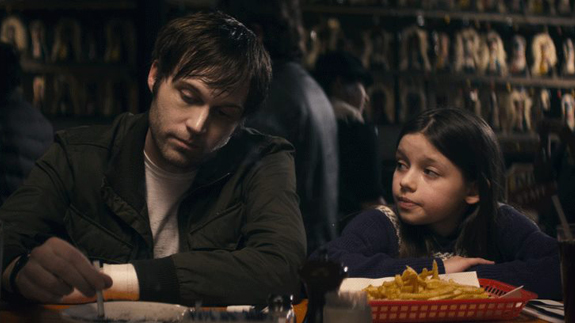
The film  begins late at night in a seedy Chinese restaurant where a reporter for a local paper (Paul Giamatti, clearly slumming) attempts to interview the  twentysomething David Wong (Chase Williamson) – who is not Asian — about his partnership with John (Rob Mayes) and their business as psychic detectives.

Continue Reading »

Bruce Willis, Jai and

Bruce Willis, Jai Courtney and Sebastian Koch

“A GOOD DAY TO DIE HARD” My rating: D (Opening wide on Feb. 15)

97 minutes | MPAA rating: R

“A Good Day to Die Hard” hits the trifecta.

Bad writing.

Bad directing.

Bad acting.

Actually, I was looking forward to the latest in the perennial series about NYC cop John McClane (Bruce Willis) who seems always to find himself in over his head with one crisis or another.

His last outing, 2007’s “Live Free or Die Hard,“ was a superior action film, thanks to the effective direction of Len Wiseman (of the “Underworld” franchise).

But “A Good Day…” finds the suddenly-ham-fisted John Moore in charge, and the thing is so goshawful from the first frame that I was tempted to get up after 10 minutes and call it a night. Alas, professional responsibility kept me seated.

At least this “Die Hard” is relatively short.

Skip Woods’ screenplay (his previous credits include the execrable “A-Team” and the barely better “X-Men Origins: Wolverine”) begins with John McClane saying goodbye to his daughter at an airport. Apparently his estranged son Jack has  gotten into some legal problems in Russia.

Once in Moscow John witnesses a terrorist attack on a courtroom where Jack (Aussie actor Jai Courtney) and the billionaire Russian dissident Komarov (Sebastian Koch), are on trial.  Turns out that far from being a criminal, Jack is a CIA agent assigned to rescue Komarov from the inside. (Why Komarov is important to the US is never explained. Get used to it.)

Continue Reading »

amour 1

amour 2

“AMOUR” My rating: A- (Opening Feb. 8 at the Tivoli and Glenwood Arts)

95 minutes | MPAA rating: PG-13

Forty years ago, when I was a cub reporter for the Kansas City Star, I followed a police dispatch call to a seedy midtown transient hotel. The bodies of an elderly couple had been found lying side by side on the bed in their cramped one-room apartment.

The cop in charge said it was either a murder-suicide or a double suicide. He’d been told that in recent weeks the wife had been seriously ill.

Back then I was too shallow and, well, scared to examine the implications of this sad tableau. But Michael Haneke’s “Amour” brought it all back to me.

Haneke is an Austrian auteur who makes seriously disturbing movies.

Movies like “Funny Games” in which a couple of young creeps imprison and torture a vacationing family. Haneke liked that one so much that he later made an English version that was almost frame-for-frame identical to the original.

Movies like “The Piano Teacher,” a psychosexual drama about a woman with buried pathologies and sado-masochistic tendencies, all wrapped up in an elegant environment.

Compared to those twisted tales “Amour,” might seem downright  humanistic. But there’s savagery  even here.

Continue Reading »

Rooney Mara...depressed

Rooney Mara…depressed

“SIDE EFFECTS” My rating: B

105 minutes | MPAA rating: R

For more than half its running time, Steven Soderbergh’s “Side Effects” keeps us guessing as to just what sort of movie it is.

It begins with a handsome young man, Martin (current “it” guy Channing Tatum), being released from prison.

So maybe it’s a gritty film about Martin trying to rebuild his life after years in stir?

But then we get to know his wife, Emily (the marvelous Rooney Mara, late of “The Girl With the Dragon Tattoo”),  an emotionally fragile individual coming apart at the seams. No sooner is her husband back home than she attempts suicide by driving her car into a wall.

So maybe it’s a hard-hitting film about depression?

Emily and Martin visit a shrink, Dr. Banks (Jude Law), who puts her on a powerful new antidepressant (he’s also a paid consultant for the drug’s manufacturer). Then Emily begins having bizarre sleepwalking episodes and does something really horrible and criminal.

So maybe it’s a socially-conscious film about our prevalent drug culture and an industry that tries to peddle dangerous side effects-heavy pharmaceuticals as if they were soda pop?

Continue Reading »